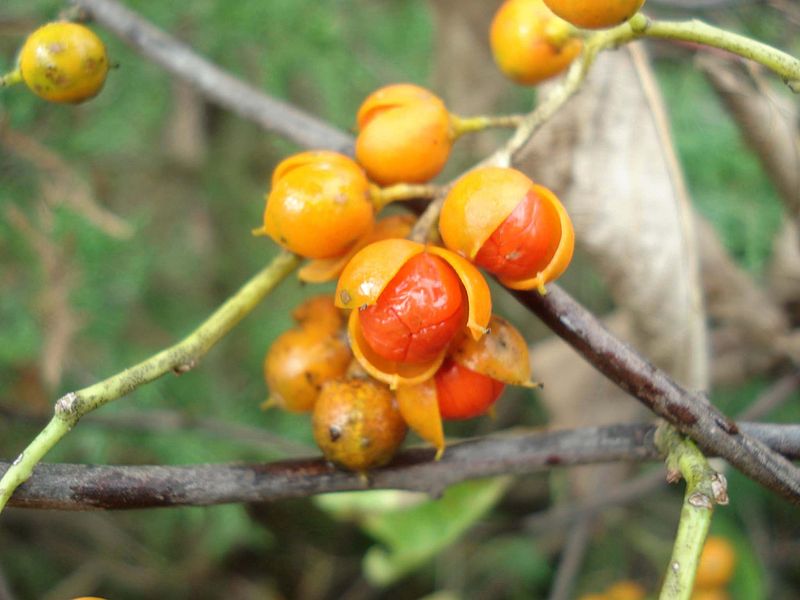
Love bittersweet but hate how it takes over your yard? Try growing American bittersweet, a native plant that is easier to control while providing berries that add color to the winter landscape.
What is American Bittersweet?

American bittersweet (Celastrus scandens) is a woody perennial vine that is native to North America. It is hardy in zones 3 through 8. The vines are commonly found in the woods growing on trees. They can attain a length of 20 to 30 feet. The vines are dioecious, meaning they are either male or female. You need both to produce the berries. The male flowers are very inconspicuous, meaning they are very small and difficult to see. The female flowers are larger but still small. Both are green. Bloom time is late May through June. The vines need pollen from the male flowers to fertilize the female flowers. Only the female vines have berries which appear any time from June through November. The berries start out orange, but that is just a capsule covering the actual berries. The capsules open in the fall revealing the red berries.

What is the difference Between American Bittersweet and Oriental Bittersweet?
American Bittersweet is a native plant that is relatively well-behaved. Oriental Bittersweet (C. orbiculatus) is an exotic that has become a dangerous invasive plant. The term “exotic” refers to the fact that a plant is not a native plant. It has been imported from another part of the world. Many imported plants become what’s known as “invasive plants” which means that they have no natural enemies here so they grow very quickly and crowd out the native plants.
Oriental bittersweet is native to China, Japan and Korea. It was introduced into the United States in 1879 as an ornamental plant. It has escaped from gardens and naturalized in the landscape. It is much larger and faster growing than American bittersweet, growing as much as 60 feet in one year. It not only climbs trees, it kills them. The weight of the huge vines topples even the largest trees. The vines are very thick, often reaching 4 inches in diameter. They don’t just climb trees, they twine around the tree trunks and squeeze them in a process known as “girdling”. Eventually they strangle the trees and kill them.
How to Grow American Bittersweet

If you want to grow American bittersweet for its colorful berries, you will need both a male and female vine. Without a male vine to pollinate the female vine, you will not get any berries. Plant your vines in a sunny location with good drainage. American bittersweet will tolerate some shade, but grows best and produces the most berries in full sun.
The vines grow 20 feet high and 20 feet wide so they will need support. Despite the fact that they climb trees in the woodlands, it’s not a good idea to encourage your vines to climb trees or shrubs in your yard. Large mature trees can bear the weight of the vines whereas the smaller trees and shrubs commonly found in our yards will be smothered and die. Provide your vines with a sturdy trellis or fence to grow on. If you are growing your vines on a trellis by a building or wall, be sure to place your trellis several inches away from the wall to allow for air circulation between the vine and the wall. American bittersweet is prone to powdery mildew which occurs when there is poor air circulation.
Water the vines when there is less than one inch of rainfall per week. You will only need to fertilize once a year in the spring. Apply a shovelful of compost or slow release fertilizer at the base and work it into the soil using a handheld cultivator.
How to Prune American Bittersweet
Pruning should be done in the winter when the vines are dormant. Remove any damaged or diseased branches. You will also want to remove any branches that produced berries. This will encourage new growth in the spring. American bittersweet blooms on “new wood” which is the new growth that appears in the spring. Branches that have already produced berries are considered “old wood” and won’t bloom and produce berries again which is why it’s a good idea to prune them away to encourage new growth that will bloom and produce berries.
Sometimes, no matter how diligent you are about your pruning, the vines will grow and become a tangled mess. This is not a problem. Just prune the entire vine down to ground level. Don’t worry, it will grow back in the spring with the added advantage that all of the branches will be “new wood” and all will flower and produce berries.
How to Grow American Bittersweet From Cuttings
When propagating American bittersweet vines by cuttings, remember that each vine is either male or female. Cuttings from a female vine will result in female vines and cuttings from male vines will result in more male vines. You need both a male and female vine to produce berries. So if you want berries, be sure that your cuttings aren’t just from a male vine. Male vines do not produce berries.
Softwood Cuttings
Softwood cuttings refer to cuttings from woody plants that are taken from the ends of the branches in spring or early summer while they are actively growing and not yet hard and woody. The advantage of taking softwood cuttings is that the branch is growing and once separated from the plant, will quickly grow roots.
Take a cutting that is 3 to 5 inches long from the end of a branch in midsummer. Strip the foliage from the bottom half of your cutting. Dip it in rooting hormone to speed up the growth of roots. Then gently press the cut end into a container with soil that is 2 parts perlite and 1 part sphagnum moss. Place the container in a sunny location, keeping the soil moist. Roots should appear in 2 to 5 weeks. You will know that your cutting has roots because new leaves will start growing. Plants without roots cannot grow new leaves.
Hardwood Cuttings
Hardwood cuttings are taken during the winter when a woody plant is dormant. The advantage of propagation by hardwood cuttings is that your cutting will have rooted and started growing by the spring so that you can plant your new vine after all danger of frost has passed.
Take a cutting that is 6 to 10 inches long from the end of a branch. It’s okay that the branch has no leaves. Dip it in rooting hormone to speed up the growth of roots. Gently press it into a container with a mixture of 1 part sphagnum moss and 2 parts perlite. Water the soil thoroughly and then cover both the plant and the container with a clear plastic bag. Place the container with your cutting on the north side of your house where it will not get direct sunlight which could fry your plant. There is no need to water your cutting. The plastic bag will act as a greenhouse keeping your cutting warm and moist. In the spring, your formerly bare cutting will start growing leaves. That tells you that it is time to remove the bag. After a week of getting acclimated to the outside, your cutting will be ready to plant.
How to Grow American Bittersweet From Seed
American bittersweet is very easy to grow from seed. Harvest the berries in the fall after the capsule has opened. You don’t need the capsules, just the berries. Spread the berries on a paper plate or paper towel in a single layer and allow them to dry for 2 to 3 weeks. When the berries are dried, remove the seeds from them and dry just the seeds for an additional week.
The seeds need to be cold stratified to germinate. Cold stratification mimics winter weather which is what the seeds experience in nature. They have evolved to only germinate after the cold weather has passed and the warm spring weather has commenced.
Sow the seeds in a container filled with pre-moistened soil, lightly covering them with more pre-moistened soil. Then cover the container with a clear plastic bag and place it in your refrigerator for 3 months. After 3 months, the seeds should start to germinate. That means that it is time to remove the container from your refrigerator and remove the bag. Place the container in a sunny place indoors. Your seedlings will be ready to transplant outdoors after all danger of frost has passed.
Leave a Reply