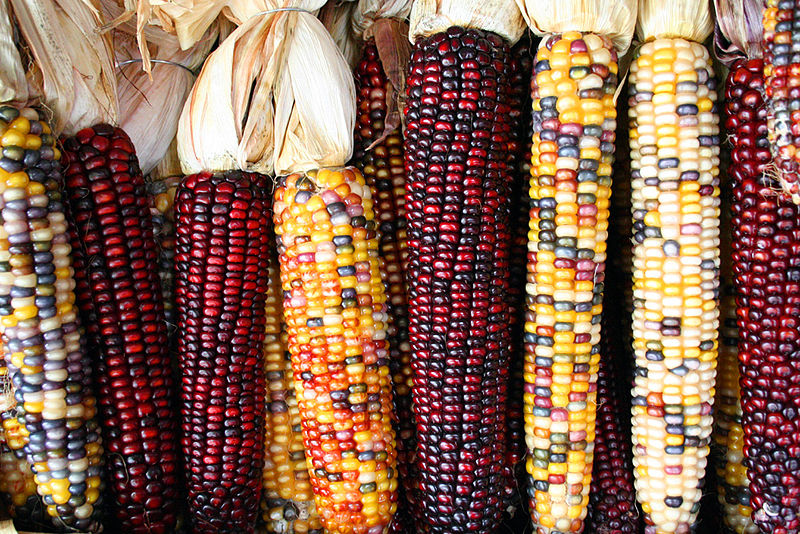
Colorful Indian, or ornamental, corn has long been associated with fall and especially the Thanksgiving holiday. In fact, it is the corn that was eaten at that first Thanksgiving meal.
What is Corn?

Corn (Zea mays) does not occur naturally in the wild. It is a manmade plant, produced within the last 10,000 years via hybridization of a native grass called teosinte that originated in Mexico.

The modern corn that we are familiar with comes in three varieties: sweet corn, dent corn, and Indian corn. Sweet corn has been bred for human consumption. It is higher in sugar than dent corn or Indian corn. Its white or yellow kernels can be canned, frozen, cooked or eaten directly from the cob.

Dent corn, also known as field corn, is also white or yellow and characterized by a pronounced dent in each kernel. It is less sweet than sweet corn and is fed to livestock. Dent corn is also used in industrial products such as ethanol as well as processed into many of the foods we eat. It is the source of the controversial high fructose corn syrup. Both sweet and dent corns are recent introductions.

Indian corn is the original corn that was bred from teosinte grass by Native Americans. It is called flint corn because its kernels are “hard as flint”. The kernels contain less moisture than dent or sweet corn and dry better with less chance of spoiling, an important consideration for Native Americans who depended on the dried corn to feed themselves until the next corn crop ripened the following year. This is the corn that the Native Americans taught the Pilgrims to grow. It is still used in dishes such as polenta and hominy.
How to Grow Indian Corn
Indian corn is easy to grow in your backyard. Corn is pollinated by the usual pollinating insects such as bees, but also via the wind blowing the pollen onto neighboring plants. All three types of corn will cross-pollinate with each other so if you are also growing sweet or dent corn, make sure that you plant each type of corn at least 300 yards apart to avoid cross-pollination. Prepare your soil by roto-tilling or turning your soil 6 to 12 inches deep. Corn are heavy feeders, so work in a good amount of compost or leaf mulch.

You can plant your seeds in either rows or hills. If you are planting them in rows, plant one seed every 4 inches in rows that are 18 to 24 inches apart. You will want to thin your seedlings to 12 inches apart when they reach a height of 4 inches. Make sure to weed aggressively so that the corn does not have to compete with the weeds for nutrients. Side dress your rows with compost or 10-10-10 fertilizer after 4 weeks and then every 4 weeks until the corn has ripened.
Alternatively, you can plant your seeds in hills like the Native Americans did. Plant 3 to 4 seeds per hill, with the hills spaced 12 inches apart. When your plants are 4 inches tall, thin them, removing any sickly or deformed plants. You can transplant healthy seedlings into any empty spaces on your hills. Weed aggressively and fertilize monthly.
Native Americans used to plant their fields using the Three Sisters: corn, pumpkins and beans. The pumpkin vines shaded out the weeds, the corn provided support for the beans to climb and the beans provided vital nitrogen for the nitrogen hungry corn and pumpkins. All legumes, such as beans, are nitrogen fixing and are often used as cover crops by modern day farmers.
How to Harvest and Dry Indian Corn

Indian corn is ripe and ready for harvest when the outer husks turn brown. Removing the ears from the stalks is easy. Simply grasp the stalk with one hand and the ear with your other hand, then rip the ear off of the stalk with a downward motion.

To dry your corn, peel the husk all the way back from the ear, exposing all of the kernels. Tie a string around the base of the husk and hang your corn in a dry, dark place. Make sure your corn is not exposed to the sun while it is drying. Sunlight will fade the brilliant colors.
Test the kernels every few days by pushing against them with your fingernail. When they are completely hard and you are unable to press into them with your nail, your corn is dry and ready for use as decoration or in a craft. To preserve your corn, brush a coat of varnish on it.
Leave a Reply