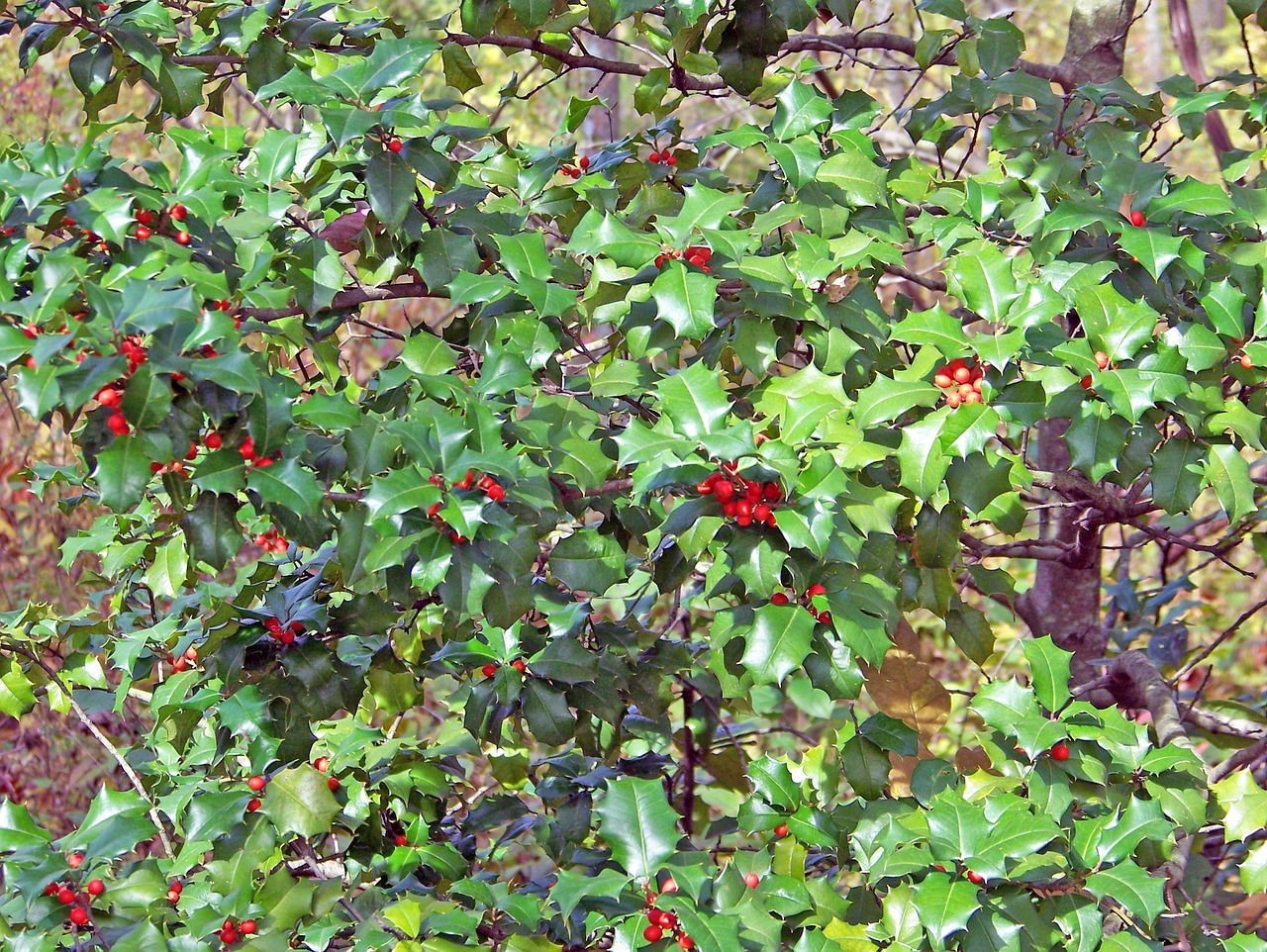
Holly has long been associated with the Christmas holiday. Its red berries and green leaves have become the colors of Christmas. Holly grows in most parts of the world, so you should have no trouble finding a variety that is right for your landscape.
The Mythology Surrounding Holly
The Romans used holly to honor Saturn, their god of agriculture. They celebrated him during their Saturnalia festivals, which took place near the time of the winter solstice. The Romans wove holly branches into wreaths, which were given as gifts to be worn on the head.
In Great Britain, holly was associated with the winter solstice in the myth of the twins, the Oak King and the Holly King. The Oak King reigned as long as the oak leaves remained on the trees but when they fell, the green of the Holly King was revealed through the bare oak branches. Druids wore holly wreaths during their solstice ceremonies in honor of the Holly King.

Other inhabitants of Great Britain known as the Celts brought sprigs of holly into their homes in the winter in the belief that they sheltered woodland fairies.
With the coming of Christianity, people were unwilling to give up their holly associations with the winter solstice so they used it to celebrate Christmas. To fit the Christian beliefs, the sharp points of the leaves were said to represent the Crown of Thorns worn by Jesus and the red berries symbolized drops of blood like that which Jesus shed to redeem believers of their sins.
How to Grow Holly
The Ilex (holly) family is found all over the world, on every continent except Australia and Antarctica. They grow in habitats ranging from temperate to tropical. Depending on the variety, they can be grown in zones 3 – 11. The holly that is traditionally associated with the Christmas season is native to Great Britain. Most hollies are evergreen. There are some hollies that are deciduous which means that they lose their leaves in the fall, Most of those hollies are found in North America.
Hollies are shrubs that range in size from 6 feet to more than 70 feet making it easy to find one suited to your landscape. The smaller varieties can be used for foundation plantings. The larger ones make excellent hedges. Hollies prefer full sun (6 to 8 hours daily), but can tolerate a little shade. All types prefer acidic soil, pH 5.0 – pH 6.0.

Hollies are dioecious, meaning that the plants are either male or female. If you want your female holly to produce berries, there must a male holly within 40 feet. Most hollies sport red berries, but some have yellow berries. All the berries are poisonous to humans and can make you very ill if you eat them. Birds love to eat holly berries. The seeds pass through them undigested and are spread around the area through their excrement.
If you want to create a bird friendly environment in your yard, plant hollies. You will attract wild turkeys, cedar waxwings, thrushes, blackbirds, goldfinches, bobwhites and mourning doves. The holly berries are too hard for the birds to eat in the summer and fall, but after a few frosts, they soften up and provide a wonderful winter food source when food is difficult for them to find. Evergreen hollies also provide protection during winter storms. Birds shelter in the shrubs, protected from wind and predators.
How to Prune Holly
Pruning can be done to give your holly an attractive shape. You should do your pruning in the late winter when the shrubs are dormant to ensure maximum flower production which, if there is a male shrub close enough, will result in a bumper crop of berries. Hollies can withstand a hard pruning or rejuvenation pruning and make excellent topiaries.
How to Grow Holly From Seed
Holly is a little tricky to grow from seed. It needs to be both warm stratified and cold stratified. Stratification is a technique to fool the seeds into thinking that summer or winter has passed.
Harvest some berries and then soak them for 24 hours to soften them enough to remove the seeds. Soak the seeds alone for another 12 hours to soften the seed coat. Holly seeds have a hard seed coat so that the seeds survive the trip through birds’ digestive systems.
Now wrap the seeds in some moist sphagnum moss and place the bundle in a plastic bag. Store the bag in a warm place between 68⁰F and 86⁰F for 60 days. This mimics the passing of a summer growing season. Holly seed does not germinate immediately in the wild.
After 60 days, place the bag in your refrigerator for 60 to 90 days to mimic winter. You should keep the bags in your refrigerator for a shorter period if you live in a warmer growing zone with a short winter. For gardeners living in northern areas with longer winters, you will want to keep the bag refrigerated for a longer period.
When you remove the bag from the refrigerator, take the bundle out and plant the seeds 3/8 inch deep in a container and keep them evenly moist. Be patient. It could take 2 to 3 years for the seeds to germinate.
Hollies are known as plants with four season interest thanks to their evergreen glossy leaves and brightly colored berries. Birds also appreciate hollies, so they can be used when creating a wildlife friendly landscape. And, of course, we all appreciate holly at holiday time.
Leave a Reply