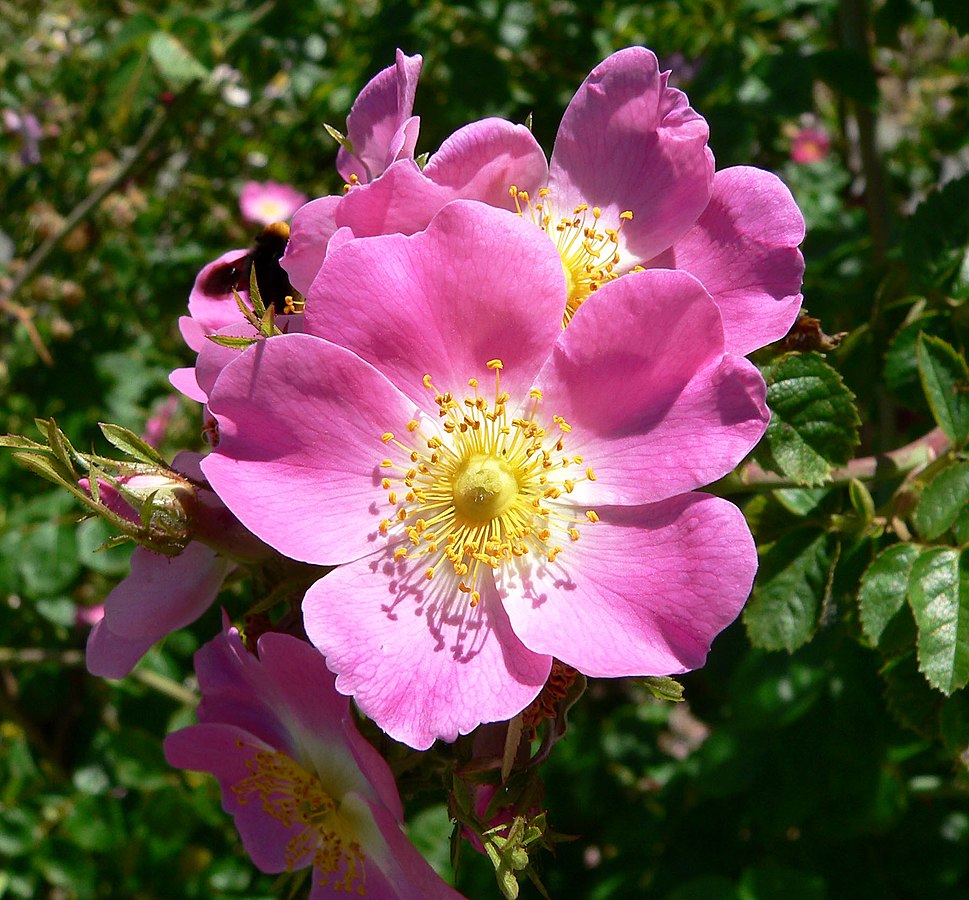
It’s no secret that I love heirloom roses. I love their many flowers, their sweet scents and most of all, the history behind each one. A must-have in my rose collection is my eglantine rose, a favorite of both Shakespeare and Chaucer.
What is the Eglantine Rose?
The eglantine rose (Rosa rubiginosa), also known as the Sweet Briar rose, is native to Europe. It was so beloved in England that both Chaucer and Shakespeare wrote of it in their poetry and plays. The English brought it with them wherever they colonized. It is so hardy that it escaped their gardens and became naturalized in the landscapes of North America, South Africa, New Zealand and Australia. It is considered an invasive plant and is banned from sale in all of those countries except the US.
How to Grow an Eglantine Rose

Hardy from zones 4 through 9, the eglantine rosebush thrives in full sun attaining a mature height of 10 to 15 feet. Its width can be up to 10 feet. The branches are heavily thorned which added to its size, makes it an ideal hedge along a property line. It is very effective at keeping unwanted animals out. It likes regular watering, especially a good soaking in the morning. The eglantine rose spreads by suckering.
Suckering is the ability of a plant to send up shoots from its roots creating new plants. This suckering is another reason why the eglantine rose makes an ideal hedge plant. The new plants are created every year, making the hedge thicker and more impenetrable each year.

This rosebush is also grown for its scent and its hips. Both the flowers and the leaves are apple scented, especially when wet. The flowers are a light pink. Each blossom has five overlapping petals and a bright yellow center. The bushes bloom for about two weeks in late spring to early summer. When the flowers have faded, the leaves provide the scent. The blooms result in large hips which turn orange in the fall. Each hip contains enough vitamin C to satisfy an adult’s minimum daily requirement. The hips are often used in teas.
How to Prune an Eglantine Rose
The eglantine rose does not require any pruning beyond the usual pruning done in very early spring to remove dead or dying canes. It is recommended that you prune before the leaves appear but I have difficulty telling dead from live branches without the leaves so I wait until the leaves are just coming out to tell me which branches are still alive and which have died over the winter and must be removed.
All dead leaves, branches and other debris should be removed from under your bush to prevent the spread of insects and disease.
How to Propagate an Eglantine Rose From Cuttings
Most woody plants are difficult to propagate from cuttings, but not surprisingly given its propensity to sucker, the eglantine rose is easy to propagate from cuttings. You can use either soft wood cuttings, which are cuttings made in the spring when the plant is actively growing or hardwood cuttings, which are made in the late fall or early winter when the plants are dormant.
If you are using soft wood cuttings, i.e. new growth, make sure that your cutting is at least as big around as a pencil or larger. No matter which kind of cutting you use, you don’t need very much, 4 to 6 inches in length is sufficient.
Dip the cut end into some rooting hormone. Rooting hormone speeds up the rate of root growth. If you don’t have any, don’t worry, you don’t absolutely need to use it. Then you simply push your cutting into a container of soil or even directly into the ground where you want your new rosebush to grow. Keep the soil in the container or your garden moist. Roots should start to form in 1 to 2 months. You will know that new roots are growing when your cutting starts growing new leaves. Plants without roots are unable to produce new growth.
How to Propagate an Eglantine Rose Using Layering
Layering is another popular technique for propagating roses. After your rosebush has finished blooming, take a newish flexible branch and gently bend it to the ground. Once you have it horizontally on the soil, anchor it there. You use the same staples that you use to anchor your tunnels in your vegetable garden. Cover the middle of the branch that is touching the ground with soil, leaving the end sticking out. That end with its leaves will provide food for the branch as it develops roots along the portion that is covered with soil. Keep that soil moist. Roots should develop in 1 to 2 months. You will know that roots are growing because the branch will be growing new leaves.
When you see the new leaves, you can sever the branch from the main bush. Careful dig up the new rootball along with the soil it is growing in and transplant the whole thing to where you want your new rosebush to grow.
Leave a Reply