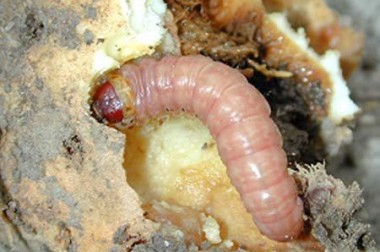
If you live west of the Rocky Mountains, right now you are scratching your head and wondering what the heck an iris borer is. For gardeners east of the Rocky Mountains, the iris borer is the scourge of the iris garden.
What are Iris Borers?
The iris borer is actually the larvae, or caterpillar, of a brown nocturnal moth which lays its eggs on the dead leaves and other debris surrounding your iris at the end of the summer, typically late August through September. A female moth can lay up to 1,000 eggs before she dies. Fortunately, there is only one generation of moths each year.

The eggs over winter in the plant debris in your garden, hatching in the spring when warm weather arrives in April or May depending on your climate. The larvae are the iris borers. They are easily identified by their pink bodies and brown heads. They head for the nearest iris, climb to the tops of the leaves and burrow inside them. Iris foliage at this time of year is usually only about 6 inches tall making it easy for the caterpillar to climb them.
During the spring months, the borers munch their way inside the leaves down to the rhizome which is their ultimate target. Once in the rhizome, usually in July, they take up residence, eating it to a hollow as they grow to their adult size of 1 to 2 inches. Then in late July or early August, they emerge from the now dead rhizome and burrow into the soil to pupate into adult moths which will then lay eggs and begin the cycle again.
Keep Your Garden Free of Weeds and Plant Debris
Obviously, the best way to rid your garden of iris borers is to keep your garden very clean. Remove all weeds, plant debris and dead or damaged leaves immediately. This makes your garden uninviting to the moths who will look elsewhere for a place to lay their eggs. When the foliage on your iris dies after the first frost, cut it down to the rhizome and remove it. Don’t forget to remove all the dead foliage from your other annual and perennial plants. Don’t leave any plant debris for the eggs to overwinter in.
Use Pyrethrin
You can try spraying your iris with any spray that contains pyrethrin. Pyrethrin is a naturally occuring insecticide that can be found in chrysanthemums. Pyrethrin is considered safe to use because it is biodegradeable. It has been used for thousands of years as both an insect repellent and an insecticide. It kills insects by destroying their nervous systems. Check the ingredients label of the insecticides at your local nursery to see which ones contain pyrethrin.
Purethrin is effective in killing the larvae as long as it is used before the borers have a chance to burrow into the leaves in April or May, depending on your growing zone.
Use Insecticidal Soap
Another alternative is to create your own insecticidal soap. Simply mix 1 part Murphy’s Soap and 9 parts water and spray it on your plants. You will need to re-spray after any rain. Insecticidal soaps work by smothering insects. The soap adheres to their bodies and covers the holes they use for respiration.
Like pyrethrin, insecticidal soap will work as long as you apply it before the borers have a chance to burrow into the leaves in April or May, depending on your growing zone.
Kill the Borers in the Leaves
If you examine the foliage on your iris closely, it’s easy to see where the borers have entered them. Simply squeeze the leaves between your fingers to destroy these pests. If you are squeamish like I am about actually touching the borers, this is a fun and easy way to kill them without having to touch them. If even just squishing the leaves bothers you, have your kids or grand kids do it for you if they like squishing bugs.
Use Diatomaceous Earth or Crushed Eggshells
Sprinkle diatomaceous earth liberally around your rhizomes. Diatomaceous earth is made up of the skeletons of diatoms that lived in ancient seas that dried up eons ago. The skeletons are ground into a white powder that has sharp edges that will tear up the abdomens of the borers, killing them, as they crawl over it to get to your iris.
There are two problems with diatomaceous earth. It is expensive and it’s a non-renewable resource. My own preference is to use crushed eggshells. They are free, a renewable resource and organic if you use organic eggs like I do.
Wash your eggshells and then crush them up. You can use your hands, a hammer or a coffee grinder. Sprinkle them around your iris. In addition to killing the borers, they have the added benefit of releasing calcium, an essential nutrient, into your soil as they decompose into the soil.
Eggshells are also an excellent addition to your compost making it rich in calcium. They will break down faster if you crush them before adding to your compost.
Preventing iris borers from destroying your iris is easy if you keep your garden debris free. Keep a close eye on your iris foliage in the spring to spot any signs of borer infestation and then squish them to death.
Leave a Reply