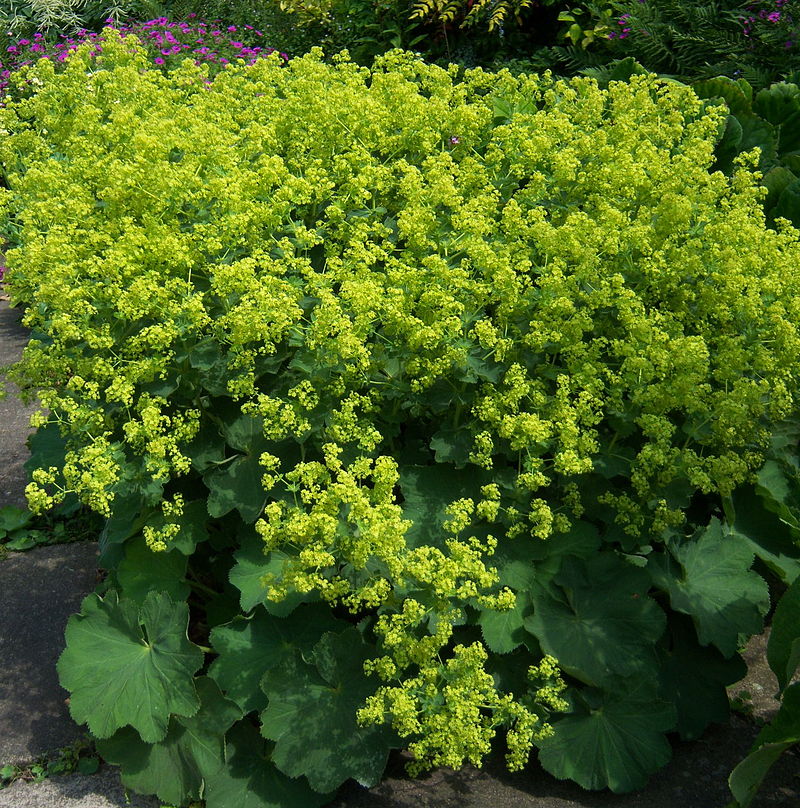
I’m in love with the foliage of Lady’s Mantle. It’s almost magical how the fuzzy leaves hold single drops of water after the rain. The droplets sparkle like diamonds in my garden. None of my other plants do that.
What is Lady’s Mantle?
Lady’s Mantle (Alchemilla mollis) is an herbaceous perennial that is native to Turkey and Southeastern Europe. It has long been associated with the virgin Mary because it was thought that the scalloped edges of the leaves resembled her cloak. That is why it is called Lady’s Mantle instead of Ladies Mantle. The “Lady” refers to Mary.

Medieval alchemists considered the drops of water on Lady’s Mantle leaves to be the purest form of water. They used this water in their experiments to turn base metals into gold.
Lady’s mantle is hardy in USDA growing zones 3 – 8. The plants prefer full sun but will tolerate some shade. In the warmer parts of its range, it needs shade in the afternoon. If grown in full sun in a hot climate, the leaves suffer sun scorch. The plants grow in mounds that are 1 ½ to 2 feet tall and 1 ½ – 2 ½ feet wide. They make a nice edging along a path or walkway.

The leaves are the most striking part of the plant for me. They are a light green and fuzzy. The hairs capture water droplets of rain or dew in the early morning. Thanks to their “fuzz”, the plants are deer resistant, an important consideration for those of us who have a deer problem. Deer do not like plants with fuzzy leaves.
The plant dies to the ground after the first hard frost. Leave the dead leaves on the plant until spring. Remove them in the early spring before new growth appears. The dead leaves protect the crown of the plant through the winter.

Lady’s mantle has lovely lime green flowers that appear in early to mid-summer. They grow in clusters on top of stems that are 12 to 18 inches taller than the plant. The flowers have no petals and no seed pods. The seeds develop in the calyxes, 1 seed per calyx. That doesn’t sound like many seeds so you might be surprised to learn that these plants are prolific self-seeders. You should deadhead the flowers to prevent them from developing seeds and then strewing them all over your garden.
How to Grow Lady’s Mantle
Most gardeners grow Lady’s Mantle in the fronts of their gardens despite their tall flower stems. When the plants have finished blooming, they shear off the stems and are left with nice edging plants.
Avoid planting Lady’s Mantle in wet, soggy soil. They will develop root rot and die. The plants are drought tolerant once they are established. A nice layer of mulch will help keep the soil moist and weeds down. Just be careful when adding it to your plants. Most of us use a shovel to spread mulch in our gardens. Because these plants are short and grow in mounds, you might accidentally cover them with mulch. Apply the mulch by hand with a trowel making sure that it doesn’t touch the crown of the plants.
There is no need to fertilize your plants unless your soil is very lacking in nutrients. In that case, some slow release fertilizer formulated for flowering plants will give them a needed boost. They are also not bothered by insects or disease.

How to Divide Lady’s Mantle
Lady’s mantle can be divided in the spring or late in the summer after the plants have finished blooming. Carefully dig up the mound that you want to divide. Then gently pry the crown apart making sure that each division has both leaves and roots. This is also a good time to get rid of any dead or dying parts of the crown. Replant your divisions, 12 inches apart, at the same depth as the parent plant.
How to Grow Lady’s Mantle From Seed
Lady’s mantle readily self-sows but if you are not fortunate enough to have some already, you can grow it from seed.
Outdoors
Sow the seeds in your garden after your last frost. Barely cover them with soil and keep them well-watered. Germination will be slow, so be patient. You should start to see seedlings in 3 to 4 weeks. When they have
developed their first pair of true leaves, thin your seedlings to 12 inches apart.
Indoors
You can also start your seeds indoors 6 to 8 weeks before your last frost. Sow them in a container with pre-moistened soil and barely cover them. I always moisten my soil before sowing my seeds because I have found that if I water after sowing my seeds, both the seeds and the soil float out of the container. Keep the soil moist until the seeds germinate in 3 to 4 weeks.
You can transplant your seedlings outdoors in your garden after your last frost when they are 4 inches
tall. Plant them 12 inches apart.
Leave a Reply