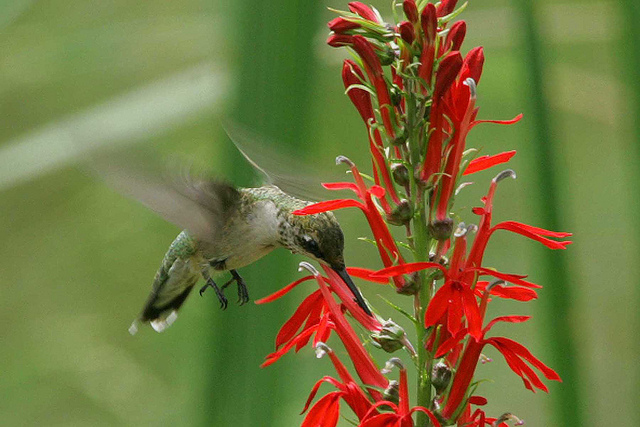
One of the joys of walking through the woods in the fall is the bright colors of the foliage. But a prelude to that colorful event is put on by a native flower, the Cardinal Flower, which sports tall spikes of bright red flowers in August and September, before the trees in its forest home put on their own show.
What are Cardinal Flowers?

Cardinal flowers (Lobelia cardinalis) are short-lived native perennial plants that have a wide range in North and Central America. They can be found as far north as Canada and as far south as Columbia. That translates to growing zones 2 through 9. They are a woodland plant, preferring shade. They are also moisture lovers. You will find them growing in marshy areas and along stream banks.
Cardinal flower is a large plant, growing 3 to 4 feet tall and 12 to 18 inches wide. In the late summer and early fall, it blooms with brilliant red tubular flowers on a tall spike. Hummingbirds find them irresistible. It’s a good thing too, because most insects, including bees, cannot access the flowers because of their narrow shape so the plants rely on hummingbirds to pollinate the flowers using their long, thin proboscis. The hummingbirds are rewarded with delicious nectar.
Why are Cardinal Flowers Considered Short-Lived Perennials?
Most perennial plants live for an average of 7 to 9 years. Some, including the cardinal flower, only live 3 or 4 years, longer than annuals and biennials, but shorter than perennials, so they are called short-lived perennials.
A cardinal flower plant can appear to live longer than 3 or 4 years because the plants readily re-seed themselves giving the appearance of longer life when it is really just new plants growing from seeds that were dropped from last year’s flowers.
Can I Grow Cardinal Flowers in My Garden?

Yes, you can! Despite loving wet soil, they will grow perfectly well in your garden which is not as wet. They will grow better with some shade, preferably morning sun with afternoon shade, but will tolerate full sun also. They are very hardy plants.
Another great reason to grow them is that they are deer resistant. So if you have a problem with deer dining on your flowers, add cardinal flowers to your garden for a burst of red color in the late summer that won’t be bothered by the deer.
How to Propagate Cardinal Flowers
Cardinal flowers are very easy to propagate, or make new plants from existing ones.
Separation
The easiest way to get new plants is by separation. Each year, new plantlets develop and grow around the crown of the existing plant. These smaller plants can be separated from the “mother” plant. In the fall before the frost hits, dig up the existing plant. Gently break off the small plants growing around the edges of the root mass or crown of the mother plant. Only break off and use plantlets that already have their own roots. You can replant these new plants where you want them in your garden. Due to the size of the mature plants, give these babies a spacing of at least 12 inches apart. You can give them a good start in life by adding a shovelful of compost into the planting holes before you settle them into their new homes.
Division
Another way to propagate cardinal flowers is by standard division. Like most perennials, cardinal flowers should be divided periodically. Because they are short-lived, division is usually done every 2 to 3 years instead of the usual 3 to 4 years. You can divide your plants in either the spring or the fall. Simply dig them up, carefully cut the crowns into 2 or 3 pieces depending on the size of the crown and then replant the divisions, spacing them at least 12 inches apart.
Stem Cuttings
A little more challenging is to grow new plants from cuttings made from an existing plant. You want to take your cuttings in mid-summer, before the plants bloom. At mid-summer, they are actively growing and putting a lot of energy into making new foliage and eventually flowers. Cuttings are most successful when they are made from an actively growing plants.
Most cuttings are made from branches with growing tips on them. For cardinal flowers, you want to take stem cuttings. Stem cuttings are cuttings made from the stem of the plant, rather than a branch. Make sure that the stem has a growing tip on it so that it is actively growing. Cut off one or more stems of your cardinal flower plant, remove the bottom third of the leaves, dip the cutting in rooting hormone and then place it in a pot filled with moist sterile potting soil. You will know that your cutting has rooted when you see new growth on the top of the plant.
How to Grow Cardinal Flowers From Seed
Outdoors -the easiest way to grow cardinal flowers from seed is to just allow the flowers to develop seeds in the fall and drop them around the plant. If your plants are mulched, you should remove the mulch from around the plants to allow the seeds to reach the soil. The seeds will not grow in mulch.

Indoors – If you want to start plants indoors from seeds, you will need to cold stratify them. Cold stratification is a method of fooling seeds into thinking that winter has passed. The seeds of most of our native plants need to experience the cold weather of winter in order to germinate successfully. The seeds only germinate after a period of cold to ensure that they germinate at the right time of year (spring) to grow successfully into plants.
Start your seeds indoors in the fall. Surface sow them in containers filled with moistened soil. Do not cover the seeds with soil. They need light to germinate. Cover the container with plastic to prevent the soil from drying out and place it in your refrigerator for 3 months, checking periodically to make sure the soil is still moist. Mist the soil if it is dry. The seeds will think that it is winter. Remove the container from your refrigerator 8 to 10 weeks before your last frost. Germination should occur within 2 weeks. You can plant your seedlings in your garden, 12 inches apart, after your last frost.
Leave a Reply