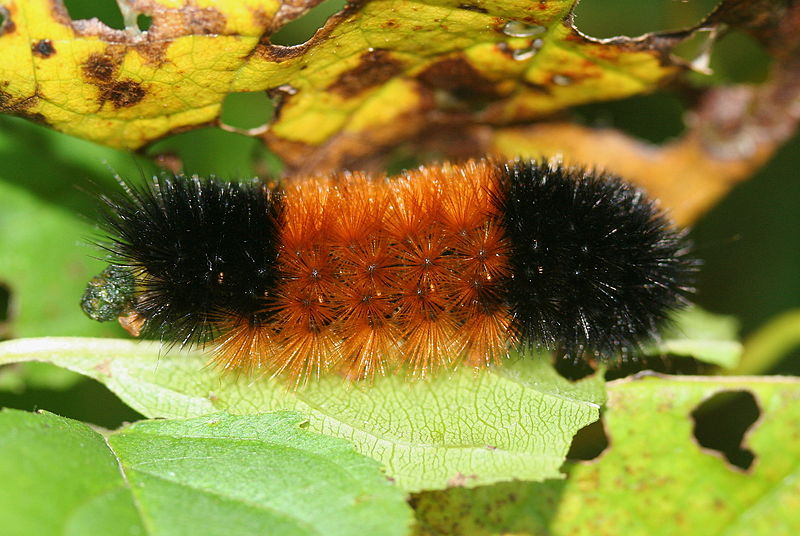
I’ve been seeing a lot of woolly bear caterpillars this fall. They triggered a memory from my childhood of predicting the winter by examining their stripes but I couldn’t remember how to do it. Time for a little research.
What are Woolly Bear Caterpillars?

Woolly bear caterpillars are the larval stage of the Isabella Tiger Moth (Pyrrharctia isabella). You’ve probably never heard of it because they are active at night and therefore rarely seen. Isabella Tiger moths are orange-yellow in color with a wingspan of 1½ to 2 inches. Their wings have black dots in a random arrangement. The abdomens are more distinctive with three parallel rows of black dots. They lay their eggs on weeds such as grasses, dandelions, nettles and plantains.
The eggs hatch into caterpillars which are “furry” with black hairs on the front and rear of their bodies and rusty brown hairs in the middle. They are most often seen in the fall when they are hunting for a place to hibernate. They have been known to travel up to a mile a day in search of the perfect spot to spend the winter. Their favorite places to hibernate are under rocks, logs or inside the bark of a tree.
The hair on their bodies is not to keep them warm. Instead, it aids them in freezing in a controlled fashion. They don’t hibernate by slowing down their metabolisms and spending the winter in a stupor like bears. Woolly caterpillars actually freeze almost solid. The interior of their cells is the only part that doesn’t freeze because the caterpillars produce glycerol, a natural organic anti-freeze. They can survive temperatures as low as -90⁰F (-68⁰C).
As the weather warms in the spring, the caterpillars thaw out and start feeding again. Two to four weeks later they pupate, that is create a cocoon. After two weeks in their cocoon, they emerge as the Isabella Tiger moth.
Why are Woolly Bear Caterpillars Never Seen in the Garden?

Woolly bear caterpillars are good for your yard because they eat weeds rather than vegetables and ornamental plants. By keeping your garden weeded, you are denying them a food source so they will look elsewhere in your yard for their favorite weeds to eat. Don’t kill them. Just enjoy watching them scurry around looking for a hiding place. And don’t touch them. This will frighten them into thinking a predator is trying to eat them. Their only defense is to curl up in a ball and play dead until they feel safe enough to continue on their way.
How Do Woolly Bear Stripes Predict the Weather?
What I learned as a child is if the middle brown stripe is wider than the black stripes on the ends, then the upcoming winter will be a mild one. But if the two black strips are wider than the brown stripe, beware! The winter will be severe.
Wooly bear caterpillars have 13 segments, supposedly representing the 13 weeks of winter so you can “predict” when the severe weather will occur. If the front black stripe is wider than the back black stripe, there will be severe weather at the beginning of winter. If the rear black stripe is wider than the front one, the weather will be severe at the end of winter.
Can Woolly Bear Caterpillars Predict the Weather?
Sadly, no. That is just a delightful myth. The truth is that the width of the stripes depend on how old the caterpillar is and how well it has been eating. Older caterpillars will have larger black stripes because they have been feeding and growing longer. Also, if the growing season was good and the caterpillar had plenty to eat, then it will have gotten larger and the black stripes will be longer. If the growing season wasn’t good, with too much or too little rain, then the caterpillars don’t grow as much and the black stripes are smaller.
So the size of their stripes tells you how the weather was during the previous summer rather than predicting what the weather will be during the upcoming winter.
Leave a Reply