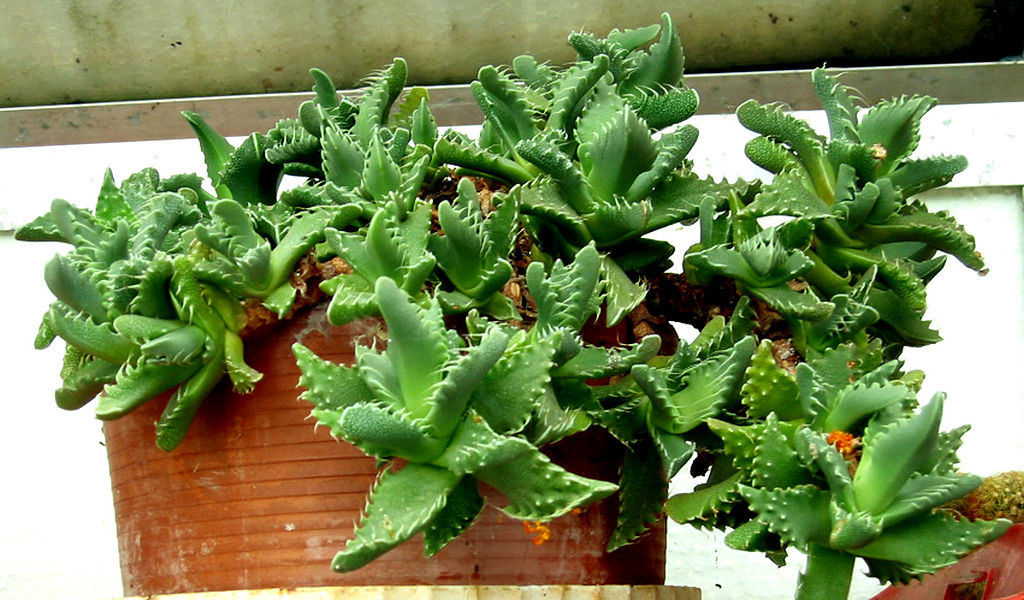
I have become a bit of a succulent junkie. There are so many different shapes and sizes, many very unique. Like the Tiger Jaws. The leaves grow in pairs and have scary looking spines on them making them look like the open jaws of a fearsome predator such as a tiger or a shark.
What are Tiger Jaws?
Tiger jaws (Faucaria tigrina) are tiny stemless succulents that are native to the deserts of South Africa. They were discovered in 1789 by Francis Masson who was on a plant hunting expedition for the Kew Royal Botanical Gardens.
The spines on the leaves look stiff and dangerous, but they are actually very soft. They are not meant as a defense against predators as you might think. Instead, they are an important adaptation to the plants’ desert environment. Fogs that blow in from the coast provide a much needed source of water. The spines on the plants catch the moisture in the fog and then direct it down to the roots of the plant.
The leaves of tiger jaws are triangular and fleshy. The fleshiness helps to store water during times of drought. The leaves grow from the center of the plant in pairs. Each pair of leaves grows in a bunch with other pairs of leaves. Mature leaves reach a height of only 3 inches.
Tiger jaws rarely bloom when grown indoors. But if you put your plant outdoors during the summer, it may bloom for you in the fall, their natural blooming period. The flowers are daisylike and bright yellow.


How to Grow Tiger Jaws
Tiger jaws are hardy in zones 10 -12 so gardeners in temperate climates grow them as houseplants. You can put your plant outside in the spring when the night time temperatures are consistently above 60⁰F. Bring your plant back indoors in the fall when night time temperatures fall to 60⁰F.
Tiger jaws should be planted in a shallow container because they have very shallow roots. If you use a regular deep pot, the soil will not dry enough between waterings and the plants will develop root rot and die. These plants need soil that drains well. Use a potting soil mixture especially formulated for cacti. You can also make your own well-draining potting soil by combining equal amounts of potting soil and perlite.
Tiger jaws are sun lovers. Grow them in your brightest, sunniest window. If you put your plant outdoors during the summer, be sure to put it in a spot where it will receive at least 3 hours of direct sunlight each day.
These plants don’t need a lot of water. If you over water your plants, they will die. They are desert plants and need a dry environment. During their growing season in the spring and summer, water lightly, allowing the soil to dry slightly between watering. In the fall and winter when the plants are resting, water less frequently, allowing the soil to dry out completely between waterings.
Since tiger jaws grow in such poor soil in their natural environment, they don’t require a lot of fertilizer. If you want, you can fertilize them in the spring to encourage new growth. Use a liquid fertilizer formulated for houseplants diluted to half strength.
How to Divide Tiger Jaws
Tiger jaws reproduce by offsets. Offsets are baby plants that are clones of the parent plants. They grow around the outside of the parent plant. The best time to propagate your plant is during its growing season. That means that the offsets will be actively growing and will rapidly acclimate to their new home.
Gently lift your tiger jaws from the soil. Then carefully break the offsets from the parent plant. The offsets that have roots can be immediately repotted. A few of the offsets may not have roots. Don’t worry. Leave those out for a day or two while they callous over. You want the damp spot where they were attached to the parent plant to dry and harden to prevent infection or insects from entering the plant. Once your offset is calloused, you can plant it in its own pot. It should start to develop roots within a month.
Leave a Reply