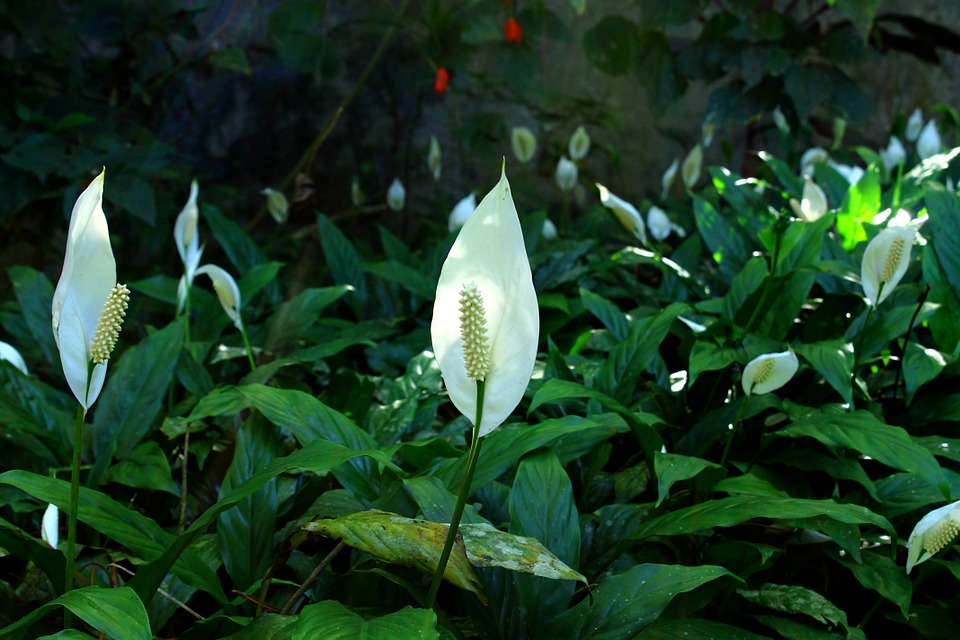
When is an anthurium not an anthurium? When it’s a spathiphyllum, of course. I admit to frequently confusing these two similar looking plants.

What are Peace Lilies?
Peace lilies (Spathiphyllum wallisii) are not true lilies. They are members of the spathiphyllum family which is related to anthuriums and have very similar flowers. Peace lilies are native to the tropical areas of the Americas and Southeast Asia. They are hardy only in zones 10 and 11. Their native habitats are forest floors where they receive little in the way of light and water. This makes them excellent houseplants for those of us who live in colder regions and grow tropical plants indoors.

In the tropics, they are perennial plants growing up to 6 feet, depending on the cultivar. Cultivars commonly grown as houseplants only grow to 16 inches tall. The “flower” is actually a spathe surrounding the flowers which grow on a spadix. The spathe is usually white or off-white, turning green as the flower ages.
Are Peace Lilies Poisonous?
Peace lilies contain calcium oxalate crystals. They are present in all parts of the plant. The crystals cause skin irritation so it is advisable to wear gloves while handling these plants. If ingested, the crystals will irritate the mouth and throat resulting in a burning sensation and making it difficult to swallow. If swallowed, the crystals cause nausea. You should keep pets and small children away from these plants. If your child has eaten any leaves, call poison control immediately. If your pet starts to salivate profusely, this is a sign that they have eaten the plants and must be seen by a veterinarian immediately.
Can Peace Lilies Clean the Air Indoors?
According to NASA studies, peace lilies absorb benzene, carbon monoxide and formaldehyde from the air during photo synthesis. In return, they release oxygen back into the air.
How to Grow Peace Lilies Outdoors
If you are fortunate enough to live in zones 10 or 11, you can grow your peace lilies outdoors. Their bright white spathes will light up the shady areas of your yard year-round. They like light shade, tolerating only a little morning or late afternoon sun. Dappled shade is the best. It mimics their natural environment on the forest floor.

Peace lilies grown outdoors commonly grow to 2 to 3 feet in height and 3 feet around. They grow in neat mounds of foliage. Plants should be spaced 2 ½ to 3 feet apart to allow for good air circulation. You should allow the same distance from your home, walkway or driveway.
Water regularly to ensure the soil is moist. If the edges of the leaves start to turn brown, you are watering too much. You only need to fertilize twice a year in the spring and the fall using a balanced fertilizer. You are fertilizing too much if the edges of the leaves start to turn brown.
You can also grow peace lilies in containers outdoors if you wish.
How to Grow Peace Lilies Indoors
Most of us grow this tropical beauty indoors as a houseplant, only allowing it to spend the summer outdoors, bringing them indoors in the fall when nighttime temperatures fall below 40F.
Peace lilies should be grown in well-drained potting soil that is rich in organic ingredients. This is the type of soil found on the floors of tropical forests. The soil should be kept moist, but not wet. You should also mist your plants regularly. They need humidity. Our homes are very dry because we have dehumidifiers installed on our HVAC systems to prevent mold from growing.

Place your plants in a room that gets bright indirect sunlight. A room that faces east is best so that it only gets morning sun. Southern exposure is too much sunlight. Keep your plants away from drafts from doors and windows. In the winter, make sure the room does not get any colder than 55⁰F. The ideal temperature range for peace lilies is 65⁰F to 80⁰F.
Peace lilies do not need a lot of fertilizer. Apply a slow release fertilizer in the spring. Do not fertilize in the winter.
Peace lilies grown indoors usually only flower once or twice a year, starting in the spring. If your plant is not blooming, move it into a brighter room. It may not be getting enough light.
How to Divide a Peace Lily
Peace lilies like to be a little pot bound which means that the roots completely fill the container. Eventually the plants will outgrow their pot and need to be repotted. It’s time to repot if you see roots growing above the soil or out of the drainage holes.
You can either repot into a larger container or you can use this as an opportunity to divide your plant. Carefully remove the plant from its pot. Gently pry apart the stems into 2 or 3 clumps. Make sure that each clump has roots. Repot those clumps into their own containers.
Leave a Reply