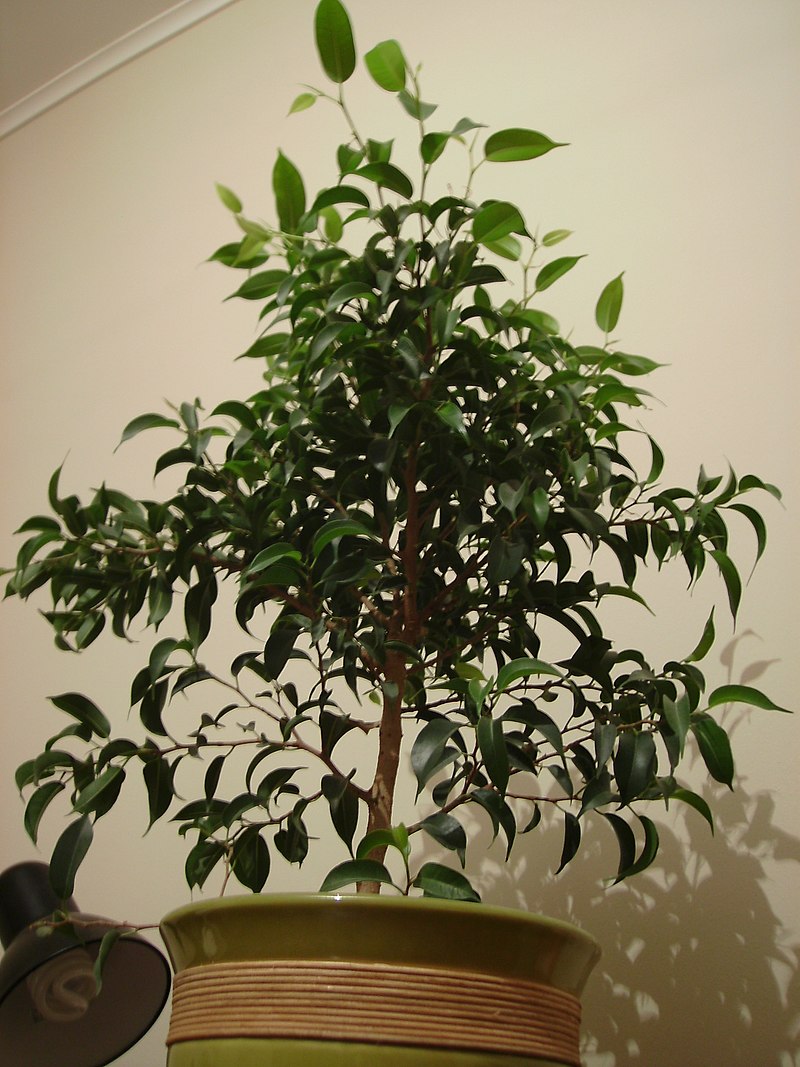
Houseplants don’t have to be small. There are trees that you can grow in pots indoors. A popular tree to grow as a houseplant is the ficus tree also known as the weeping fig.
What is a Ficus?
There are many plants in the ficus family, which includes fig trees. The weeping fig (Ficus benjamina) is a popular one to grow indoors as a houseplant. They are native to Asia where they can grow as high as 50 feet tall. Here in the US, they are only hardy in zones 10 and 11 so most of us have to grow them in containers and bring them indoors in the winter or grow them as houseplants. They make good houseplants because they don’t require direct sunlight. Even if we have sunny windows, our homes are too dark for sun loving plants. The plants we call houseplants are usually shade plants in their native environments. A ficus tree will be happy either in front of a sunny window or in a corner of your room away for the window.

Do Weeping Figs Produce Figs?
Yes, weeping figs will bear fruit if grown outdoors. They will produce flowers which are then pollinated by wasps to produce the figs. The trees never bear fruit when they are grown solely indoors. They rarely flower indoors. When they do flower, there are no wasps to pollinate the flowers so the trees will not bear fruit.
How to Grow a Ficus Indoors
Plant your ficus in a pot with standard potting soil that has perlite or vermiculate added for drainage. Drainage is important. The roots should never sit in soggy soil. They will rot and die. Water it well, until the water is running out of the drainage hole. Wait at least a week for the soil to dry out before you water it again.

If your tree is spending the summer indoors, place it in front of a sunny window. In the winter, move it away from the window to a spot where it will receive light part of the day. Remember to give your tree a quarter turn every week so that the new growth doesn’t only happen on one side of your tree making it lopsided. You want it to evenly grow on all sides.
Another reason why you want to move your tree away from the window in the winter is the possibility of drafts during cold weather. Weeping figs will die in temperatures below 55⁰F. So it is best to keep your tree away from windows and doors when the outdoor temperatures fall below 55⁰F.
Add a slow release fertilizer to the container at the beginning of the summer when your tree will be actively growing. Do not fertilize it during the winter when it will be resting and not actively growing. Pruning should be done in late winter or early spring before any new growth appears.
How to Move an Indoor Ficus Outdoors For the Summer
You can grow a ficus tree outdoors in the summer and indoors during the winter. When moving your tree outdoors in the summer, wait until after your last frost. In my zone 6 New Jersey garden, I usually wait until Memorial Day at the end of May to move my houseplants and tender perennials outdoors. There is the occasional late frost but more importantly, the days may be warm in May, but the nights can become very cold.
Choose a spot outdoors that is not in direct sunlight. A north-facing location or a place in your yard that gets morning sun and afternoon shade is perfect. While your tree is outdoors, there is the temptation to water it using your hose because it’s more convenient, but that is not what’s best for your tree. Overhead watering encourages disease such as powdery mildew. Use a watering can and water your tree at the roots rather than from overhead which wets the leaves leaving your tree prone to disease.
I start thinking about bringing my plants indoors around Labor Day in September. Years ago, the temperatures would start to drop after that date but with climate change, the days and nights remain warm sometimes through the middle of October. Nevertheless, I start watching the weather forecast closely after Labor Day and when the nighttime temperatures start to dip into the 50s, it’s time for my plants to come inside.
Why Do Ficus Drop Their Leaves So Often?
Ficus trees are very sensitive to their environments. Any change in their environment will cause them to drop their leaves. When you turn the plant so that it will grow evenly, the side now facing away from the sunlight, will drop its leaves. If you over- or under-water your tree, it will drop its leaves. If it is exposed to a draft, it will drop its leaves. When you move it away from a window in the winter, it will drop its leaves. The good news is that once it has adjusted to the change in its environment, it will grow new leaves.

Ficus Trees as Bonsai
Weeping figs have flexible branches when they are young, making them excellent candidates for things like braiding their trunks. There are miniature cultivars that are used in bonsai. Bonsai trees are kept small by pruning both the branches and the roots of the trees. Their unique shapes are created by bending, or “training” as it is known, the branches to create the silhouettes that are favored by bonsai enthusiasts.
How to Grow a Ficus From a Cutting
Since ficus don’t readily produce fruit, gardeners propagate their trees through cuttings or air layering.
The most popular method is via cuttings. Choose a young, flexible branch that is not stiff or woody. This is an actively growing branch which will root more readily. Cut off 4 to 5 inches, including the growing tip. Remove the leaves from the bottom 2 inches. Dip the cut end in rooting hormone and push it into the soil up to the first leaves. Be patient. Cuttings made from trees and shrubs take longer to grow roots than cuttings from soft stem plants like flowers and herbs. You will know that new roots have started growing when you see new growth sprouting at the top of your cutting. Plants that don’t have roots cannot grow new leaves.
How to Propagate a Ficus Using Air Layering
Air layering is more difficult. It should be done in the spring when the plant is actively growing. In this case, you want to use a woody branch that is approximately 12 inches long and ¼ inch thick. Choose a spot in the middle of the branch where there are leaf buds growing. You need the leaf buds because this is where the new roots will grow from. Scrape the leaf buds off, then score the surrounding bark and peel it off. Rub rooting hormone in the bare spot on the branch and wrap it in sphagnum moss which you have moistened ahead of time. Wrap plastic around the branch to hold the moss in place. Secure it at either end. You should see new roots forming within 1 to 2 months.
When the new roots appear, sever the branch from the tree below the plastic. Carefully unwrap the plastic and then just as carefully plant the roots in a container and water well. Congratulations! You have a new ficus tree.
Leave a Reply