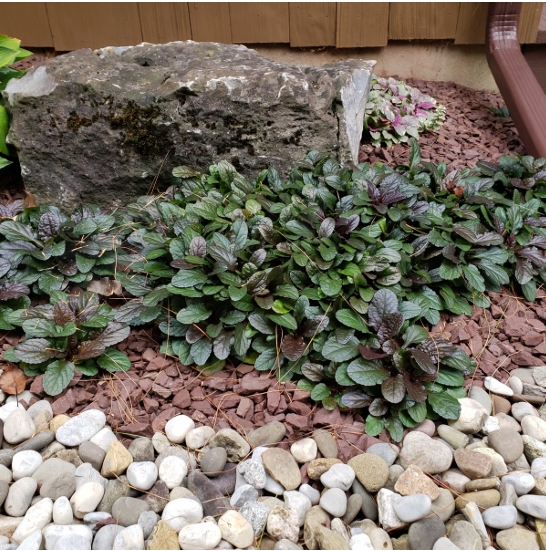
I’ve just discovered a beautiful ground cover for shady spots: bugleweed. One
problem, though. It’s related to mint so it can be invasive. If you can overlook its rapid
spreading, the foliage is lovely and the flowers are very unusual.
What is Bugleweed?
Bugleweed (Ajuga reptans) is a flowering perennial plant that is native to Europe, the
Near East and northern Africa. It is a member of the mint family. It’s easy to tell if a
plant is a member of the mint family. All plants that are members of the mint family
have square stems instead of the usual round stems.

Mint is an aggressive spreader so it is no surprise that bugleweed is also an aggressive spreader. After its introduction to North America by European colonists, it
has become invasive in some parts of the US and Canada.
Bugleweed spreads using underground stolons. Stolons are also called runners. They are stems that grow close to the soil or under the soil from which new plants can grow. Bugleweed spreads readily via underground stolons and can invade your
lawn or other nearby garden beds. You will need to keep a sharp eye on your plants and quickly pull up any new plants that appear in places where they are not wanted.
The plant is popular as a ground cover because of its attractive leaves. They are
dark green with hints of purple. Newer cultivars have rose instead of purple or
variegated leaves. Because the plants will grow in partial shade, it is perfect for
adding color to a semi-shady corner of your yard.

Bugleweed hugs the ground, only growing up to 6 inches in height. The flower stems
can add another few inches to its height. The flowers grow in racemes (clusters of
flowers on a stem) and are usually blue or violet-blue. To me, the flowers look a lot like the flowers of the Great Blue Lobelia, a native plant that is not related to bugleweed.
Bloom time is late spring, May through early June. Remove the flowers after they die
to keep your plants looking neat.
How to Grow Bugleweed
Bugleweed is hardy in zones 3 – 9. It grows in both full sun and partial shade which
gives you more choices where to use it.
It is usually purchased as plants from a nursery. Individual plants should be planted
12 inches apart. If you want faster coverage of the area, plant them closer together,
about 6 to 9 inches apart. If you live in the southern portion of its range, avoid
crowding the plants to prevent crown rot.
Crown rot is caused by a fungus that lives in the soil. Plants that are too close
together in soil which doesn’t drain well results in wet conditions which will
encourage growth of the fungus. Plant your bugleweed 12 inches apart and divide it
when it starts to get crowded. Division is best done after the plants have finished
flowering.
Well-drained soil will also help prevent crown rot. The plants do best in rich, well
drained soil. Use compost to enrich and aerate your soil especially if you have clay
soil. As long as you continue feeding with compost, you will not need to fertilize your
plants.
Another way to prevent crown rot is to water sparingly. When you first install your
plants, water them weekly as they settle into their new home. Once they are
established, you can cut back watering to once every 2 or 3 weeks. You will know
when it is time to water when the top inch of the soil is dry.
How to Divide Bugleweed
No matter which growing zone you garden in, eventually you will have to divide your
bugleweed. Those small plants that you so carefully spaced 12 inches apart will have
grown together, filling all of the space you allotted for it and may even be spreading
into places that you never intended for it to grow.
To divide your plants, wait until after they have finished blooming. Remove the spent
flower heads. Using a garden fork, carefully dig up the plants. You will notice that
they are actually growing in individual clumps.
Carefully examine each clump. Get rid of any that are brown or withered. You only
want healthy, green plants. Using a sharp knife, cut the stolons that have grown
between each clump so that the clumps are separated.
Replant the new healthy clumps 12 inches apart. Water weekly until they become
established, then cut back watering to every 2 to 3 weeks. Water only when the top 1
inch of the soil is dry.
Leave a Reply