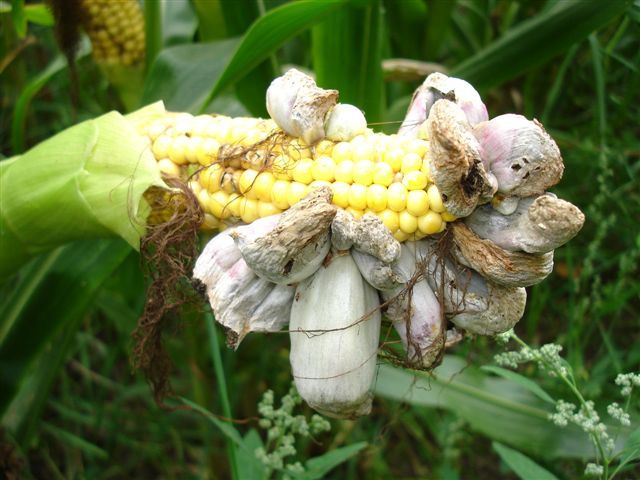
A gardener or farmer here in the U.S. who checks their corn crop and finds corn smut despairs. The crop is ruined and must be destroyed. A gardener or farmer in Mexico who checks their corn crop and finds corn smut is elated. A delicious treat for their table or market has appeared in their crop.
Why is the reaction different between the U.S. and Mexico?
What is Corn Smut?

them to darken in color.
Corn smut is a fungus (Ustilago maydis) that infects all parts of the corn plant. It won’t kill the plant, but it will reduce the yield. The fungus is spread through spores that fall to the ground where they can survive in the soil for up to seven years. When it rains, the spores are splashed onto the plants, infecting them. The spores can also be spread on the wind to infect corn that is not in the immediate vicinity. And they can be spread through the manure from animals who have eaten infected corn.

will either drop to the ground or be blown on the wind to infect more corn plants.
After the spores infect a plant, the fungus forms galls that range in size from a pea up to five inches. The galls form where the spores have landed on the plant and can appear on the stalk, the leaves or the tassels but are largest and most apparent on the ears. In the ears, the galls form between the kernels. This prevents the ear from completely filling with kernels, reducing the yield.
The galls are white as they begin to develop but as they mature and fill with black spores, they turn brown or black. Fully mature galls rupture, spilling their spores on the ground. If it is a windy day, the spores will be blown on the breeze spreading infection to neighboring fields.
How to Get Rid of Corn Smut
There is no treatment for corn smut. Once a plant has become infected the only remedy is to remove the entire plant immediately from your garden and destroy it. Don’t wait for fall cleanup. It is important to destroy the galls when they are young before they have formed spores that can spread the infection. Do not compost infected plants. This will only result in spores infecting your compost for up to seven years. The following year, you will be spreading the spores as you add compost to your garden.
The best “cure” is prevention:
Clean up and destroy all garden debris in the fall to prevent spores from overwintering in the soil.
Practice crop rotation. Plant your corn in a different bed every year. Try planting sweet corn varieties that are bred to be resistant to the fungus such as Silver King, Seneca Sensation or Fantasia.
Is Corn Smut Edible?

are also fungi.
Yes! In Mexico it is considered a delicacy. Mexican farmers will sometimes deliberately infect their corn crop to produce the edible galls. The galls are harvested when they are white before they mature and fill with spores. The galls can be purchased fresh in markets and stands or canned in grocery stores. The canned galls are usually used in fillings for tortillas and in soups. Fresh galls can be eaten raw. The taste is similar to mushrooms which are also fungi.
Attempts have been made to introduce this Mexican delicacy into the United States. The galls have even been renamed as Mexican Truffle to entice consumers. The galls have been slow to catch on perhaps because there is a very small quantity available thanks to the USDA which has devoted tremendous resources to eliminating corn smut from American corn. Maybe the USDA should instead devote some of those resources to encouraging Americans to eat corn smut rather than destroy it. It is certainly an organic solution to a common fungal infection.
Leave a Reply