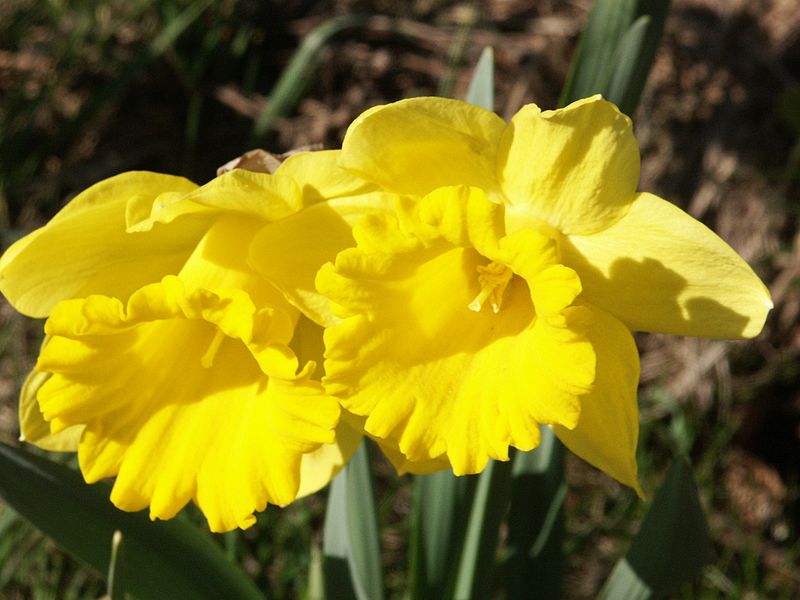
The sunny yellow flowers of daffodils are a welcome sight after a long winter, especially in areas of the country where deer are a problem. Deer don’t eat them because they are poisonous.
In some parts of the country, daffodils are called jonquils. Bulb catalogs often refer to large cup varieties as daffodils and the rest as narcissus. And then there are usually a couple of pages of jonquils. Confused yet?
A Daffodil By Any Other Name …
Let’s see if we can sort this out. No matter what they are called by gardeners, all daffodils, narcissus and jonquils are members of the Narcissi family. Within that family there are 12 groups of flowers:
- Trumpet
- Large Cup
- Small Cup
- Double
- Triandrus
- Cyclamineus
- Jonquilla
- Tazetta
- Poeticus
- Bulbocodium
- Split Corona
- Other Cultivars
Trumpet vs. Large Cup

Most of us are familiar with trumpet daffodils such as the classic yellow King Alfred and the heirloom white Mount Hood. Aren’t large cup the same as trumpet? Actually, no. A daffodil is considered a trumpet if it has a single flower on each stem and if the length of the corona (“trumpet”) is as long as or longer than the perianth (surrounding petals). To be considered a large cup daffodil, it has to have a single flower on each stem with the corona shorter than the perianth but at least one third as large.
Small Cup vs. Poeticus

Small cup daffodils have single flowers and coronas that are shorter than one third the length of the perianth. Poeticus daffodils are my favorite. They have single flowers and the corona is only a tiny disc usually with a red rim.
Double

Double daffodils are pretty self-explanatory. The corona or the perianth or sometimes both, are double giving them the
appearance of peonies or roses.
Triandrus

Not often seen, Triandrus daffodils have two or more flowers per stem. The coronas point downwards while the surrounding perianth are “reflexed”, meaning that they are bent away from the corona.

Cyclamineous
Cyclamineus daffodils are similar to Triandrus but they only have a single flower per stem. They have the same downwards facing coronas and reflexed perianth.

Jonquilla
Finally, we get to the jonquils. Jonquils usually have one to five flowers per stem and short coronas. Look at where they are joined to the stem. It is bent at almost a ninety degree angle from the stem to the flower.
Tazetta

If you have ever forced bulbs indoors, then you are familiar with Tazetta daffodils. The most common variety used in forcing are called Paperwhite Narcissus. They have multiple flowers per stem, anywhere from three to twenty and they are very, very fragrant. The one and only time that I forced daffodils in my home, the scent was over-powering in the tiny apartment where I lived.
Bulbocodium

These are very tiny plants, only 6 to 8 inches tall. The leaves look like grass. Be careful when weeding in the spring! You might mistake these for weeds. The flowers are also unusual. Instead of being shaped like a trumpet, the coronas are flared. The perianth are just almost non-existent, just a few spike-y petals.
Split Corona

The coronas on these don’t look like “normal” trumpets, more like individual petals. To me, they look like the flowers have exploded. I prefer the double-flowered over the split coronas.

Other Cultivars
This is a catch-all category that includes any daffodils that don’t fit into the other categories. A good example is the Tete-a-Tete, a miniature daffodil.
I hope that this very brief overview of the large family of daffodils will be helpful to you when choosing which ones to plant in your spring garden. Try a few of the unusual ones and see how you like them. If you are like me and forget over the winter what you have planted, you will find exciting surprises as spring progresses. Only the deer will be disappointed.
Leave a Reply