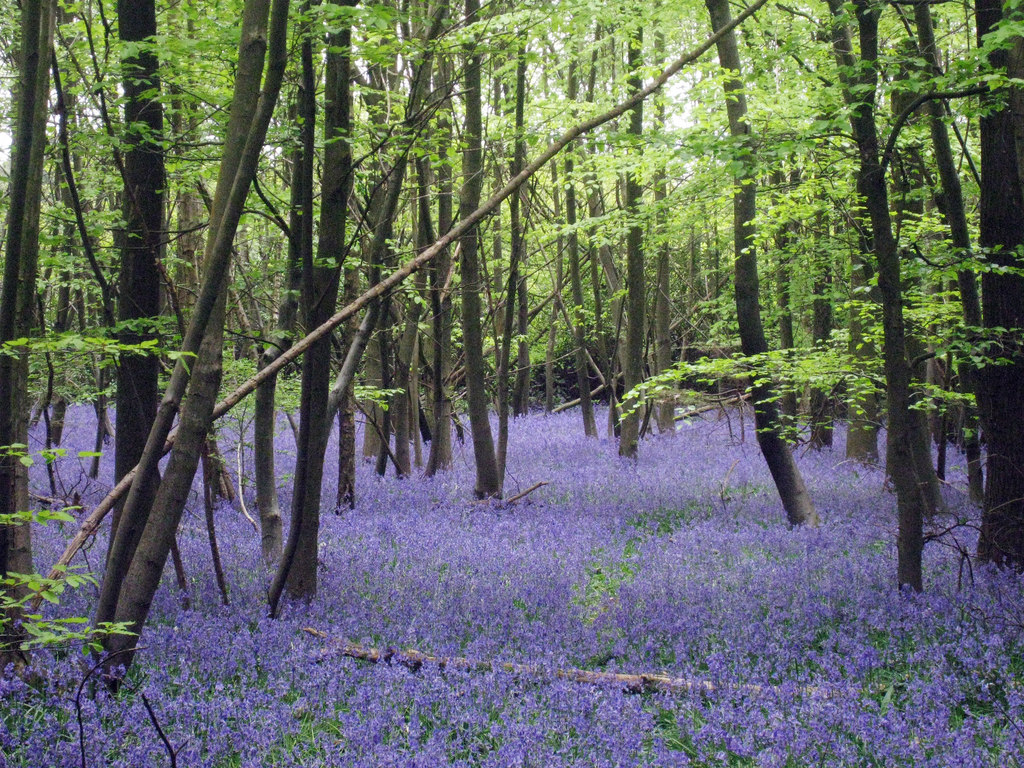
Look closely the next time you see bluebells. Are they light blue or dark blue? Are the flowers all on one side of the stem or all around it? The answers to these questions will tell you whether you are looking at English bluebells (Hyacinthoides non-scripta ) or Spanish bluebells (H. hispanica).
What are English Bluebells?

English bluebells are native to the British Isles and northern Europe. They are one of the favorite flowers of the British people. A protected species in Great Britain, it is illegal to dig them up from your yard or remove them from their native woodlands. They like partial shade and do best in deciduous woodlands. Bluebells are used as an “indicator species” which is a plant or animal species that marks a specific condition or environment. In the case of bluebells, an open field of bluebells is an indication that an ancient forest once grew in that area.
English bluebells grow from bulbs, usually in woodlands but they will also grow in your garden. They like the cool summers of their native lands. Their flowers are shaped like bells and dark blue in color. The flowers grow in a single row along one side of the stem. The weight of the flowers causes the stem to curl downwards. English bluebell flowers are very fragrant.
What are Spanish Bluebells?

Spanish bluebells are native to the Iberian peninsula. They like more sun and tolerate dryness better than their English cousins. They were introduced to Great Britain in 1680 where they became an invasive species, driving out the native English bluebells while also hybridizing with them. Spanish bluebells are extremely disliked in Great Britain both because they hybridize with the beloved native bluebells and because they are nearly impossible to get rid of.
The bulbs grow deep into the soil. Even if they are dug out and thrown away in a compost or garbage pile, they will take root in their new location. If you truly want to get rid of them, place them in a garbage bag and put them out with the trash.
Spanish bluebells grow from bulbs and like sunlight. They prefer a warmer environment than English bluebells. Their flowers are bell-shaped and a light gray blue in color. Thanks to plant breeders, there are now cultivars in pink, blue and white. My own experience growing them was that after a few years, they revert back to the original light gray blue color. Spanish bluebell flowers grow all the way around the stem so the stem stays upright instead of curling downward like their English cousins. They are not fragrant.
Both the English and Spanish bluebells bloom in the late spring along with hyacinths, late blooming daffodils, and early tulips.
In Scotland, the name bluebells refers to harebells which are related to campanulas. In the US, the name bluebells refers to Virginia Bluebells which are related to borage.
How to Grow Bluebells From Seed
Both English and Spanish bluebells can be grown from seed. The easiest way to grow them from seed is to direct sow them in your garden in the fall. They will germinate in the spring.
If you want to start them indoors, the seeds will need to be cold stratified to mimic winter. Start them 10 to 12 weeks before your last frost date. The seeds need light to germinate so you should surface sow them. Do not cover them with soil. Cover your container with a plastic bag and place the whole thing in your refrigerator for 6 weeks. At the end of 6 weeks, you can remove the container from your refrigerator and remove the plastic bag. Germination should occur in 2 to 3 weeks.
You can set the plants out in your garden after your last frost. Don’t expect flowers the first year. It will take 4 to 5 years before bluebells grown from seed to flower. The seedlings will begin to form a bulb. Only when that bulb has attained a full-grown size, will the plants start to bloom. While the bulb is growing, the roots are also growing and will literally pull the bulb down into the soil. Once established and flowering in your garden, they will re-seed each year, creating more plants.
How to Grow Bluebells From Bulbs
The most common way to add bluebells to your garden is by planting bulbs. The bulbs should be planted in early to mid-fall, after the soil has cooled down. The rule of thumb is to plant them at a depth that is 4 times the size of the bulb, usually 4 to 8 inches deep. Plant them with the pointed end up. That is the growing tip where your plant will grow from. You can expect flowers the following spring.
How to Divide Bluebells
Because bluebells will freely seed themselves around your garden, the plants will become crowded and should be divided to keep them growing and healthy. Dig up the bulbs in the fall and replant them farther apart, discarding any that are soft or appear diseased or deformed. Planting only healthy bulbs will ensure that your bluebells will continue to grow and multiply year after year.
Leave a Reply