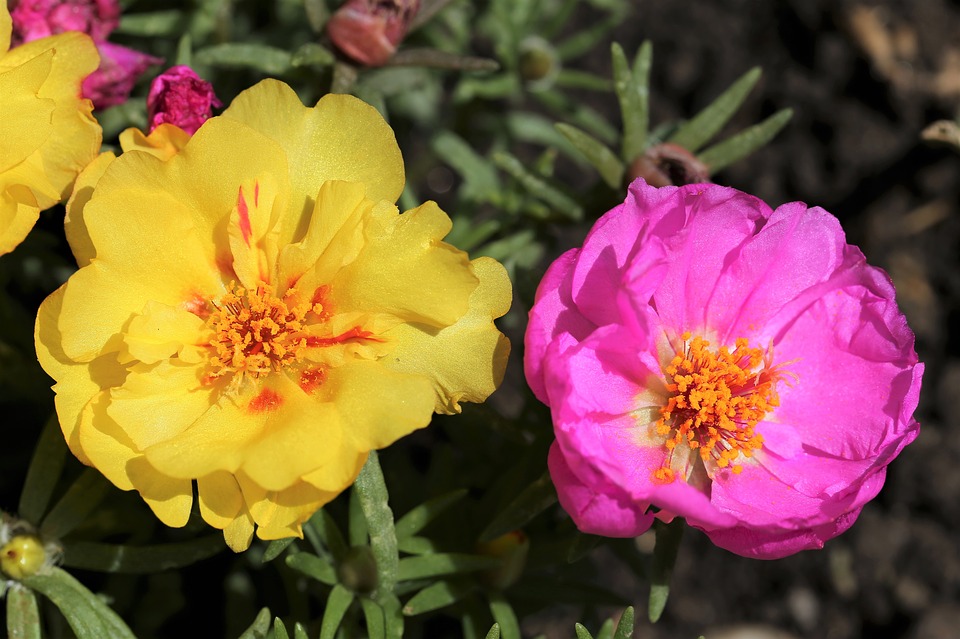
When I was a child, portulaca was a popular ground cover. I loved its rose-like flowers and fat succulent leaves. Then it seemed to go out of style. I’m so happy to see it regaining popularity. It’s a colorful, tough and versatile bedding plant.
What is Portulaca?
Portulaca (Portulaca oleracea), also known as moss rose, is an annual plant that is related to purslane. The foliage is so similar that you should be careful in the spring when you are weeding purslane out of your garden that you don’t weed out portulaca seedlings too! It’s easy to tell them apart if you look carefully. Purslane leaves are flatter while portulaca leaves look like fat, fleshy pine needles.

Full grown portulaca plants are only 6 to 8 inches tall. Their thick leaves mean that they are drought tolerant. Be careful not to over water them. Grow portulaca in well-drained or even sandy soil. It is salt tolerant so it’s perfect for gardens and containers near the ocean. The plants need full sun, 6 to 8 hours per day, for best growth and blooms.

The flowers can be single, double or semi-double. They come in a variety of colors including red, orange, yellow, pink, violet, white and cream. They can also be bi-color. Bloom time is from mid-summer until frost. The flowers open in the morning and close at night. If the day is very cloudy, they may not open at all. When grown in partial shade conditions, the flowers will close during the shady part of the day.
A big drawback of this plant is that it is a prolific self-sower. You will want to keep this one deadheaded so that it doesn’t produce a lot of seed that will sprout all over your garden next spring. Deadheading will also encourage your plants to keep blooming until they are killed by a hard frost in the fall.

The Best Places to Grow Portulaca

Portulaca is a very versatile plant. It can be used as a ground cover because it is so short. Or you can use it in your rock garden along with your short alpine plants. It’s a great cover for areas where you grow spring bulbs. Its sprawling habit will cover the empty spaces after the foliage of your bulbs dies. Its tolerance of dry conditions means that it you won’t need to worry about your bulbs rotting in the ground from too much water.
Portulaca also drapes nicely when planted in containers and hanging baskets. Because it requires little water, it is perfect to tuck into stacked stone walls and between pavers in paths. Or it can be used as an edging along paths and flower beds.
How to Start Portulaca Seeds Outdoors
Thanks to its propensity for self-sowing, portulaca is very easy to grow from seed. You can direct sow it in your garden after your last frost. Ideally the soil should be 65⁰F. The seeds are very tiny so the easiest way to sow them is by mixing them in sand. Broadcast the sand and seed mixture over the area where you want your portulaca to grow. This will ensure even coverage of the seeds. However, do not cover the seeds with soil. They need light to germinate. Gently tamp the soil to ensure good contact between it and the seeds. I usually water the soil before planting fine seed like portulaca because the seed will wash away if you water with a garden hose or watering can after planting. Germination should occur within 10 to 14 days. If necessary, thin your seedlings to 6 inches apart.
How to Start Portulaca Seeds Indoors
If you prefer, you can start your seeds indoors 6 to 8 weeks before your last frost. Surface sow the seeds. Do not cover them. They need light to germinate. You can hasten germination by using a heat mat, otherwise expect your seeds to germinate within 10 to 14 days. You can transplant your seedlings outdoors in your garden after your last frost. Seedlings should be spaced 6 inches apart. Be careful while transplanting. Portulaca does not like its roots disturbed.
Germinating your seedlings in biodegradable peat pots or cowpots allows you to plant the entire container in the garden without disturbing the plants’ roots. The pots will decay into the soil, adding nutrients, during the growing season. An alternative to purchasing biodegradable pots is to make your own using paper or newsprint. A quick search on Youtube shows that there are many ways to make these pots. One caveat is to use plain paper or newsprint only. Glossy magazine pages do not break down as easily in the soil and the inks may contain heavy metals. The ink used in newspapers is vegetable-based so it won’t harm your plants or your soil.
Leave a Reply