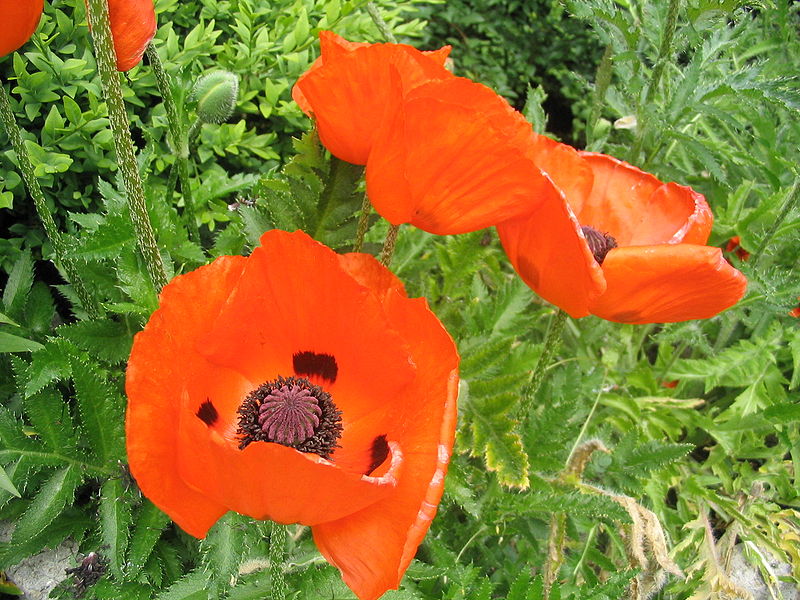
A popular late spring/early summer flower is the poppy. Or I should say poppies. They come in three different varieties.
What are Poppies?
The oriental poppy (Papaver orientale) is a perennial most often seen in old-fashioned gardens. The plants are large with hairy leaves. They appear in the spring, growing until mid-summer when they burst into bloom. When they have finished blooming, the foliage dies leaving an empty space in your garden until the following spring. It’s best to plant perennials around your oriental poppies to mask that empty space. Most older gardens sport oriental poppies with orange blossoms (pictured above) but newer cultivars have white, salmon, red or purple flowers.
The field or corn poppy (Papaver rhoeas) is an annual and is the symbol of Veteran’s Day here in the US, known as Remembrance Day in Europe. Before the advent of modern herbicides, field poppies were a common weed. It was said that when the shelling stopped at the end of WWI, the fields were covered with red poppies because the soil had been churned up and long buried seeds germinated. Their red flowers appear in late spring. P. rhoeas was hybridized by an English clergyman, Rev. William Wilkes, into the popular Shirley poppies which sport blooms in scarlet, purple, pink and white. The scarlet, purple and pink flowers have delicate white edges.


The opium poppy (Papaver somniferum) is the source of opium but also the delicious seeds used in baking. It is an annual plant with gray-green foliage and white, lavender or red flowers that appear in early summer. The opium is contained in the sap in the seed pods that appear after the flowers have finished. It is legal in the US to grow opium poppies but illegal to harvest the opium from them. You are free to harvest the seeds to either save to plant next year or to use in your favorite recipes.
How to Grow Poppies
Poppies originated in the the Mediterranean area, a dry environment. They require full sun and well-drained soil. You will have to be careful to not overwater them. They prefer to be dry which is why they grow so well in areas like the Mideast. Their tall stems are fragile, so it is best to grow them in an area where they are protected from strong gusts of wind. If you grow them away from protection, be sure to stake them.
How to Grow Poppies From Seed
No matter what kind of poppies you choose, they are easy to grow from seed. Choose a sunny spot in your garden and surface sow the seeds. Do not cover them. They need light to germinate. You can sow the seeds in the late fall or early spring before your last frost. They need a period of cold to germinate. You can even sprinkle the seeds on top of the snow in the winter and when it melts in the spring, the seeds will germinate when they come into contact with the soil. It’s best to sow your seeds where you want your plants to grow because they do not transplant well.
The seeds are tiny so they can be difficult to sow. A good solution is to mix your seeds with sand at a rate of one part seed to two parts sand. Spread the sand over the area where you want the seeds to grow. This will allow you to sow them more evenly.
Keep the seeded area moist. You can expect germination within 2 weeks if your soil is at least 55⁰F. Thin your seedlings when they are one inch high so that the resulting plants will be 6 to 10 inches apart.
If you want to start your seeds indoors, you will need to cold stratify them. Cold stratification is a technique used to mimic cold weather for seeds that require cold temperatures to germinate. Eight weeks before your last frost, surface sow your poppy seeds in a container and cover it with a plastic bag. The plastic bag will keep the soil moist while the container is in the refrigerator. Check the soil regularly. If it dries out, replace the moisture by misting. Place the bagged container in your refrigerator for 4 weeks. Then take it out of your refrigerator and place it in a sunny window.
Germination should occur within 2 weeks. You can plant your seedlings, 6 to 10 inches apart in your garden after your last frost.
How to Harvest Poppy Seeds
After your poppies have finished blooming, you can remove the seed pod before the seeds form or if you wish to harvest the seeds, leave the pods on the plants until they turn brown. They will be ready when you hear the seeds rattling around inside. Gather the pods in a paper bag with slits cut into it for air circulation to finish drying. When completely dry, the seeds will begin to spill out of the pods through holes along the top edge. To remove all of the seeds, simply pop the top of the pod.
Since poppies grow so well from seed, you might want to leave some pods on the plants to spread their seeds in your garden for next year.
Leave a Reply