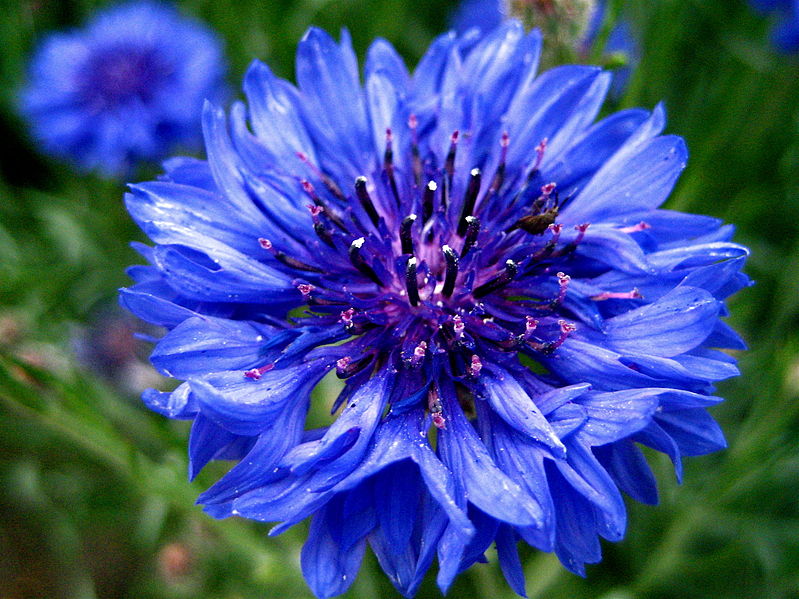
We often think of bachelor’s buttons, also known as cornflowers, as old-fashioned flowers, but in reality, they are ancient. They have been grown for thousands of years. A wreath of bachelor’s buttons was even found in King Tut’s tomb.
What are Bachelor’s Buttons?
Bachelor’s buttons (Centaurea cyanus) are annual flowering plants that are native to Europe. They became
naturalized in North America and Australia thanks to European colonization.

They used to grow as wildflowers found in fields of grains which are known as corn in Britain, hence the name cornflower. They were also called “hurtsickle” because they blunted the cutting edges of the sickles that were used to harvest grains. They gained the name “Bachelor’s Button” because young single men wore them as boutonnieres when they were courting. Folklore claimed that if the flower wilted quickly, it was a sign that that the young man’s romantic aspirations would fail.
Today, thanks to modern herbicides used in grain fields, cornflowers have almost disappeared as wildflowers. Thankfully, they have long been welcomed in our gardens so they haven’t become extinct.
How to Grow Bachelor’s Buttons
Bachelor’s buttons prefer full sun, but will grow in part shade. They reach their maximum height of 1 to 3 feet in full sun. However, as they grow taller they tend to fall over and need staking. They can tolerate dry conditions but prefer about 1 inch of water per week in well-drained soil.

The foliage is a striking silver green. Thanks to modern hybridization, the original blue flowered plants now also come in purple, pink and white. I have come to love these different colors. Modern hybrids are also more fully double, resembling carnations. They start blooming in early summer and if deadheaded will produce a second flush of flowers at the end of summer.
Deadheading is the practice of removing spent flowers to prevent seed production. When deadheaded, annual flowers will flower again in an attempt to produce seeds for the following year.
How to Grow Bachelor’s Buttons From Seed
Bachelor’s buttons are easily grown from seed. They should be direct sown in your garden after your last frost.
Sow the seeds ½ inch deep and keep them moist. Like most annuals, the seeds will germinate quickly, usually within one week to ten days. They will tolerate crowding but do best and bloom more if you thin the plants to 6 to 12 inches apart. The plants develop multiple stems so they need extra space to grow properly. Crowded plants can result in disease or insect infestation.
Bachelor’s buttons will freely self-sow in your garden if you allow the flowers to go to seed as I do. Alternatively, you can harvest the seed heads, dry the seeds and sow the seeds again the following spring or even share them with your gardening friends.
If you want to get a head start, you can start your seeds indoors 3 to 4 weeks before your last frost. Sow them ½ inch deep and keep them evenly moist. Germination should occur in 7 to 10 days. You can transplant your seedlings outdoors after your last frost when they have reached a height of 3 to 4 inches tall. Plant them 6 to 12 inches apart.
No matter how you start them, the plants will start to grow buds within 65 days of germination.
How to Harvest Bachelor’s Buttons For Cut Flowers
In Canada, bachelor’s buttons are grown for use as cut flowers by florists. To use them as cut flowers in your own bouquets, harvest the flowers early in the morning when they are at their best. Choose flowers that are not yet fully open. They will finish opening within a few hours. If you aren’t going to use them right away, place them in a container of water and refrigerate them until you are ready to start arranging your bouquet.
Other Uses For Bachelor’s Buttons
Grow them in your pollinator garden. Bees find the flowers irresistible.
Dry the flowers for use in dried arrangements and wreaths.
The flowers are edible and are often used as part of an herbal tea blend. Bachelor’s buttons are an ingredient in the famous Lady Grey blend made by Twinings of London, a well-known tea company.
Leave a Reply