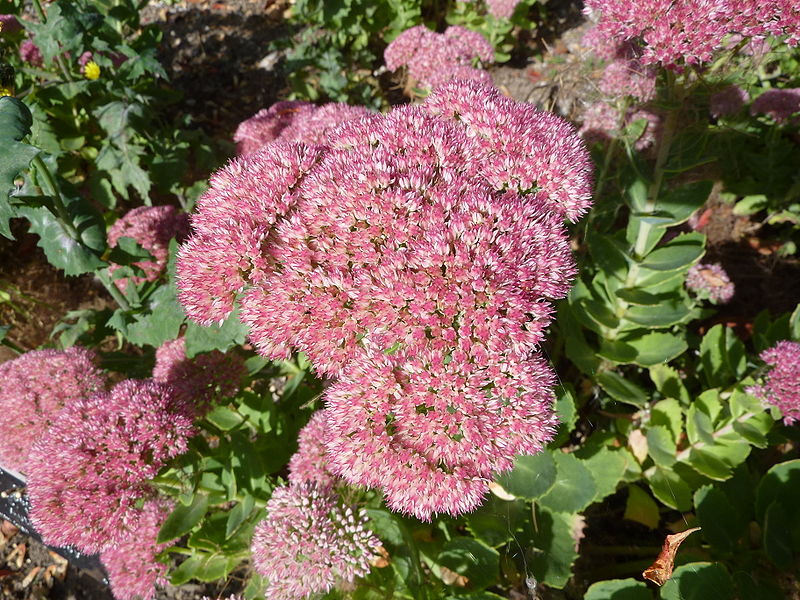
What is Sedum?
Sedum (Hylotelephium spp) is a large family of flowering perennials that offer wonderful color and texture in the garden. It is often overlooked amongst the chrysanthemums, asters and goldenrod of fall. A favorite sedum is the cultivar Autumn Joy which provides texture during spring and summer with its fleshy leaves and then bursts into bloom in the late summer or early autumn. Initially the blooms are pink, but as they age, they turn a deep red or rust color, a perfect fall hue.
Sedums are hardy from zone 3 through zone 11. Low growing varieties, which usually only grow to 2 inches tall, make excellent groundcovers, work well in rock gardens and are often used on green roofs. Taller varieties, reaching heights of 2 feet or more, are staples in cottage gardens.
Sedums are also used in butterfly gardens because they are the nectar plants for several species of butterflies including monarchs, American Painted Ladies, Buckeyes and Gray Hairstreaks. Nectar plants are the plants that provide food for butterflies. Host plants provide food for caterpillars. Butterfly gardens contain both nectar plants and host plants.
How to Grow Sedum
Sedums grow best in full sun although the shorter varieties can tolerate some shade. They should be planted in well-drained soil and not over-watered. A thick layer of mulch will help keep the soil moist and the roots shaded from the heat of the sun. The fleshy leaves give us the clue that they are a drought tolerant plant.

Be careful not to over-fertilize. They prefer less rich soils. Too much fertilizer will result in tall, leggy plants that will flop over. Compost is an excellent fertilizer because it is not nutrient dense and helps with the drainage of the soil. Depending on the variety, sedums bloom in the summer or fall in pinks, reds, yellows and whites. The flowers can be dried and used in floral arrangements.
At Rutgers Gardens in New Jersey, sedum is grown on water conservation terraces where the only moisture they receive is from rainfall.
How to Divide Sedum
Propagation is usually done by division. Sedum can be divided in the spring or the fall. Simply dig up your plants and gently pull the crowns apart, discarding any dead or diseased parts. Replant the divisions immediately to avoid the roots drying out, maintaining 6 to 12 inches, or 24 inches for larger plants, between plants, depending on their size. You should divide your plants every 3 to 4 years to maintain their health. You will know that it is time to divide your plants when the flowers are smaller than usual.
How to Grow Sedum From Cuttings
Sedum is also easy to grow from cuttings. The cuttings should be taken in early summer when the plants are actively growing but before they have set buds or flowered.
You can make two types of cuttings. Tip cuttings are cuttings made from the ends of the branches of the plant. You can simply stick them in soil, either in containers or directly in your garden.
Or you can make stem cuttings. In this case you would carefully dig around the crown of the plant and cut off a few stems from the crown. Again, you simply stick the cuttings either in a container or directly into your garden.
How to Grow Sedum From Seeds
Sedums are easily grown from seeds. You can direct sow your seeds in the early spring in your sunny garden or start them indoors 4 to 6 weeks before your last frost date. The seeds should be sown on the surface of the soil. Do not cover them. They need sunlight to germinate. After germination, thin your seedlings to a spacing of 6 to 12 inches between plants. Larger varieties should be spaced 24 inches apart. If starting your seeds indoors, you can transplant them into your garden after all danger of frost has passed.
Common Sedum Pests
I live in New Jersey where there is a big problem with deer. The first question we ask when considering adding a new plant to our yards is whether or not it is deer resistant. Alas, sedums are not deer resistant. Surprisingly, they are rabbit resistant so if your problem is with rabbits and not deer, you can safely plant sedums.
Other pests that love sedums are slugs and snails, mealybugs, and scale.
Autumn Joy Sedum

The cultivar Autumn Joy is just that; a joy in your fall garden. After dying to the ground in the fall, fresh green shoots make their appearance in the spring, eventually growing to a height of 3 feet. It’s best to pinch the growing tips off, like you do to your chrysanthemums, to encourage bushiness which will result in stronger plants that are better able to support the tall flower stalks. You should begin pinching your plants when they reach a height of 6 to 8 inches. The leaves are fleshy, reminiscent of succulents. Their serrated edges lend their own interest to your garden during the spring and summer.
In late summer, your Autumn Joy will begin to send up stems that will eventually develop green buds that have been described as looking like broccoli. Those buds will open into star shaped pink flowers, that will darken with age to a deep red or rust color. Left alone, the flowers will dry on the plants and can be left there to lend winter interest to your garden.
Leave a Reply