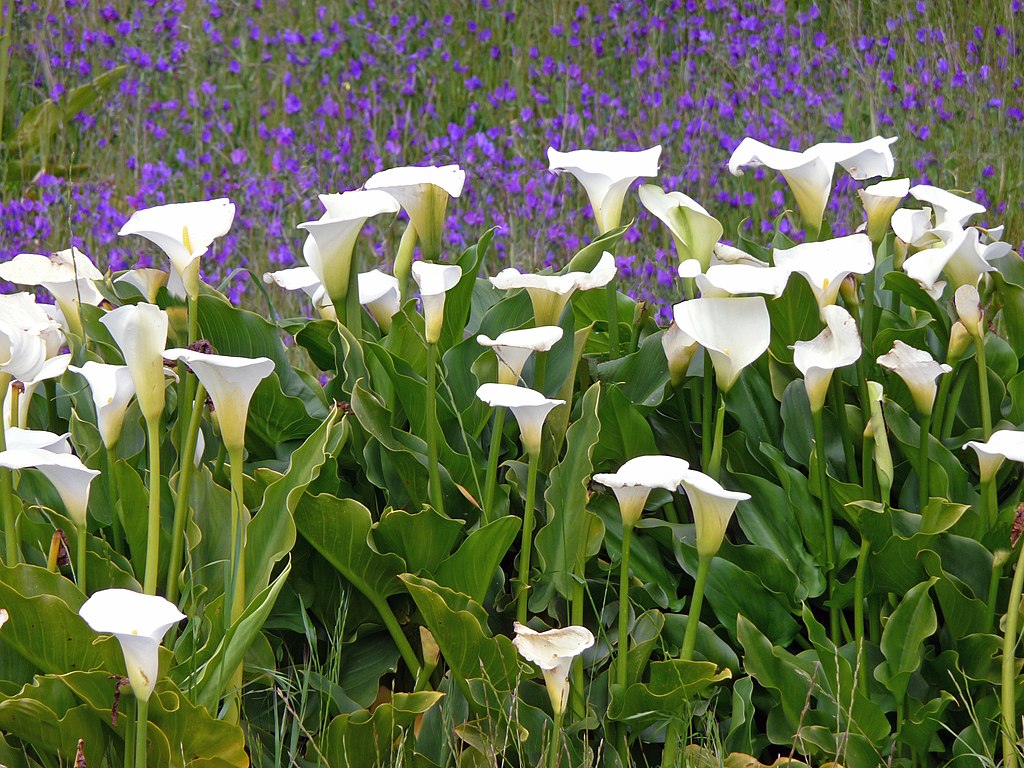
One of my co-workers is looking forward to purchasing her first home. She plans to surround it with her favorite flower, calla lilies.
What are Calla Lilies?

Calla lilies (Zantedeschia aethiopica) are not actually lilies. They are arums, related to plants like peace lilies (also not true lilies), jack-in-the-pulpits and caladiums. Calla lilies are native to southern Africa, found in South Africa, Mozambique, Swaziland and Lesotho. They have naturalized in other areas of the globe. They are considered invasive in Australia and New Zealand.
The plants are perennial in zones 8 – 10. In colder growing zones (3 – 7), they are grown as annuals. Gardeners in colder climates either plant new bulbs each year or dig up their bulbs in the fall and store them indoors during the winter. Calla lilies can also be grown as house plants.

Calla lilies grow from rhizomes. The leaves grow directly from the rhizome, rather from a stem. The leaves are dark green and sword shaped. They grow 18 inches in height. The flowers grow on a stalk that can be up to 3 feet tall. They are surrounded by a spathe which is often mistaken for the flower. The spathe can be pure white, which is popular for weddings, or yellow, orange, pink, dark maroon or lavender. The spadix inside of the spathe is yellow and contains the actual flowers.
In areas where they are perennial, flowering begins in early summer. In colder areas where the rhizomes are planted in the late spring, the plants bloom in late summer.
How to Grow Calla Lilies Outdoors
Calla lilies will grow in full sun or partial shade. In the warmest areas, partial shade is best. In cooler climates, full sun is a must. These plants like rich, well-drained soil that is slightly acidic, pH 6.0 – 6.5. If you are unsure about the pH of your soil, have a professional soil test done.

Calla lilies don’t normally require fertilizer, but if you want to add some to your garden, a slow release fertilizer is handy if you don’t want to fertilize every two weeks with a liquid fertilizer. Use a fertilizer that is especially formulated for flowers.
Calla lilies are from the dry areas of southern Africa so it is important not to overwater them, especially when they are first planted. Water them sparingly until they are established, then water them weekly. A thick layer of mulch will help the soil to retain its moisture between waterings.
How to Over- Winter Calla Lily Rhizomes
In zones 8 – 11, you can leave your rhizomes in the ground year round. In colder growing zones, you can either allow the plants to die and replace them next year or lift the rhizomes from the soil and store them over the winter.
To over-winter your rhizomes, when the foliage dies, carefully dig up your rhizomes. Brush the soil off and cut the foliage off leaving about an inch of the stems. Cure them in a warm dry place for a few days. Curing them helps to dry them enough so that there is not excess moisture on them that would cause them to rot. Then place the rhizomes in a box filled with damp peat moss. This is to prevent them from drying out during the time that they are out of the ground.
Store the box somewhere dark that has a constant temperature of 50°F to 60°F. Check your rhizomes a few times over the winter to make sure that there is no rot or that they aren’t shriveled up and dry.
How to Grow Calla Lilies Indoors as Houseplants
Since calla lilies can grow in partial shade, they are perfect as houseplants because our homes are darker than outdoors.

Plant your rhizomes 3 inches deep and 4 inches apart in a container. Use rich, well-drained potting soil. Since containers dry out more quickly than soil in your garden, water your rhizomes after planting them.
Fertilize with a slow release fertilizer. Fertilizer is important when growing plants in containers because every time that you water your plant, the water that comes out of the drainage hole in the bottom is leaching nutrients from the potting soil. You have to replace those nutrients in the soil or your plants will die.
In the fall, your calla lily will stop flowering and the foliage will start to die back. Cut back on your watering and allow the plant to dry and go dormant. This is normal behavior. Then in late February, repot your rhizomes into fresh soil and begin watering again.
Eventually your plants will become potbound, i.e. too large for their container. Simply lift the entire rootball out of the old container and transfer it into a larger container. Add soil as needed and water thoroughly.
How to Divide Calla Lilies
You will need to divide your calla lilies every 3 – 4 years. In warmer climates, it is best done in the spring. In colder climates where gardeners dig up the rhizomes in the fall, it is best to divide them in the fall before they are put away for storage.
Using a garden fork, gently dig up the clump. Using a sharp knife or pruners, carefully cut the mass of rhizomes into separate pieces making sure that each piece has both roots and foliage. Discard any dead or diseased pieces.
In warm areas, replant your divisions 3 – 4 inches deep and 6 inches apart. In cold areas, cure your divisions for a few days in a warm, dark place then pack them in peat moss and store somewhere dark that will remain 50°F – 60°F throughout the winter.
Leave a Reply