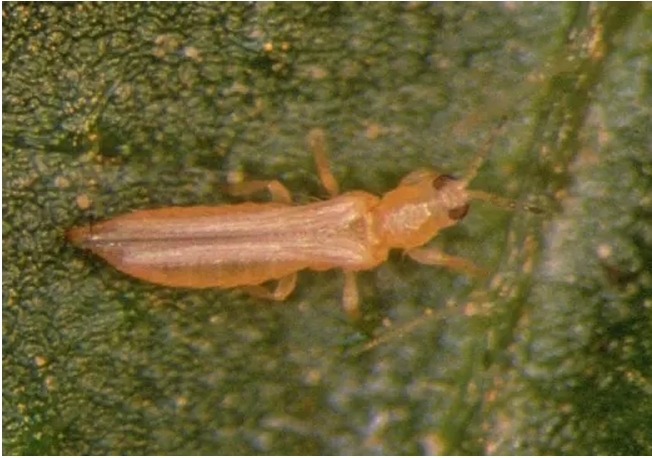
Thrips are tiny insects that literally suck the life out of your plants, resulting in pale leaves and twisted, discolored plants. One of the best ways to get rid of them is by enlisting the help of their mortal enemies.
What are Thrips?
Thrips (Thysanoptera spp.) are so tiny that without a magnifying glass, they just look like threads on your plants. But despite their size, they are very destructive. They are classified as sucking insects because they feed on sap by sucking it out of the plants. They are a scourge in both the vegetable garden and the flower garden.
In addition to sucking all the sap out of plants, they also transmit disease much like mosquitoes transmit malaria when they suck your blood. This dual danger of loss of sap plus disease transmission is what makes thrips so dangerous.
Thrips overwinter in the soil of your garden in both the adult form and as larvae. When the soil warms in the spring, the adults emerge. The females fly to your plants, make slits in the stems and leaves, and lay up to 80 eggs at a time. They do not need to mate to produce eggs. The eggs hatch within a few days or weeks depending on the temperature, and the larvae begin to feed on the plants’ sap. Within two weeks, they drop to the soil to pupate into adults.
Because their lifecycle is so short, there can be a dozen or more generations within one growing season.
Use Beneficial Insects
Beneficial insects are insects that eat pests in your garden. They are the best defense against thrips. The Amblyseius cucumeris is a predatory mite that you can purchase via mail order to release into your garden where it will eat both the larvae and eggs of thrips.
Pirate bugs, lady bugs and lacewings are also available by mail order and all love dining on thrips, as well as other pests that they find in your garden.
Be aware that once the beneficial insects have consumed all of the thrips in your garden, they will leave in search of more food. They won’t wait around for the next generation to hatch.
Use Insecticidal Soaps
Spraying with insecticidal soaps such as neem oil can be effective in killing thrips. They work by coating the insects and smothering them. Soaps and neem oil cover the insects blocking the pores through which they breathe.
When spraying, make sure that you spray the entire plant. Don’t forget the undersides of the leaves and where the leaves attach to the stems. Both are places where thrips love to hide.
Use Insecticides That Use Pyrethrum
Insecticidal sprays are effective in killing thrips, but they also kill all other insects. Insecticides make no distinctions between “good” bugs such as pollinators and “bad” bugs that destroy your plants.
Sprays containing pyrethrum are a good choice if you are overwhelmed with thrips and must spray. Pyrethrum is
potent but loses its toxicity within a few days, so beneficial insects can safely move back into your garden.
Since pyrethrum is toxic for honey bees, use it early in the morning or at dusk when bees are not active. The spray should be dried by the time the honey bees come looking for nectar.
Once you have cleared your garden of thrips using a spray, release predatory insects to prevent the thrips from infesting your plants again. Remember, there are larvae pupating into adults in the soil which will emerge after you have sprayed.
Remove Infected Leaves or Whole Plants
Check your garden daily for signs of thrips. Cut off and discard any damaged leaves that you see.
If the insects have infested most of the plant, remove the entire plant and discard it. Make sure that you throw away your infected plants in the garbage, not in your composter. If you discard infected plant material into your composter, you risk infecting your compost with thrips which will then be spread all over your garden when you add the infected compost to it.
Remove All Plant Waste From Your Garden
Remove all plant waste from your garden, such as onion tops, weeds, and grass where thrips like to hide.
Use dry mulch like wood chips, because thrips don’t like the dryness. They prefer green mulches and plant waste which are moist.
A colony of thrips can decimate your garden. Keep them under control using a mixture of beneficial insects, sprays and sanitary practices.
Leave a Reply