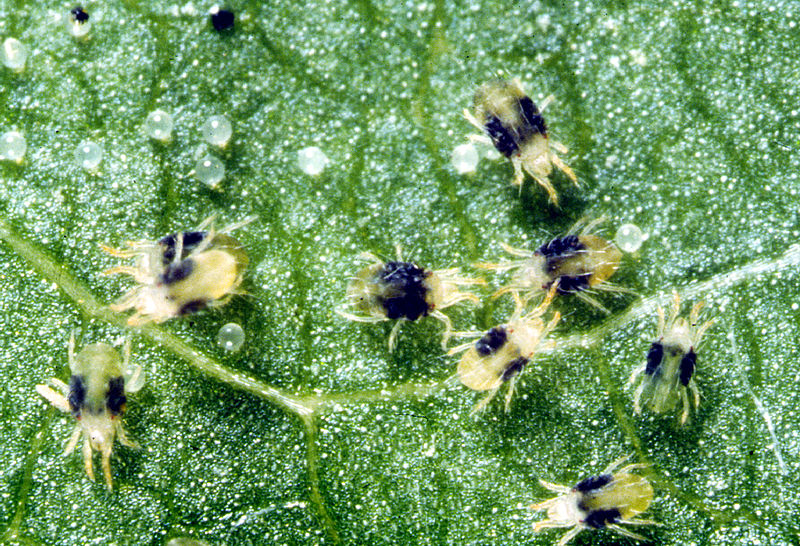
See that web on the underside of that leaf? It wasn’t made by a spider. It was made by its cousin, the spider mite who got its name because it spins webs just like spiders.
What are Spider Mites?

Spider mites are not insects. They are spiders. You can tell by counting their legs. They have 8 legs like spiders instead of 6 legs which is characteristic of insects. You’ll need a 10x magnifying lens to count the legs. Spider mites are tiny, only 1mm or 4/100ths of an inch in size and come in various colors. The easiest way to ID them is to place a sheet of white paper under a leaf and shake the leaf. The tiny black dots that fall on the paper are the mites. It’s easier to see them on the white paper with your magnifying lens than on the back of a leaf where they live.

Spider mites live fast and die young. They hatch within 3 days and mature within 5 days. Females can lay up to 20 eggs per day. During their brief lifetime of only 2 to 4 weeks, they can lay hundreds of eggs. This quick life cycle allows them to easily become resistant to chemical pesticides.
Spider mites live on the undersides of leaves. They have a varied diet, enjoying plants like tomatoes, peppers, potatoes, strawberries, corn and beans. They spin their characteristic webs to protect their colonies, especially their vulnerable eggs, from predators. Since the mites themselves are so tiny, their webs are usually the first sign you will see indicating their presence.
You may also notice that the leaves on your plants have developed yellow spots, have begun to curl or die and drop off of the plants. Spider mites feed by literally sucking the life out of your plants. They pierce the leaves and feed on the sap inside them.
Knock Them Off With a Hose
The best way to get rid of spider mites is with a hose. Attach a nozzle that will give you a strong spray and spray your plants, especially the undersides of the leaves. This knocks the mites off the leaves. You can do something similar for your houseplants. Turn them upside down in a sink and using the sprayer attachment, wash the leaves thoroughly. Alternatively, you can use a sponge to clean each individual leaf.
Use Neem Oil
Another tried and true method is to spray your plants with neem oil. It acts in different ways. It can be a repellent preventing the mites from infesting your plants. It can interfere with their ability to feed. Neem can also interfere with their hormones making it difficult for them to lay eggs. You will need to spray for a couple of weeks, concentrating on the undersides of the leaves, to completely rid your plants of spider mites.
Use Insecticidal Soaps
Insecticidal soaps are an ecologically friendly way to get rid of spider mites and insects that damage your plants. They work by smothering the pests. Just as soap can dry out your skin, insecticidal soap dries out the insects’ bodies, killing them. Like the neem oil, you will need to spray for a couple of weeks to make sure that you have gotten rid of all the adults and eggs.

Use Beneficial Insects
Not all mites are bad. Predatory mite eats spider mites for breakfast. And lunch. And dinner. They love adults, juveniles, even eggs. They will happily eat up to 5 adults or juveniles each day or 20 eggs per day. You can purchase them for release in your garden. As with all predatory insects, don’t expect them to stick around forever. Once they have eaten all of the spider mites, they will move on in search of more food.
Keep the Soil Moist
Spider mites thrive in hot, dry conditions. Keep your plants well-watered. The humidity from the moist soil will discourage the mites from moving in. If you allow your plants to become dry, especially in hot dry summer conditions, spider mites will make themselves at home.
Remove Infested Leaves and Plants
A good way to stop an infestation of spider mites is by throwing them away. The minute you see an infected leaf, remove and discard it in the garbage, not your composter, before the mites move on to the other leaves on the plant. If an entire plant is infested, dig it up, wrap it up and throw it in the garbage before it can infect your other plants.
Check Plants For Spider Mites Before Purchasing
You know that old saying about an ounce of prevention. When you are purchasing plants, examine them closely. If they show any signs of infestation, don’t buy those plants. Once you purchase your plants and bring them home, even if they seem perfectly healthy, isolate them from your other plants for at least a week to make sure that they aren’t harboring any unwelcome visitors.
Leave a Reply