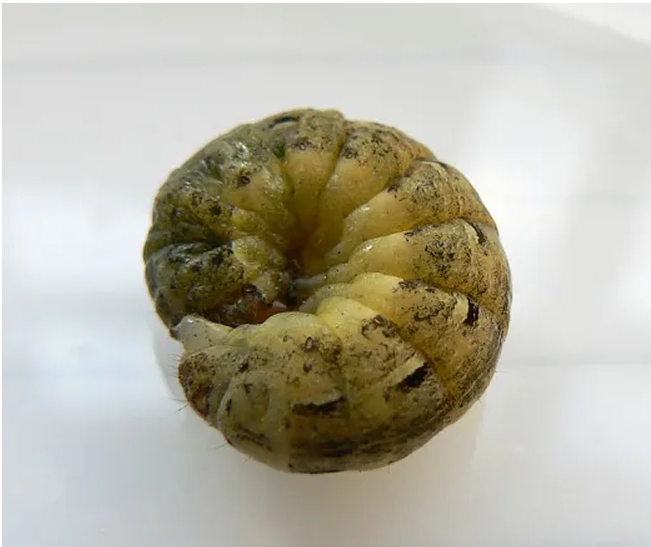
You just planted all those vegetable plants that you purchased at a local nursery or plant sale, and the next day, a number of them have been sliced off at ground level and killed. What happened? Cutworms are what happened.
What are Cutworms?

Cutworms are the larvae of dark winged moths. Despite their name, they are caterpillars, not worms. The moths lay their eggs either directly on the soil, on low growing plants or in plant or leaf debris in the fall. The eggs hatch before winter and the resulting larvae overwinter under the soil, waking up in the spring just in time to feast on your lovingly planted vegetable plants. Some moths lay eggs in the early spring, just in time to launch a new generation of larvae to wreak havoc in your garden.
The caterpillars are one to two inches long depending on the adult moth species. Their body color can be brown, gray, yellow or green. All of them have either longitudinal stripes or spots on their bodies. They can be active in the summer, but most are active in the spring. They feed at night and hide in plant debris or under the soil during the day to avoid predators. They destroy your plants by wrapping themselves around the stems and chewing through them, essentially cutting them in half.
Here are some organic solutions to cutworm problems.
Leave a Bare Perimeter
Leave a 3 to 4 foot strip of soil with nothing planted in it around the perimeter of your garden. The moths will not lay their eggs on the bare soil nor will cutworms cross the bare soil to get to your garden.
Mow the grass surrounding your garden very short to discourage egg-laying moths. Additionally, short grass does not provide adequate cover from predators during the day for the cutworms as well as providing them with very little to eat.
Till Your Garden
Tilling your garden before planting will kill all of the larvae that are overwintering in the soil before they have a chance to destroy your plants. If you do not till your soil, at the first sign of cutworm damage, manually dig the soil surrounding the affected plants to 2 inches deep. This should expose the caterpillars so that you can kill them.
Use Diatomaceous Earth or Crushed Eggshells
Surround your plants with diatomaceous earth (the fossilized remains of diatoms) or crushed eggshells. Both have sharp edges which will slice up the soft underbellies of the caterpillars as they cross them to get at your plants. I prefer eggshells because they are cheap, readily available and decompose into the soil, providing needed calcium.

Use a Collar as a Barrier
Cutworms feed by wrapping themselves around the stems of plants. You can prevent this by using “collars” around your plants. When you plant, place a piece of PVC pipe, a ring of aluminum foil, half a toilet paper tube or a ring of folded newspaper around each plant. The collars should be 2 to 3 inches tall. Press them into the soil so that the caterpillars cannot reach your plants from either under the soil or over the top of the ring if they hide in plant debris. The caterpillars will not be able to wrap themselves around the collar nor will they be able to get at your plants. Cardboard and newsprint are biodegradable and can be left in your garden. PVC pipe and aluminum foil should be removed when you remove the plants in the fall.
Manually Pick the Cutworms
You can visit your garden in the evening and manually pick the caterpillars from your plants. Wear gloves if you do not want to touch the caterpillars. You can also use a trap crop to attract them.
A trap crop are plants that are favorite foods of pests such as cutworms. Trap crops are planted to lure pests away from your valuable vegetable plants.
Sunflowers are an attractive addition to your garden and as a favored food, they are an excellent trap crop for cutworms. Plant them around the perimeter of your garden. Be sure to check your sunflowers daily for the caterpillars. If you leave them unattended, the larvae will destroy the sunflowers, then move on to your vegetables. You must remain vigilant!
Use Beneficial Animals, Birds and Insects
The predators that the cutworms are hiding from include birds, firefly larvae, toads, moles and shrews.
You can create a bird-friendly yard by providing them with nesting areas and water. Install birdhouses or plant trees and shrubs to provide spots for birds to build their nests and raise their young. Put out a birdbath and keep it filled to provide drinking water and a spot to bathe. Be sure to clean your birdbath regularly so that it doesn’t develop algae.
Toads are also easy to attract. Instead of throwing out your broken flower pots, put a few in your garden for toads to use as shelter. Toads also need a source of water, either a small pond or by sinking the dish from a large birdbath into the ground.
An infestation of cutworms can destroy a garden very quickly. You can get rid of them by tilling, with barriers, handpicking or inviting their predators into your garden.
Leave a Reply