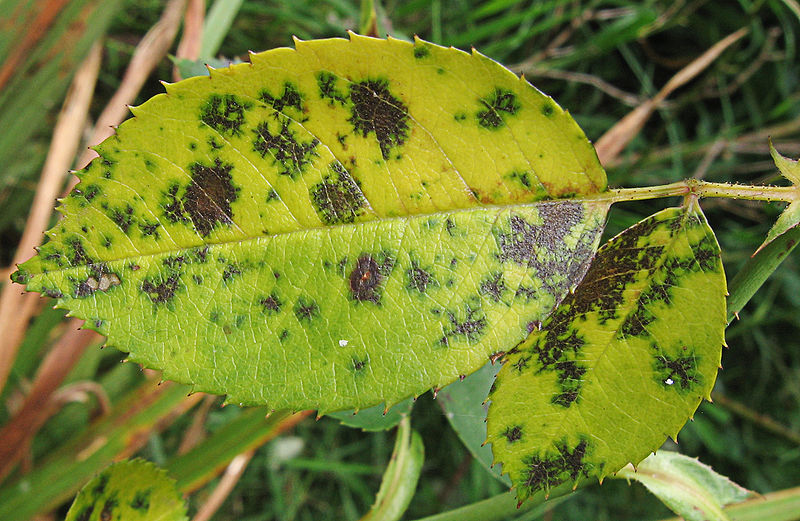
My favorite roses are heirloom roses. I love their myriad flower shapes and fragrances. I don’t love the fact that they are susceptible to black spot and drop their leaves every year. Ridding my roses of black spot has become my mission in life.
What is Black Spot?

Black spot is a fungal disease that affects roses. It thrives in a warm, wet environment. The spores are spread by rain or by watering your bushes. The water splashes from the soil on to the leaves spreading the spores upwards. The spores are most active at 75⁰F but they can live in temperatures between 65⁰F and 85⁰F. Temperatures above 85⁰F will stop the spread of the fungus.
The first signs are black spots that are about half an inch in diameter on the leaves of your roses. The edges of the spots are feathery or ragged and surrounded by a circle of yellow. The spots will grow larger until they cover the entire leaf’s surface at which point the leaf dies and falls to the ground.

Because the fungus is spread when the spores are splashed on to the foliage, the disease appears on the lower leaves first, gradually spreading upwards to infect the entire shrub. Even the stems can become infected. Although black spot will not kill your roses by itself, left unchecked it will weaken the bushes making them susceptible to other diseases which will kill them.
Fungicides and sulphur can kill the spores but before you bring out the chemicals, try these organic methods first.
Space Your Roses Correctly
Air circulation is important. The spores thrive in the hot, humid environment that is often created by overcrowding so don’t crowd your roses. Plant them with plenty of space between them. If one of them becomes infected with black spot, it will not be able to infect its neighbors.
Prune Your Roses
Promote air circulation in individual bushes by pruning out any old canes, weak canes, canes that cross or if the canes are too crowded. Pruning is best done in late winter.
Water Close to the Roots

Keeping in mind that the spores are spread by soil splashing on the leaves, never water from overhead. Always water at the roots. A watering wand is very helpful in getting down close the soil line. Drip irrigation is another good technique to minimize splashing while watering. A thick layer of mulch will help retain moisture so that you don’t need to water as often. Make sure that the mulch doesn’t touch the canes.
Remove Infected Leaves
Remove any infected leaves immediately so that the spores can’t spread to the rest of the bush. If the canes of the rose have become infected, prune them out cutting 6 to 8 inches below the infection. Do this on a day that is not rainy or that you won’t be watering. Be sure to sanitize your pruners afterwards so that you don’t spread the spores to other roses. Use rubbing alcohol or a 10% bleach solution.
Remove any leaves that have fallen to the ground. This is especially important in the fall. The spores will overwinter in the debris under your bush and be ready to infect your roses again the following spring.
Throw out the infected leaves and stems. Do not put them in your composter.
Use Neem Oil
Neem oil is derived from the seeds of the neem tree. You can buy neem oil at your local nursery. It coats the leaves preventing the spores from taking root. It also kills aphids. You will need to spray your roses with neem oil every one to two weeks during the growing season depending on how often it rains. Make sure you coat both the top and the undersides of all the leaves on your bushes.
Three Anti-Black Spot Sprays That You Can Make Yourself
- Baking Soda: mix 1 teaspoon of baking soda and 1 teaspoon of liquid soap in 1 quart of warm water. Spray your plants weekly with this mixture. The soap helps the mixture to adhere to the leaves and the baking soda kills the fungus. This will also help with powdery mildew.
- White Vinegar: use 1 tablespoon white vinegar, 1 tablespoon baking soda and 1 tablespoon horticultural oil mixed in 1 gallon of water. The vinegar and the baking soda kills the fungus and the oil helps the mixture to adhere to the leaves. You will need to spray this weekly.
- Milk: This DIY solution has also been reported as a deer repellent. Mix 1 part milk with 2 parts water and spray weekly. The lactoferrin in the milk acts as a natural fungicide. You need to use cow’s milk. Non-dairy milk such as soy milk or almond milk do not contain lactoferrin.
Black spot is the scourge of the rose garden. Keep the garden free of debris, be careful how you water and at the first signs of the disease, try neem oil or another homemade spray/com.
Leave a Reply