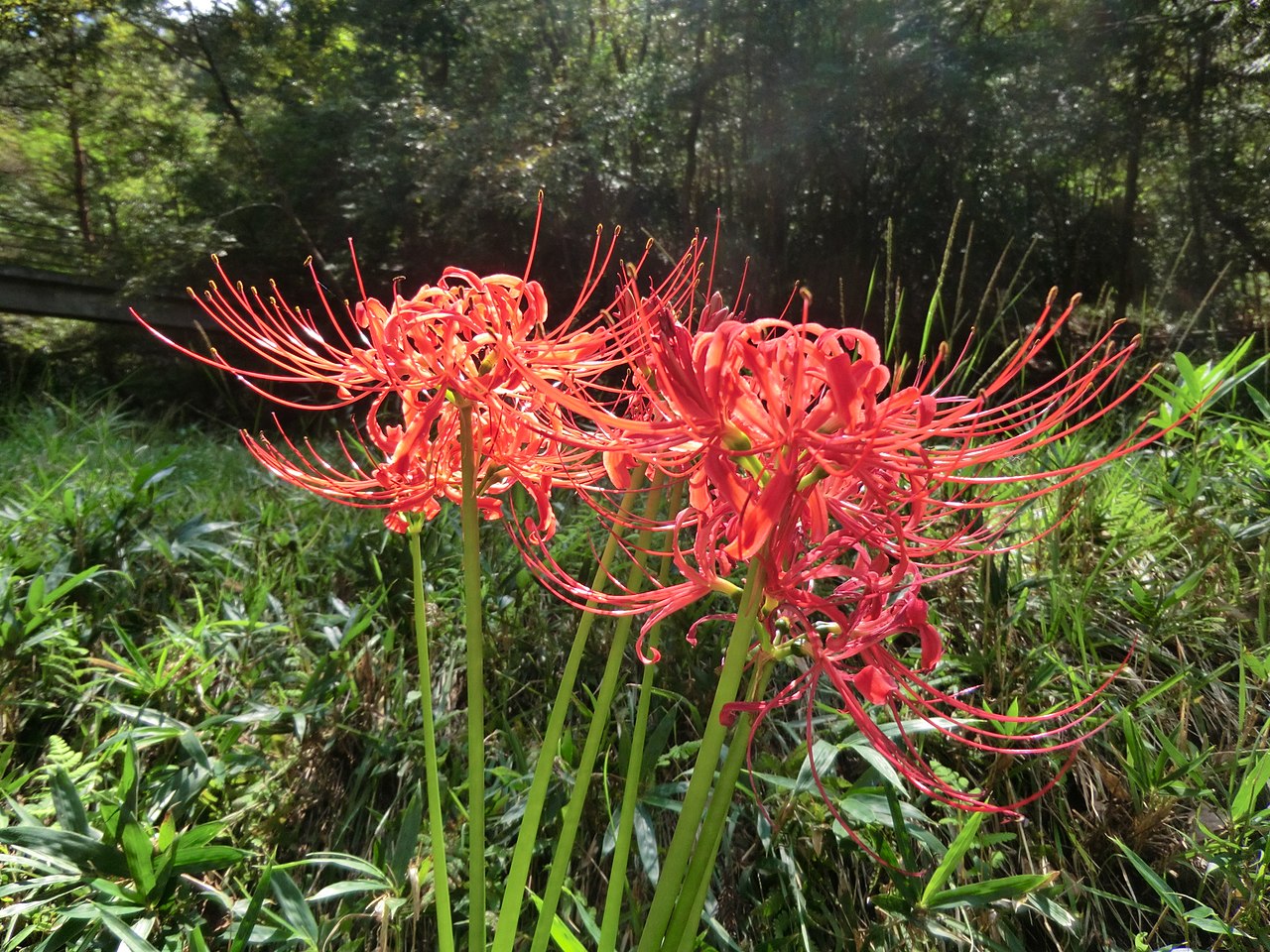
What are Red Spider Lilies?
Red spider lilies (Lycoris radiata) are flowering perennials that are related to
amaryllis. They are native to China, Korea and Nepal. They were introduced to Japan in 700 CE from China, it is thought along with rice. The bulbs of the red spider lily are poisonous so the Japanese plant it on the edges of rice paddies to keep predators away.
Here in the US, they are deer and rabbit proof because they are poisonous. The bulbs are also toxic for people. If ingested, they can cause nausea, vomiting and diarrhea.

Red spider lilies were introduced to the US in 1854 when Japan opened to the rest of the world. They have
become naturalized in the southeastern parts of the US where they have become known as the “Hurricane
Flower” because they bloom in late summer/early fall during the hurricane season.
Red spider lilies are hardy in zones 6 – 10. They are also known as Naked Lily because the flowers appear
before the leaves. After the plant is done blooming, it sends up its leaves in October. The leaves are 10
inches long and about ¼ inch wide. They are evergreen, remaining green through the fall and winter, only
dying the following spring.

The bulb goes dormant through the summer months.
The flowers emerge in the late summer or early fall. They bloom on stalks that are 1 to 2 feet tall. The flowers grow in umbels, which are clusters of small flowers that grow in a rounded shape. Their unique appearance gives them their name. The flowers are tubes with exceptionally long stamens which look like spider legs. The flowers start out red, then after a week, fade to pink for another week before dying.
Spider lilies are sterile. They don’t produce seeds. Instead, the reproduce vegetatively by bulb offsets.
How to Grow Red Spider Lilies
Red spider lily bulbs are planted in the fall. Leave the neck of the bulb above ground. If you bury the bulb
completely, it won’t bloom. Space your bulbs 9 inches apart.
Plant them in either full sun or partial shade. They need rich, well-drained soil with a pH of 6 – 7.5. Drainage
is important because you don’t want your bulbs to rot during the summer while they are dormant.
The bulbs do best in places with dry summers. It has a long taproot which can grow deep into the soil in
search of moisture. Once the bulb starts growing its flowers, you can start watering your plants. Keep the soil moist but not soaking wet. A thick layer of mulch will help keep the soil moist as well as suppress weeds that could compete with your plants for water and sunlight.
Fertilize your bulbs in the fall when the leaves have emerged. Use a 5-10-10 formula fertilizer every other
month until the foliage dies in the spring.
In zones 6 and 7, you will need to protect your bulbs from the harsh winter weather. Apply a thick layer of
mulch around the leaves and the bulb.
How to Divide Red Spider Lilies
If your bulbs aren’t blooming as well as in the past, it is time to divide them. Red spider lilies reproduce via
offsets which are small bulbs that are attached to the main bulb. That is why even though you planted single bulbs, your lilies eventually multiply and become a colony. Red spider lilies don’t like to be disturbed, so it is not necessary to divide them often.
Division should be done during the summer when the bulbs are dormant. Use a garden fork to carefully dig
them up. It is not necessary to dig very deeply. The bulbs are planted close to the surface of the soil with the neck exposed so they should be fairly easy to dig up.
Brush the soil off of the bulbs and examine them. You should see small bulbs growing around the base of the original bulbs that you planted. Gently break them off of the parent bulb. Only remove the ones that have roots. If an offset doesn’t have roots, leave it alone. It is getting its nutrients from the main bulb. Bulbs can’t grow without roots.
Replant both the original bulbs and the offsets 9 inches apart with the necks above the ground. Offsets may
not bloom for 1 to 2 years after they are planted. They will produce leaves in the fall but no flowers. That is
because they need to grow to full size before they will start blooming.
Leave a Reply