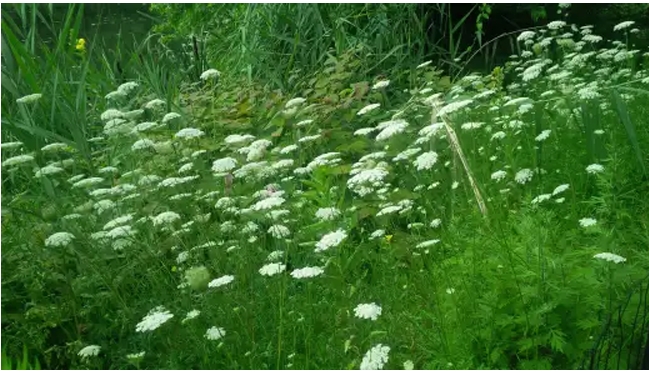
I have always loved Queen Anne’s Lace. As a child, I used to pick the flowers, hold them over my head and pretend that they were lacy parasols. Or I would uproot the plant and “serve” the carrot-smelling root at pretend “picnics.”
What is Queen Anne’s Lace?
Queen Anne’s Lace (Daucus carota) is a beloved wildflower, but it is not native to North America. Its homeland is the temperate zones of Europe and Southwest Asia. European colonists brought it to our shores, as well as to Australia. It has become naturalized on both continents.
Queen Anne’s Lace is named for one of the queens of England, but it is not known which Queen Anne. It could be, either Queen Anne of Great Britain (1665 – 1714) or her grandmother, Anne of Denmark (1574 – 1619) wife of King James I of Great Britain. The plants were named after one of the queens because the flowers resemble the lace worn by women of the time.
Other common names are wild carrot, bird’s nest, and bishop’s lace.
Queen Anne’s Lace is related to carrots, but is not the ancestor of the domesticated carrots that we eat as some sources claim. Garden carrots are actually a cultivar of a sub-species, Daucus carota subsp. Sativus. Queen Anne’s Lace roots are edible and taste of carrots, but they are much smaller and skinnier. The roots are usually consumed when they are young, during the first year of the plant’s life. After that, they become very woody and tasteless. The long taproot enables the plant to tolerate periods of dryness.
Poison Warning
You should always be very, very cautious about eating Queen Anne’s Lace. It looks very much like poison hemlock (Conium maculatum) which is so poisonous that it will kill you within minutes.
How to Grow Queen Anne’s Lace

Queen Anne’s Lace is a biennial which means that it lives for only two years. The first year, the plant develops a rosette of leaves. After dying to the ground in the winter, the plants send up leaves in the spring on stems that reach 1 to 2 feet in height. The plants flower in the late summer. The white lacy flowers are actually made of many tiny white flowers in an umbel shape. In the center you will see a single reddish or purple flower. In folklore, the center flower was said to represent a drop of blood resulting from the queen pricking her finger while making lace.

to help spread the seeds – Author Photo
After the flowers have been pollinated, they fold in on themselves to protect the developing seeds. Once the seeds are completely matured, the folded flowers dry out and detach from the plants to be blown around the landscape like tumbleweeds spreading the seeds. The seeds have bristly hairs on them which readily attach to the fur of passing animals which transport them to new areas. The seeds germinate all during the growing season.
Queen Anne’s Lace has been used medicinally in the past, but the danger from mistaking poison hemlock for this useful weed should discourage anyone from trying to use it for modern remedies.
You should also be cautious about handling Queen Anne’s Lace. Touching the plant or the leaves can cause photo sensitivity. Exposure to sunlight after handling the plant can result in burns and blisters. It’s a good idea to wear gloves while handling it.
How to Grow Queen Anne’s Lace From Seed
The easiest way to grow Queen Anne’s Lace from seed is to collect the seed heads from wild plants when they are brown and dry. Then simply sow the seeds, barely covering them with soil, where you want them to grow in your garden. You can sow the seeds in either the spring or the fall. Be aware that the seedlings will look like grass until they develop their true leaves. You should also be aware that since this is a wild plant, it can become invasive and take over your garden. To prevent it from doing so, deadhead the flowers before they produce seed. This will prevent the plants from sowing seeds all over your garden. This is a problem because the seeds germinate throughout the growing season rather than just in the spring or fall.
Leave a Reply