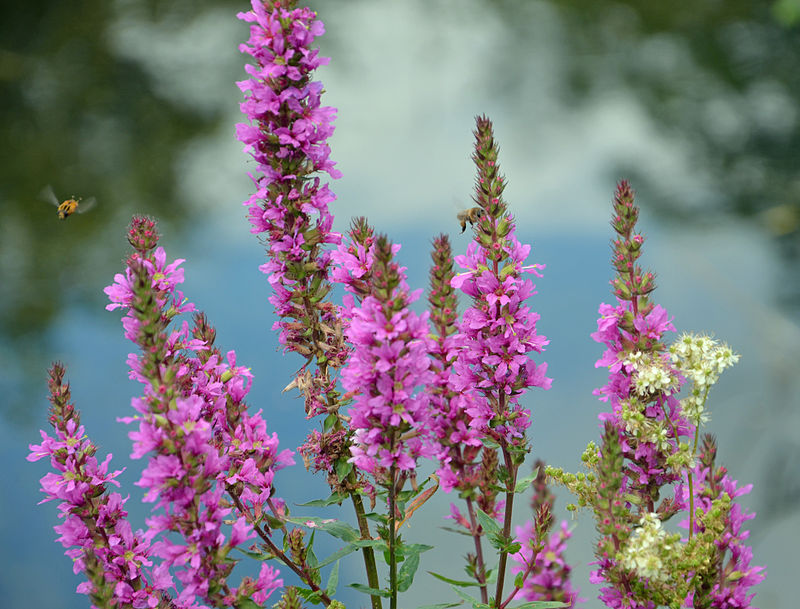
Why do I shudder whenever I pass that lovely purple wildflower growing along the roadside? Because it’s purple loosestrife, an invasive plant that destroys native habitats.
What is Purple Loosestrife?
Purple loosestrife (Lythrum salicaria) is a flowering plant that is native to Europe and Asia. It shouldn’t be confused with other plants whose common names are also loosestrife such as Fringed Loosestrife and Gooseneck Loosestrife, both members of the primrose family. Purple loosestrife is in the Lythracaea family which includes pomegranates and crepe myrtle trees.
The plants were introduced to North America in the early 1800s by European colonists who brought the plants with them for their flower and medicinal gardens. The seeds were probably also present in the soil that was used as ballast in the ships of that time.
Purple loosestrife has been used medicinally for centuries to treat diarrhea and dysentery. It is considered so safe that it has been used on infants. I do not recommend using this plant medicinally.

This pretty flowering perennial is also grown as an ornamental plant. Its native habitat is wetlands such as marshes, lakes, ponds and alongside streams and rivers. But it will grow fine in the dryer environment of a flower garden. Just be aware that it is invasive and will crowd out your other flowers. It will also escape your garden and start growing in wild areas, eventually crowding out the native plants.
Check your state regulations before adding it to your garden. In some states it is illegal to plant this invasive plant because once it takes hold, it is almost impossible to get rid of. Mail order nurseries will usually note that they are not allowed to ship to certain states.
Why is Purple Loosestrife and Invasive Plant?
Invasive species cause harm because they have no enemies to keep them in check in their new homes. In their original homes, there are predators that eat the plants and keep their population under control. Without those enemies in their new home, the invasive species grow wildly, displacing native species.
In the case of purple loosestrife, it grows by forming dense mats of roots and new shoots that choke out other plants. Soon there is nothing but purple loosestrife growing in an area. The native plants that the animals, birds and insects depend on for food and habitat are gone. The roots can also clog waterways impeding the flow of the water and robbing the aquatic life of food and shelter.
What Does Purple Loosestrife Look Like?

Purple loosestrife is easiest to identify when it is flowering. Bloom time is mid-summer, from the end of June through the beginning of August. The plants grow mainly in wet areas. Look for purple flowers growing on a spike similar to liatris. The spikes can be quite tall, up to 6 feet. The plants themselves are also tall, about 6 feet tall. The leaves grow in pairs opposite each other on the stems.
How to Get Rid of Purple Loosestrife
Pull it by Hand – If you can catch it when it is young, only 1 or 2 years old, the easiest way to get rid of this pest is by pulling it up by hand. It lives in wet soil, so it is not difficult to pull up. Just make sure that you get as much of the roots as possible. Any roots left behind will sprout new plants.
For older infestations, use a garden fork to pry up the root mass. Again, be sure to get as much of the root system as possible because any roots left behind will sprout new plants.
Don’t put this plant in your composter. Bag it up and put it out with the garbage.
Remove the Flowers – If you can’t dig it up, remove the flowers before they go to seed to slow the spread. Each mature plant can produce up to 2.7 million seeds each year. If you can prevent it from reseeding itself, the mats formed by the plants will not grow as large.
Don’t throw the flowers in your composter. Bag them up and put them out with the garbage.
If you throw either the plants or the flowers into your composter, you risk “infecting” your composter with purple loosestrife. Then, when you use the compost in your garden, you will be spreading this invasive plant all over your garden.
Leave a Reply