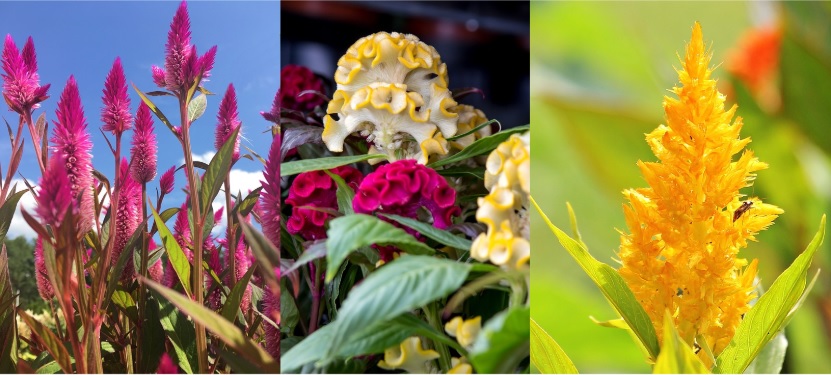
If you like to craft with dried flowers, you need to add celosia to your cutting garden. The flowers come in many bright colors, are easy to dry and retain their colors for months.
What is Celosia?
Celosia is an annual flower that is related to amaranth. Unlike amaranth, it is not edible. Celosia is native to North Africa. There are many species of celosia, but the most common one grown in our gardens is Celosia argentea. There are three sub-species that are popular:
C. spicata have flowers that resemble wheat.
C. plumosa flowers are bushy and look like flames.
C. cristata is my personal favorite. It is also called “cockscomb” because the flowers have
intricate folds that look like a cockscomb.
The plants flower in reds, yellows, oranges and purples. The vibrant flowers of all three sub-species retain their color when dried making them excellent choices for dried arrangements.


How to Grow Celosia
Celosia is hardy in zones 10 and 11 which are tropical. The rest of us grow them as annuals. Be sure to grow your plants where they will get full sun which means a minimum of 6 to 8 hours of sunlight every day. Morning only or afternoon only sun is not enough. They also need well-drained soil because they are subject to root rot. If your soil has a lot of clay in it, consider adding compost to it to provide nutrients and drainage. Raised beds are also a good option.
Spicata plants are tall and can grow up to 3 feet tall. The plumosa and cristatas are shorter and stockier, closer to 12 to 18 inches, making them excellent candidates for container plantings.
Water them well when you plant them, but afterwards as long as your area is not experiencing an unusual drought, you will not need to water your plants. They are drought tolerant. This is another reason why they make good container plants. Containers dry out faster than your garden. You don’t have to worry about keeping your container watered because of their drought tolerance.
The plants also don’t require fertilizer. You can add some time release fertilizer when you first plant them. Unless the plants are not doing well, it is not necessary to fertilize. If you do fertilize, use one specially formulated for flowering plants.
How to Grow Celosia From Seed
Celosia is easy to grow from seed. No matter which variety you are growing, you treat the seed the same way.
You can direct sow the seed, barely covering it, in your garden after your last frost. The seeds will begin to germinate within 1 to 2 weeks when the soil reaches 60⁰F. This is the preferred method because celosia does not transplant well. It doesn’t like having its roots disturbed.
If you want to start your seeds indoors, it is best to sow them in individual peat pots or other biodegradable pots that can be planted directly into the garden without having to disturb the seedlings’ roots. Sow the seeds 6 to 8 weeks before your last frost in the biodegradable containers and barely cover them. Use a heat mat to keep the soil at 70⁰F to 75⁰F. Germination should occur within 1 to 2 weeks.
Transplant your seedlings into your garden, peat pot and all, two weeks after your last frost.
How to Dry Celosia
Celosia flowers should be harvested for drying when they are fully open unlike most dried flowers which are harvested when they are only partially open. Celosia is harvested at the fully open stage so that they are at their most colorful.

dried flowers have been added to an orchid pot to provide both color and texture.
Harvest your flowers early in the morning after the dew dries. You want to harvest early before the sun has a chance to fade any of the color but at the same time you don’t want them wet from the dew. If they are wet when harvested, the flowers will get moldy rather than drying. Cut the stalks off at soil level or as close to the ground as you can get.
Remove all of the leaves. Tie the stems together in small bunches, no more than 6 to 10 stems per bunch.
Hang the bunches upside down somewhere that is warm, dry, has good air circulation and is dark. Sunlight will fade your flowers. Humidity will cause mold to form so avoid basements. Also avoid anywhere that there is not good air circulation to gently blow the mold spores off of your flowers. Attics are good if they have good air circulation. Sheds and garages can also be used if you hang your bunches well away from any windows.
Properly dried, celosia flowers will retain their colors for up to 6 months.
Leave a Reply