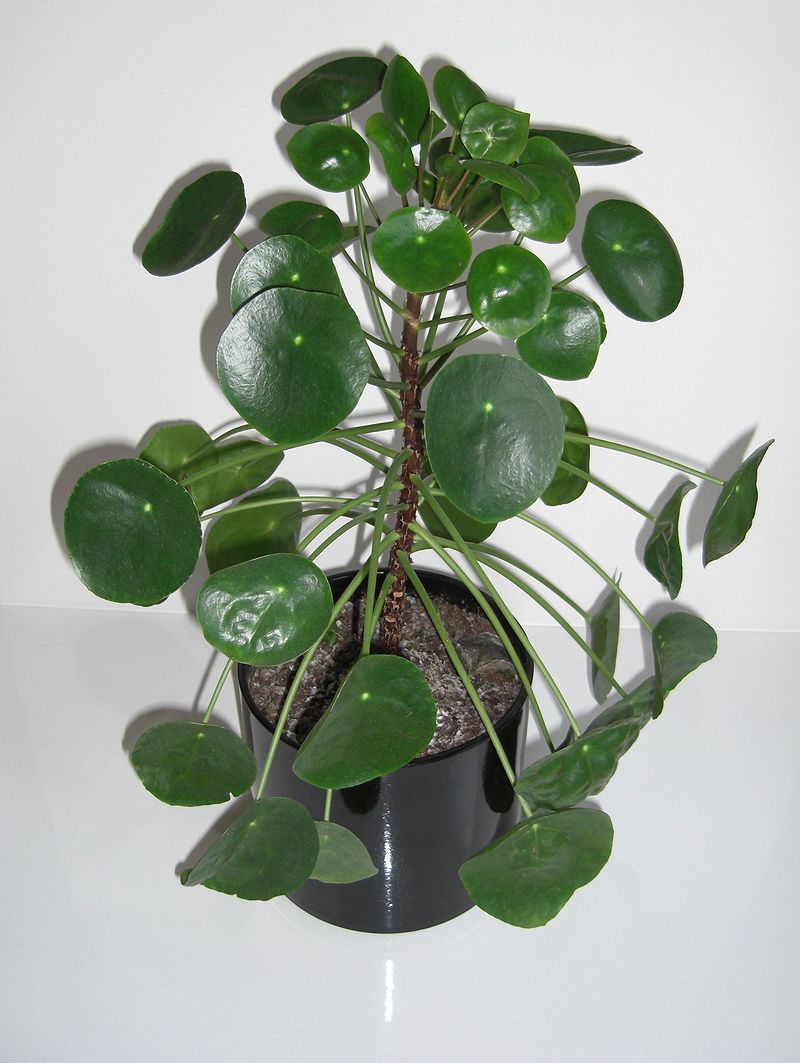
What is Chinese Money Plant?

Chinese money plant (Pilea peperomioides) is a flowering plant that is related to nettles. It is native to Southern China, specifically the Sichuan and Yunan provinces. It was “discovered” several times by Europeans. However, it was a Norwegian missionary who brought it to Norway in 1946 which set off the craze for this plant in Scandinavia where it is now commonly found. It is more difficult to obtain here in the US unless you have a friend who is willing to share an offset with you or you can order from an online source.
Chinese money plant is only hardy through zone 10 so most gardeners grow it as a houseplant. The plants are small, about 12 inches tall and 12 inches wide.
The plants get their name from their unique leaves which are dark green and round like coins. They are about 4 inches in diameter. They grow on long petioles. Petioles are the leaf stalks that attach to the stem. The petioles of the Chinese money plant can be up to a foot long giving it a distinctive appearance.
Chinese money plant rarely blooms when grown indoors as a houseplant. When it does bloom, the flowers are tiny, white in color and grow on pink stems.
How to Grow Chinese Money Plant
Chinese money plant prefers bright filtered sunlight. An east facing or west facing window where the plant will get about half day sun is preferred. Don’t put your plant directly in front of the window unless it is covered with a sheer curtain. If there is no curtain, place your plant further away from the window so that the sun is not shining directly on it.
Any well-drained potting soil will work for these plants. Drainage is important otherwise your plant will develop root rot and die. Make sure that the pot you put it in has a drainage hole in the bottom. Water every 7 to 10 days allowing the plant to dry out between waterings.
Humidity is also important to keep your plant thriving. Since our homes are too dry for them, you can either mist your plant daily or construct a humidity tray.
A humidity tray is a shallow tray that is filled with ornamental gravel and water. Place your plant on top of the gravel, not in it. The water will evaporate surrounding your plant with humidity. Check your humidity tray regularly to keep it full of water. If all of the water evaporates and is not replaced, no humidity will be produced.
You will need to fertilize your plant monthly during the growing seasons, spring and summer. You can use a standard all-purpose houseplant fertilizer. There is no need to fertilize your plant during the fall and winter when it will be resting.
How to Grow Chinese Money Plant From an Offset
Since we grow Chinese money plant as a houseplant, when it blooms there are no insects to pollinate the flowers to produce seeds. Propagation for these plants is done via offsets.
Chinese money plant regularly produces offsets which are brand new plants that grow from shoots that grow laterally from the parent plant. They are called clones because they are genetically identical to the parent plant.

To create a new plant, take a sharp knife and carefully cut the offset from the parent plant and then repot it into its own pot. It is best to choose an offset that has its own leaves and roots which ensures that the new plant will have the best chance of surviving after being cut from the parent plant.
If the offset that you cut has few or no roots, you can root it directly in soil. Just push the part that was under the soil in the original pot into the soil of the new pot and keep the soil moist. When you see new leaves growing, you will know that new roots are also growing because a plant with no roots cannot grow new leaves.
It’s not a good idea to root plants in water. The roots that grow are very weak because they haven’t had to push against soil which strengthens them. When you root in water and then try to plant your cutting or offset, those weak roots very often break and there’s a good chance that your new plant will die. Always root directly in the soil for strong roots and no need to transplant which can also stress the plant.
Leave a Reply