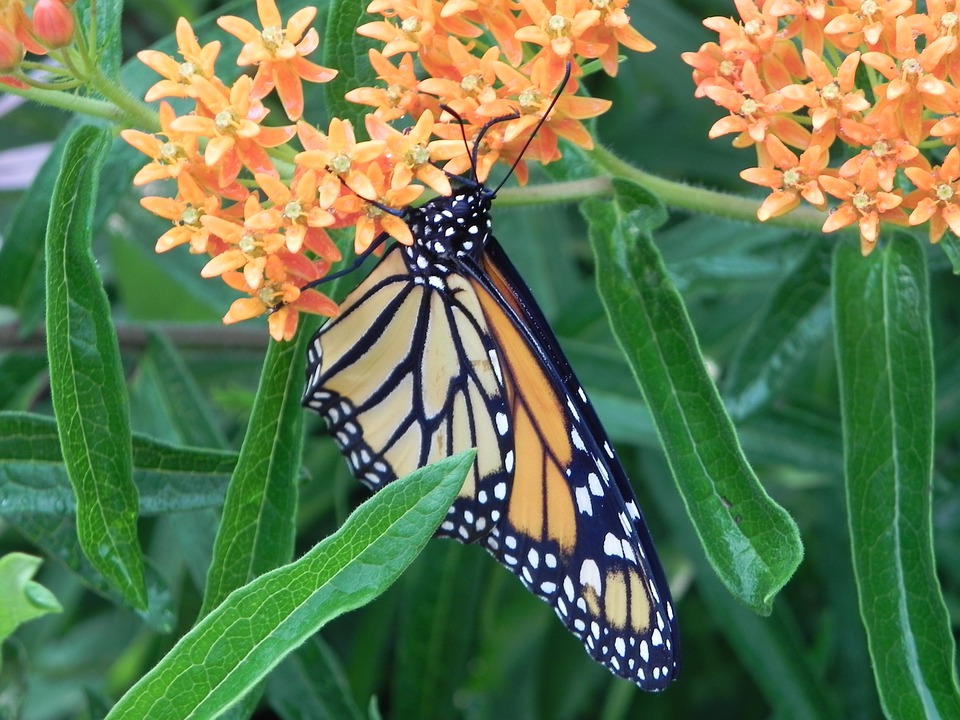
It’s no secret that monarch butterflies are in serious danger. Their population has plummeted by 90% in the past decade. There are many reasons for this, but the two most important ones are the overuse of pesticides and edge to edge plowing. Edge to edge plowing is a technique used by farmers to maximize the yield in their fields. They used to leave strips of plants composed of weeds and wildflowers, including milkweed, along roadsides and between fields, but those have almost all disappeared as farmers now till all of the available land. This has almost eliminated milkweed throughout most of the US.
The reason that milkweed is so critical for monarch butterflies is because it is the only plant on which both the adults and the caterpillars feed. Fortunately, milkweed can be grown in our yards and gardens so we can help in the survival of monarch butterflies. If you plant it, they will come.

What is Milkweed?
Milkweed (Asclepias spp.) is a family of perennial flowering plants that are native to Africa and North and South America. They are called milkweed because the plants contain latex, a milky white fluid. The fluid is also poisonous. Some insects such as monarch butterflies have evolved a resistance to the poison and can safely consume the plants. After eating the plants, the insects themselves become poisonous so predators avoid them. This has led to mimicry in other butterflies which do not consume milkweed. They have evolved to look like monarchs, both the butterflies and the caterpillars, in an effort to trick predators into thinking that they are also poisonous and shouldn’t be eaten.
Milkweed seedpods contain silky fibers that act as parachutes for the seeds. These fibers have other uses as well. They are an effective insulation, have been used to help clean up oil spills and can be made into strong ropes.


How to Choose the Right Milkweed For Your Garden
There are many different species of milkweed across North America. Each one has evolved to grow in a specific climate. Monarchs migrate through different parts of the US and have developed a tolerance to specific milkweed species in those areas. When planning your garden, be sure to select a milkweed species that is native to your area. If you try to grow a species that is not native to your area, it will not grow as well and monarchs will not be as attracted to it. You can check with your local Master Gardeners or agricultural extension office for a list of native milkweed species for your area and climate.
How to Grow Milkweed
Because it is a native plant, provided you plant the right species, milkweed is easy to grow. It requires full sun. It is not picky about soil. It doesn’t need to be fertilized. And once the plants are established, they do not need to be watered. They will survive just fine with the local rainfall. The plants are poisonous, so you don’t have worry about pests. Except if you live in the Northeast like I do, and try to grow A. incarnata, the swamp milkweed. I fell for its lovely pink flowers and planted it. Unfortunately, it is prone to attract and then succumb to aphids. It is the only milkweed that I am aware of that is troubled by insect pests. Milkweeds are also deer resistant because they are poisonous.
Bloomtime for the plants is early summer. When the flowers fade, the characteristic seedpods filled with rows of seeds attached to silky parachutes form. Remove those pods! Milkweed is an aggressive self-seeder. If you allow the pods to mature and release their seeds, you will find your garden overrun with milkweed plants the following year. And beyond – it’s been a few years since the disaster with the swamp milkweed, but every spring seedlings still pop up in my garden because I didn’t remove all of the pods.


How to Grow Milkweed From Seed
Milkweed is easy to grow from seed. You don’t even need to buy seed. The seed is simple to harvest from the ripe pods. The pods open when the seeds are ready to go so you can just reach in and take as many as you need.
If you live in a climate with a warmer winter, you can plant your seeds in either the spring or the fall. Those of us with cold winters need to either sow our seeds in the fall or cold stratify them for spring planting. Milkweed releases its seeds at the end of the summer. They blow away on the wind thanks to their silky parachutes. Wherever they land, they wait until the following spring to germinate. It’s the cold winter weather and then the warming spring temperatures that tell the seeds it’s time to sprout. The reason the seeds do that is if they germinated in the fall, the resulting seedlings would not survive the winter. So they wait until spring so that the seedlings will have the entire growing season to grow and mature.
If you live in the north and want to sow your seeds in the spring, you will need to fool them into thinking that winter has come and gone. You do this by planting your seeds ¼ inch deep in a container with pre-moistened soil. Place a plastic bag over the container and put the whole thing in your refrigerator for 4 to 6 weeks or about a month. The plastic bag prevents the soil from drying out in your refrigerator but it is still a good idea to check it weekly and add more water if it feels dry.
After you remove the container from the refrigerator, leave the plastic bag over it to keep it humid and place it in a sunny window or under lights. The seeds should germinate in 10 to 14 days. You can plant your seedlings in your garden after the last frost when they are at least 3 inches tall. Plant them 18 inches apart.
Leave a Reply