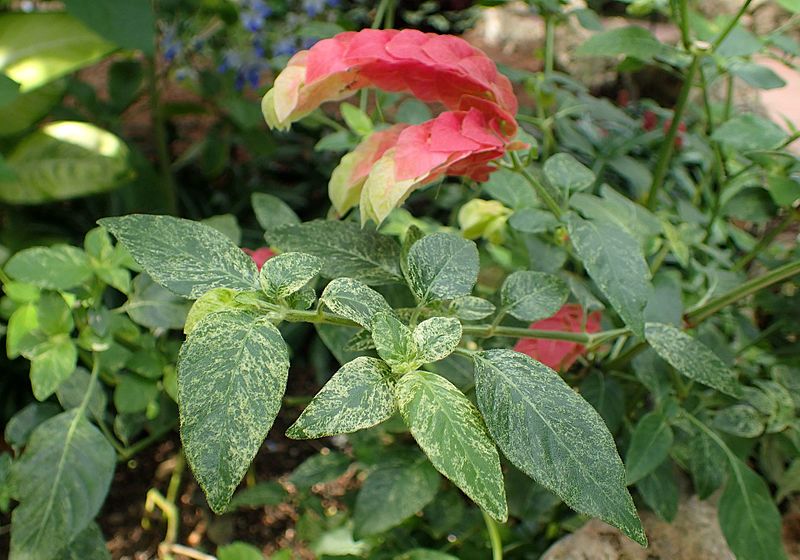
My house looks like a jungle. It’s chock full of houseplants. Most of them are variations of green and rarely flower so I value any that do produce flowers and add color to my home. I also enjoy unusual flower forms. The shrimp plant fills the bill nicely.
What are Shrimp Plants?

Shrimp plants (Justicia brandegeeana) are shrubs that are native to Mexico. They are a popular landscape plant in the southern US and have escaped cultivation to naturalize in Florida. They are hardy in zones 10 – 12. In zones 8 and 9, the plants die to the ground in the winter, growing again in the spring. In their native environment, they are understory plants. That means that they grow under larger plants which offer semi-shade. Their tolerance for shade makes them perfect as houseplants for those of us who live outside of tropical areas.

The shrubs grow to about 3 feet tall and 3 feet around. In their Mexican home, they can reach 5 feet in height. It’s a good idea to keep your shrub pruned because the stems are brittle and weak. They will fall over and break off if allowed to grow too tall.
Shrimp plant got its name because of its pink flowers that look like cooked shrimp. Actually the “shrimps” are bracts. The flowers are white with purple markings and grow out of the ends of the bracts. The bracts are white when they first start to grow. As they “age” and are exposed to the sun, they turn the familiar pink. They also continue to grow longer, sometimes reaching a length of 12 inches. Eventually, the bracts fall off of the plants. Shrimp plants attract both hummingbirds and butterflies. Pollination is by hummingbirds which have a long proboscis that can reach deep inside the flowers growing out of the bracts.
How to Grow Shrimp Plants Outdoors
Gardeners who are fortunate enough to live in warmer climates can grow shrimp plants outdoors year round. In zones 10 through 12, the shrubs are green and bloom all year. In zones 8 and 9, the shrubs die to the ground in the fall. The roots can survive the winter and push up new growth in the spring.

Choose a spot in your yard that offers semi-shade which mimics the shrubs’ natural environment. Be sure to provide plenty of water. These plants do not tolerate being dry. Fertilize regularly with a balanced fertilizer. Shrimp plants are heavy feeders. They needs lots of nutrients to both grow and to produce their spectacular bracts.
Keep your shrub pruned to 3 feet tall or less. If they are allowed to grow to their full height, their brittle branches will fall over and break. A hard pruning in the spring is recommended. A “hard pruning” means cutting a plant down to about 12 inches.
How to Grow Shrimp Plants Indoors
Most of us grow our shrimp plants indoors as houseplants. They grow well in our homes because they prefer a semi shady environment. That translates to what appears to us as a sunny room, but to plants as light shade.

Be sure to water your plant regularly. They do not like to be dry. If your plant starts to drop its leaves, it’s telling you that it’s not getting enough water.
Shrimp plants are heavy feeders so they need to be fertilized weekly with a fertilizer formulated for flowering houseplants. That may seem excessive, but remember that nutrients in the soil are leached out each time that you water a plant growing in a pot. These nutrients need to be replaced.
Keep your plant pruned to prevent the brittle stems from breaking off. A hard pruning in the spring is recommended. You can move your plant outdoors in the spring when night time temperatures are above 55⁰F. You will need to bring them back indoors in the fall when night time temperatures fall to 55⁰F.
Shrimp plants grown as houseplants should be repotted regularly. Repot your plant every two years if it is grown totally indoors or every year if it spends the summer outdoors where it will grow faster.
How to Grow Shrimp Plants From Cuttings
Shrimp plants are propagated by stem cuttings. Stem cuttings are made from the stems or branches of a plant. To take a stem cutting of a shrimp plant, choose a young, actively growing stem and cut off 4 to 6 inches. Remove the leaves from the bottom 2 inches of your cutting. Dip the cut end into rooting hormone. Rooting hormone helps speed up the growth of new roots. If you don’t have rooting hormone, your cutting will take longer to form new roots.
Gently push your cutting 2 inches into a pot filled with moist soil. Cover the cutting and the pot with a plastic bag to create a humid environment. Place in a sunny window. Keep the soil moist, but not soggy. You will know that your cutting has new roots when it starts growing new leaves. Plants without roots cannot grow new leaves.
Leave a Reply