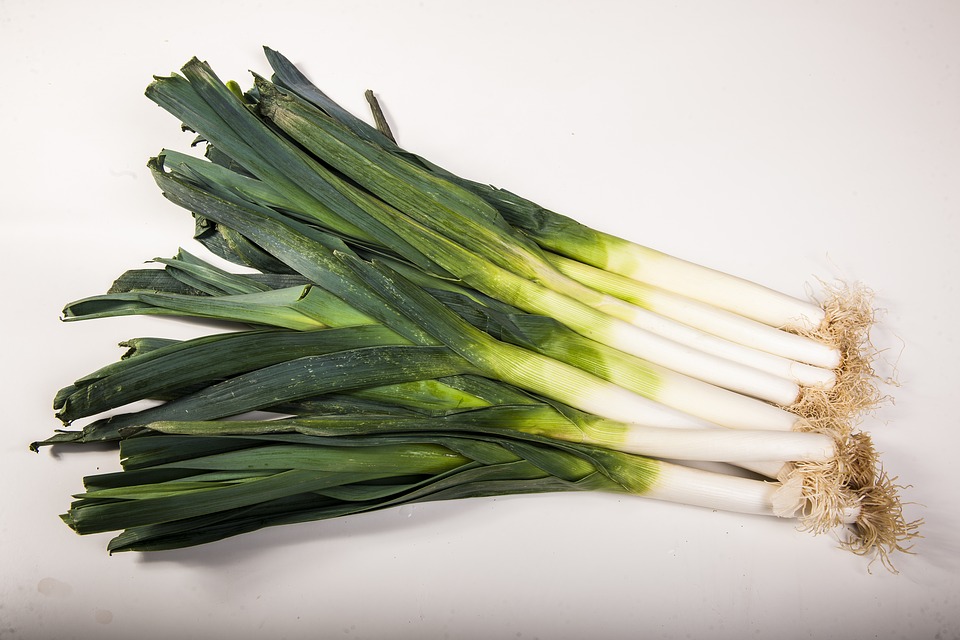
One of my favorite soups is potato leek soup. I love the subtle onion taste of the leeks. Leeks can be expensive to buy in the grocery store. Fortunately, they are easy to grow.
What are Leeks?

Leeks (Allium ampeloprasum) are an ancient vegetable that was enjoyed by the Egyptians and Mesopotamians. They are also mentioned in the Bible. Originating in the Mediterranean, they were later spread throughout Europe and Britain by the conquering Romans.
Leeks are in the same family as onions (A. cepa) but have a milder flavor and do not form bulbs. Rather, the leaves grow tightly together at the base which is usually blanched while growing. Most people use only the white part, but the green leaves, which are tough, can be used for flavoring sauces or as part of a bouquet garni.
Should I Buy Starts or Seeds?
Most gardeners prefer to grow their leeks from seed. There are a number of leek varieties, including heirlooms, that are more readily available as seeds than as starts. Most nurseries don’t carry leek starts and the ones that do carry starts just carry modern hybrid varieties.
How to Grow Leeks From Seed
Leeks have a long growing season, 120 to 150 days so most gardeners start their seeds indoors. Some modern hybrids have shorter growing seasons of 90 days so it is possible to direct sow those seeds in your garden.
Northern gardeners with a shorter growing season start their seeds indoors 8 to 12 weeks before their last spring frost. Southern gardeners have a longer growing season so they start their seeds 3 to 4 weeks before their last frost.
Sow your seeds 1/2 inch deep. Germination should occur in 5 to 7 days. You can plant your seedlings into your garden after your last spring frost and when the temperatures stay consistently above 40 degrees Farenheit.
How to Blanche Leeks

Leeks grow mainly above ground with very shallow roots. Left alone, they will be all green because the entire above ground part of the plant is leaves. To get the desirable white bottoms, you have to blanche them as they grow. Blanching means denying the bottom part of the leeks sunlight. The parts of the plant that are kept out of the sunlight never develop the chlorophyll which gives plants their green color. The blanched part will stay white and softer than the leaves which are exposed to light which causes them to become tough.

There are three methods commonly used to blanche leeks. The first method is to plant them shallowly in the soil and then mound the soil around them as they grow as you do with your potatoes. This is called “hilling”. The second method is to plant your leeks in a pre-dug trench and add soil to the trench as the plants grow, another way to hill them. The third method is to use the cardboard tube from a toilet paper roll or paper towel roll (you will need to cut it down a bit). Slip the tube over your leeks when you plant them. The tube will block the sunlight from the bottom portion of the plants.
How to Grow Leeks
Leeks prefer a slightly acidic soil with a pH of 6.0 – 6.8. They will also do well in the more alkaline soils found in most vegetable gardens. If you are going to grow your leeks in a trench, you will need to dig the trench 4 to 6 inches deep. Plant your seedlings 6 inches apart in your pre-dug trench, just barely covering the roots and then gradually fill in the trench throughout the season as the leeks grow to blanche them.
If you prefer to hill your leeks, make sure that you have soil available throughout the season to cover the plant bases as they grow. Plant your seedlings at ground level, 6 inches apart with their roots barely covered with soil. Then throughout the growing season, you can either mound soil around the bases of your plants to blanch them or when your plants are about 8 inches tall, you can lean two boards against them to create a V-shape that will shade and blanche the bases.
To use the cardboard tube method, plant your seedlings 6 inches apart with their roots barely covered with soil and then lower the cardboard tube over the plant, burying it slightly in the soil for support. The leek will grow inside the tube which will block the sun from the base, blanching it.
Leeks do not like to compete against weeds so you will need to keep them well-weeded. Be careful when weeding because leeks have very shallow roots. Rather than pull them out, cut the weeds down to soil level so that you don’t disturb your leeks’ shallow roots. Make sure your plants get at least 1 inch of water per week. A thick layer of organic mulch will keep the soil moist between waterings. It is recommended that you side-dress your plants with composted manure midway through the growing season.
How to Harvest Leeks
There are two types of leeks. So-called summer leeks are harvested the same year that they are planted. Hardier varieties are left in the ground over the winter and harvested the following spring. Over-wintered leeks are larger and stronger tasting than summer leeks.
Unlike their onion cousins, leek foliage does not die back indicating that they are ready for harvest. Rather, leeks are harvested when their bases are 1 inch in diameter for summer leeks or 3 inches in diameter for spring harvested leeks. The plants can be dug up or you can simply grab the leaves, twist and then pull the entire plant from the ground.
How to Store Leeks
After harvest, gently wipe the soil from your leeks but don’t wash them if you aren’t using them right away. You can store them in your refrigerator, wrapped in plastic to keep them from drying out, for 1 to 2 weeks. If you plan to freeze them, blanche them first by boiling them in water for 2 to 3 minutes. They can be frozen for up to 3 months. Be warned though. After you defrost them, they will have lost their nice firm texture and some of their taste.
Cooked leeks will only keep in your refrigerator for 1 or 2 days. It’s best to use them up right away.
Leave a Reply