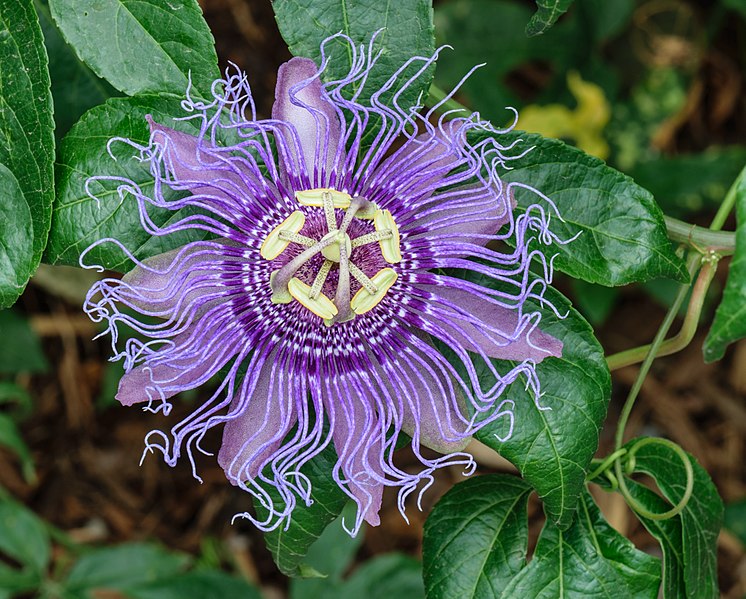
What are Passion Flowers?

The name passion flower (Passiflora spp.) is associated with an entire genus of plants. They are mainly vines. A few are trees or shrubs. Most are native to Mexico, and Central and South America though other members of the genus are found throughout the world. The plants are known both for their distinctive flowers and their fruit.

The passion in the name refers to the crucifixion of Jesus. The association was made by Spanish Christian
missionaries. Different parts of the plant and flowers were assigned meanings to the story of the crucifixion. For instance, the most well-known is that the flowers’ radial filaments represent the crown of thorns that Jesus was forced to wear.
The passion fruit is the fruit of the passion flower. It is popular both for eating raw and for cooking. The size and flavor of the fruit depends on the species of passion flower that produced it.
What is Maypop?

Maypop is the common name given to the passion flower species that is native to North America, P. incarnata, specifically the Southeastern US. It is hardy in zones 5- 8 and can withstand winter temperatures of -4⁰F. It is a vine that grows to 8 feet. The flowers are violet.
Maypop was used as a medicinal plant by the Native Americans. They passed on their knowledge of the plant to the European colonists. The leaves were used fresh or dried to make a tea with sedative properties. There is no medical evidence to support this.
How to Grow Passion Flowers
Most passion flowers are tropical plants. Outside of tropical areas they are grown in containers and brought indoors during the winter.

They will grow in full sun to partial shade. In tropical areas, it is best to plant them in a spot where they will get afternoon shade to protect them from scorching afternoon temperatures. They prefer rich, well-drained soil with a pH of 6.1 to 7.5. They also need to be watered regularly, 1 to 1 ½ inches per week.
Passion flowers are heavy feeders. Plan on fertilizing them every 4 to 6 weeks with a balanced fertilizer such as 10-10-10.
How to Grow Passion Flowers in a Container
Thankfully for us northern gardeners who love passion flowers, they grow well in containers so that we can bring them indoors during the winter. Use rich potting soil, water frequently (containers dry out quickly) and fertilize often using the same balanced 10-10-10 fertilizer. You will need to fertilize weekly because the constant watering needed to maintain your plant in its container also washes away nutrients in the soil very quickly.
Plan on bringing your plant indoors in the fall when night time temperatures fall below 50⁰F. You can overwinter it in one of two ways.
Dormant
A lot of gardeners prefer to allow their plants to go dormant during the winter indoors because they require little care. Store your plant in a cool, dark place such as your basement. It will drop its leaves. This is normal. Water it about once a month. You want to keep the roots moist so that they don’t die. In the spring when night time temperatures are above 50⁰F, you can bring your plant back outdoors and it will start growing again.
As a Houseplant
Alternatively, you can bring your plant indoors and grow it like your houseplants. Since passion flowers need full sun outdoors, you will want to place your plant in the sunniest window in your home. A south-facing window is best. Water regularly to keep it moist as you did when it was outdoors. Our homes are too dry for these plants so you will need to provide humidity for them either by misting them regularly or by creating a humidity tray.
A humidity tray is a shallow pan that you fill with ornamental gravel (not the gravel form your driveway!) and then fill with water. Place your plant on top of the gravel. As the water evaporates, it creates a humid environment for your plant. Be sure to keep refilling the tray to provide constant evaporation.
You can bring your plant outdoors in the spring when night time temperatures are above 50⁰F.
How to Prune Passion Flowers
Passion flowers should be pruned in the early spring. They bloom on new wood which means that the flower buds are formed on the new growth in the current year. If you wait too long to prune, you will risk pruning away the developing buds and end up with few flowers or none at all. While you are pruning, be sure to also get rid of any dead branches.
Passion flowers that die to the ground in the fall do not require any pruning in the spring.
How to Propagate Passion Flowers From Leaf Cuttings
You can propagate your passion flower from cuttings using leaves. Choose a healthy leaf on your vine. Carefully remove the leaf from the vine. Do not detach it from its stem. Do not detach the stem from the vine. Instead cut a small slice from the vine that includes the bud from which the leaf and stem grew.
Plant your cutting in a container deep enough so that only the leaf shows above the soil. Place the container in a sunny window and keep the soil moist. When new growth appears, you will know that your cutting has rooted.
How to Grow Passion Flower From Seed
Passion flower seeds can be started any time. They have hard seed coats, so you will need to soak the seeds 1 to 2 days to soften them. After soaking them, surface sow them in a container of pre-moistened soil. I have found that if I water after I sow my seeds, both the soil and the seeds wash away. Do not cover the seeds. They need light to germinate. Cover the container with a plastic bag to create a humid environment. You can also place your container on a heat mat to warm the soil and hasten germination.
Be patient. It will take a few weeks or a few months for the seeds to germinate. Keep the seedlings out of direct sunlight until they have their first true leaves.
Leave a Reply