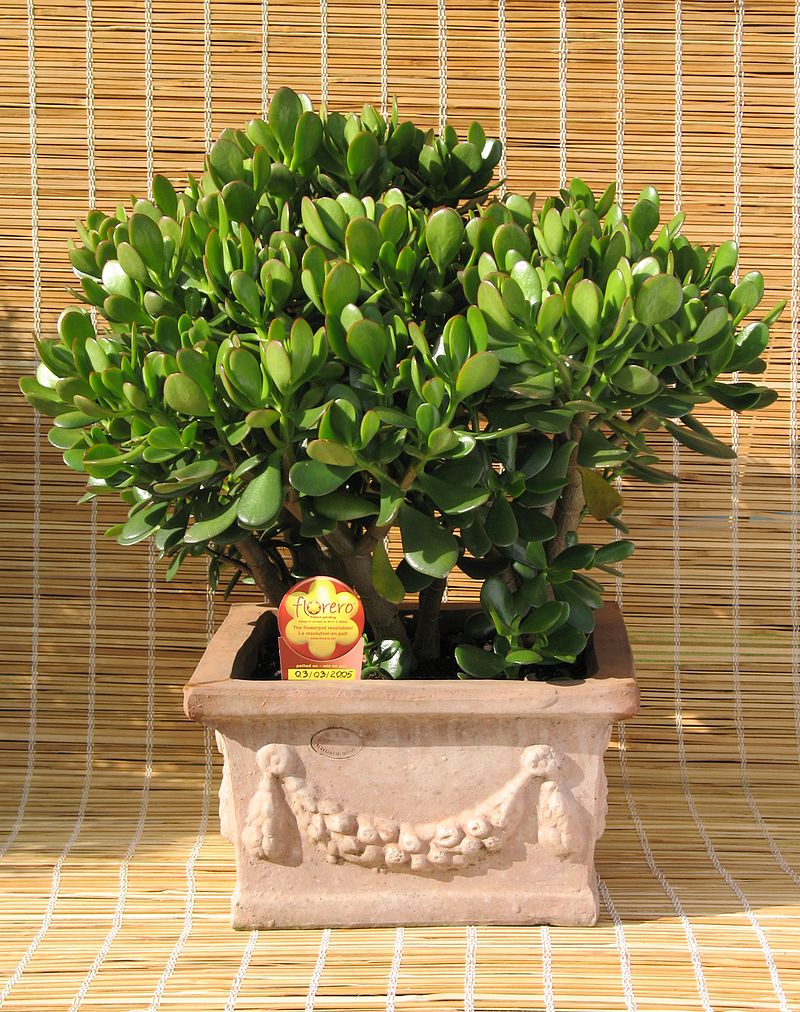
What are Jade Plants?
Jade plants (Crassula ovata) look like trees, but they are actually succulents. Their brown “trunks” are fleshy stems, and, like most succulents, they are native to South Africa. They can reach a height of 8 to 9 feet tall in the wild. When grown as a houseplant, they usually grow to 3 feet, although with time and care, they will sometimes grow to 5 feet.
Folklore Associated With Jade Plants
Jade plants have been called by many names. They were called money plant or lucky plant because it was thought that they brought prosperity and good luck. Because of their reputation as bringers of prosperity, they were frequently given as housewarming gifts earning them the nickname of friendship tree.
Varieties of Jade Plants
I grow three different varieties of jade plants.
- The plants you see most often offered for sale with the flat green leaves
- A variegated variety called “Tricolor”. The leaves are mainly green and white with a touch of red.
- My favorite is called “Gollum” or “Hobbit”. The leaves are long and tubular looking.


How to Grow a Jade Plant
Growing a jade plant is very easy making them a popular houseplant. They grow well in a southern window where they will receive at least four hours of direct sunlight each day. They should be grown in potting soil formulated specifically for succulents which drains well. Jade plants, like their succulent cousins, are prone to root rot if their soil is too wet.
Keep the soil moist during the growing season but allow it to dry between waterings during the winter. When you water, if there is water in the saucer under the pot, empty it immediately. Leaving your plant standing in water will cause root rot.
Ideal indoor temperatures for growing jade plants are daytime temperatures of 65⁰F to 75⁰F and nighttime temperatures of 55⁰F. The plants prefer cooler temperatures in the winter of 55⁰F both day and night. I say “ideal” because I have grown jade plants successfully in rooms both hotter and cooler than the recommended temperatures so don’t worry about getting them just right.

You can use regular liquid houseplant fertilizer three to four times during the growing season. No fertilizer should be used during the winter. During the winter if you withhold fertilizer and keep your plant cool enough and dry enough, you will be rewarded with flowers which will be either pink or white.
How to Grow a Jade Plant From a Single Leaf
You can grow a new jade plant from a single leaf. Break a leaf off of your plant and let it sit and dry out on the end where you broke it off. This is called callousing. Once the callous has formed, stick the leaf in soil, callous side down, just partially submerging it. Don’t bury the entire leaf, just the bottom. Keep the soil moist. When you see new growth forming, usually in about four weeks, you will know that your leaf has rooted and is becoming a new plant.
How to Grow a Jade Plant From a Cutting
In the wild jade plants have a very unusual way of propagating themselves. Because their branches are soft rather than woody, when they become too heavy for the plants to support, they break off and fall to the ground. Once on the ground, the ends where they broke off eventually grow new roots and create new plants. I do this sometimes when I am pruning my jade plants. I just stick the pruned stems into soil and they will root on their own.
If you want to make a cutting from your plant, you can do so in the spring or early summer when the plant is actively growing. Cut a stem that is 2 – 4 inches long. Leave it in a cool, dark place for a few days so that it can callous over. Then remove the bottom leaves and dip the calloused end in rooting hormone. Gently press your cutting into a container filled with moist soil.
I always moisten the soil before planting my cuttings. If I water afterwards, very often both the soil and the cutting will wash away.
Place the container in a sunny window where it will get 6 to 8 hours of sunlight. If possible, use a heat mat to keep the soil at 75F. Only water when the top of the soil is dry. Do not overwater. Roots should begin to form in 4 weeks. You will know that roots are growing because your plant will have new leaves. Plants without roots cannot grow leaves.
How to Bonsai a Jade Plant
Jade plants are so easy to grow as bonsai that they are often used by beginners to learn how to create and maintain bonsai plants.
The first step is to look at your plant and envision how you want it to look. Then begin to prune it into the shape that you desire. Only prune a few branches or leaves at a time because each time you prune off part of the plant, new growth will appear in that spot, usually two stems or two leaves where you pruned only one stem or one leaf. You can take advantage of that trait to create more branches or more leaves to make your plant look fuller.

Keep an eye on your plant. Once or twice a week, you will want to snip off leaves that have grown too large or leaf buds that appear in places like the trunk that you don’t want leaves to grow.
There is no need to use a wound sealant where you have removed leaves or branches. Allow the wounds to callous over naturally. If you seal the wounds, you risk sealing in fungus or bacteria that could grow and kill your plant.
Another trait that you can take advantage of is the flexibility of the branches. Bend the branches into your desired shape and loosely wrap wire around them to hold the shape. You will want to do the bending in increments each week so that you don’t snap them off by bending too much at once.
Leave a Reply