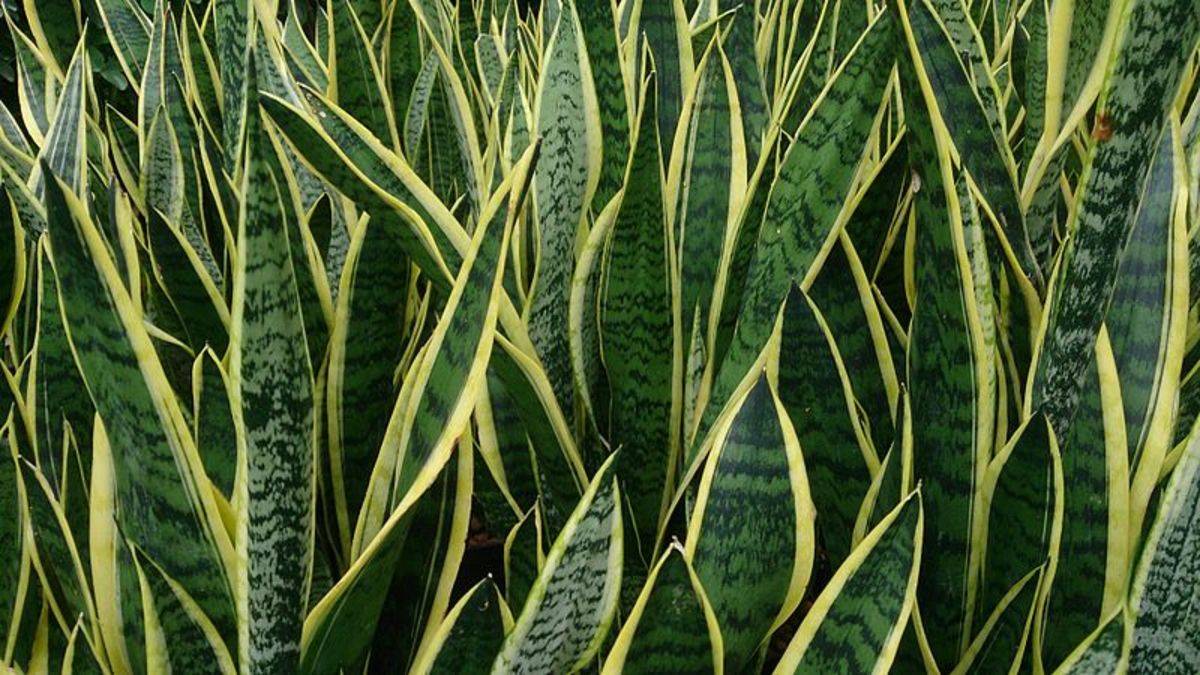
Sansevieria are easy houseplants to grow. They are great for beginners or for people who have not been able to successfully grow houseplants. They require minimal care and not much sunlight.
What are Sanseverias?

Sansevierias (Sanseveria spp).are native to Africa, the island of Madagascar and southern Asia. They are only hardy in zones 9 through 11. Sansevieria are more commonly called snake plant or mother-in-law’s tongue. There are actually 70 different species. The most common species grown as a houseplant here in the US is S. trifasciata . It comes in two forms, an upright form and a smaller called a Birdnest sanseviera. The birdsnest forms are short, less than 12 inches, with curly leaves. .

More commonly seen are the plants with tall, upright leaves that can reach heights of 3 to 4 feet. The all green leaved plants are called snake plants. The plants with gold bordered leaves are called mother-in-law’s tongue.
Sanseveria produce flowers, but they are tiny. The plants are grown for their foliage rather than their flowers. The tiny flowers grow in a bunch on long stems called racemes, eventually producing berries. In their native habitats, the flowers are pollinated by moths. Because the flowers are small in size and number, not many seeds are produced. Grown indoors, they will not produce berries because there are no moths to pollinate the flowers.
Sansevieria can grow from seeds, but they more often reproduce by spreading through underground rhizomes. The smaller types don’t spread as much but the taller types spread aggressively and can become invasive in the landscape in tropical areas.
How to Grow Sanseveria Outdoors
If you live in USDA growing zones 9 through 11, then you can grow sansevieria outdoors. They are tough, easy to grow plants but their one non-negotiable requirement is good drainage. If they are over-watered or planted in a wet area, they will rot and die. On the plus side, their preference for dryness makes them excellent candidates for desert or xeriscape landscapes. The thick cuticle on their leaves prevents them from drying out in arid conditions.
Sansevieria prefer full sun, but will grow in light to moderate shade. If you are growing mother-in-law’s-tongue, it is less likely to sport its jaunty gold borders in the shade. It needs sun to manifest its full variegation. Too little light can also result in weak, spindly plants.
There are three options for preventing your sansevieria from becoming invasive in your yard:
- You can dig it up every two to three years and divide it.
- You can plant it in containers which can be sunk into the ground up to their rims. That way, the containers remain out of sight while keeping your plants in check.
- You can surround your plants with barriers extending at least 12 inches into the ground to prevent the roots from spreading into surrounding areas.
How to Grow Sanseveria Indoors
Most of us grow sansevieria as houseplants. They are well-adapted to life indoors where light levels can be low. Your sansevieria will do best in a sunny spot but even a room with little sunlight is suitable. Use cactus potting soil or add coarse sand to regular potting soil to provide the drainage that these plants need.
Be careful not to over water them. Allow the soil to dry out slightly between waterings. The ideal container for sansevieria is made of clay because clay is porous so the soil will dry more quickly than in a plastic pot. Plastic pots hold in moisture which is great for plants who need moist soil but can cause root rot in plants like sansevieria which need dry conditions. Sansevieria are tough plants but two things will surely kill them: too much water or no water at all.
Because they are tropical plants, they are very sensitive to cold temperatures. Keep them in a warm room away from drafty windows and doors during the winter. Temperatures below 50°F will injure or kill them. They prefer temperatures ranging from 70⁰F to 90⁰F.
Sansevieria will quickly outgrow or even break their containers. You should divide and repot them annually, always using a container that is shallow and wide. The plants have a very shallow root system. The soil at the bottom of a deeper container will retain moisture which can encourage root rot. You want less soil so that it will dry out between waterings.
A wide, shallow container will also provide stability. My own sansevieria is 4 feet tall and very top heavy. In a regular deep container which has a smaller circumference, it has a tendency to fall over. A wider container gives it a secure base so that it is less likely to tip over.
Repotting should be done in the spring. At the same time, you can fertilize your plant using a balanced fertilizer (10-10-10 or 8-8-8) that is diluted to half strength. You can fertilize again near the end of the growing season in August. The plants should not be fertilized during the winter when they are resting and not actively growing.
How to Grow Sanseveria From Divisions

Although sanseviera produces seeds, it is usually propagated from divisions. When you repot your plant in the spring is a good time to divide it. Your first step should be to cover the surface that you will be using with newspaper or a tarp. This is will be a messy procedure.
To repot and divide your plant, run a knife around the edge of the container to loosen the soil from the sides of the pot. If you don’t have a knife handy, I have found that simply rolling the pot on its side will loosen the root ball.
Turn the pot upside down with one hand on top of the pot supporting your plant so that it doesn’t fall out of the pot and break. With your hand supporting the plant, pull the pot upwards with your other hand, exposing the root ball. Once the root ball is completely exposed, quickly turn your plant right side up and lower it to the newspaper.
Gently pull the plant apart. Because sansevierias grow by underground rhizomes, the crown may not come apart easily. You may have to use a sharp knife or garden shears to cut the rhizomes to make your divisions. Plant the resulting divisions in shallow pots using cactus potting soil or regular potting soil that has been amended with coarse sand for drainage. Water thoroughly. This is also a good time to give your plants their annual spring dose of fertilize with a balanced fertilizer diluted to half strength.
Leave a Reply