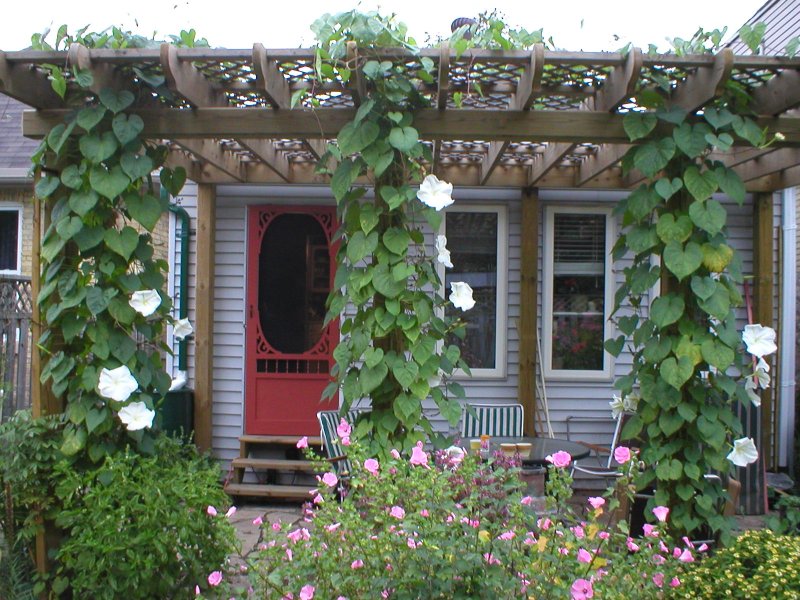
I love morning glories. Is there anything better than to be greeted first thing in the morning by their bright trumpets? Unfortunately by noon, their lovely flowers have closed for the day. I’ve learned to extend my enjoyment of trumpet flowered vines by planting moonflowers, which bloom in the evening.
What are Moonflowers
Moonflowers (Ipomoea alba) are tropical vines that are native to Central and South America. They are related to morning glories. Unlike morning glories, they only come in two colors, white and pale pink. And they bloom throughout the night, closing at dawn rather than blooming in the mornings like morning glories.

Moonflowers also have a delightful scent. The scent attracts moths, which pollinate the flowers. First the moths are attracted by the scent and then as they follow the scent, they can see the white flowers glowing in the moonlight. This combination of color and scent makes moonflowers perfect for moon gardens which contain plants which have white or silver foliage or white flowers or are heavily scented at night.
Moonflowers grow on long vines that can grow up to 70 feet long in tropical areas where they are perennial. In colder climates where they are grown as annuals, they grow 10 to 15 feet long in a single growing season. The leaves are heart shaped like morning glory leaves. The flowers are much larger than their morning glory cousins, reaching 6 inches in diameter. The flowers open in the evening as the sun goes down and stay open until dawn when the sun starts to come up. On cloudy days, they may stay open longer during the day. Like morning glories, moonflowers are prolific self-sowers and can become invasive. Several states have banned the seed from being sold within their borders. Check your state’s laws before planting them.
How to Plant Moonflowers
It’s best to direct sow moonflowers in your garden because they don’t like having their roots disturbed. But if you are purchasing plants or have started seeds indoors, it is possible to very gently remove the plants from their pots. In a case like this, I usually cut away the pot from the root ball rather than try to slide or dig the plant out. By removing the pot rather than the plant, there is less chance of disturbing the roots.
Another good option if you are starting seeds indoors, is to start them in peat pots or other types of biodegradable pots. Biodegradable pots can be planted directly into the garden. They will break down over time. By using the biodegradable pots, you can just plant your seedling, pot and all, directly into your garden so there is no chance of disturbing the roots.
Regardless if you start your plants from seed or purchase or grow seedlings, be sure to have a sturdy trellis for them to climb already installed in your garden. If you wait until after your vines start growing, pushing the trellis into the ground could damage the roots. The vines will reach 10 to 15 feet, so your trellis will need to be at least 6 feet tall.
Water your vines regularly and refrain from over-fertilizing. If you must fertilize, avoid high nitrogen fertilizer. When fed too much nitrogen, the vines produce all foliage and no flowers.
Can Moonflowers be Grown in a Container?
It is not recommended to grow moonflowers in containers because it is not possible to provide enough support for the long vines in a container. Having said that, gardeners do attempt to grow them in containers because they want to be able to over-winter them rather than starting new vines from seed the following year.
How to Grow Moonflowers From Seed Outdoors
Probably the easiest way (and the method that I use) is to direct sow moonflower seeds in your garden after your last frost when the soil has reached a minimum temperature of 50⁰F. Remember, these are tropical plants so they need warmer weather and warmer soil to germinate and grow. If the soil is too cold, the seeds won’t germinate.

Before you sow your seeds, you will need to soak them overnight or nick them. The seedcoats are very hard. Soaking them in water overnight softens the outer shell so that water can penetrate to the seed to prompt germination. If you forgot to soak your seeds, take a sharp knife or a pair of nail clippers and make a shallow cut in the seedcoat. Be careful not to go too deeply because you will risk harming the embryo. You just want to damage the hard outer shell so that water can penetrate and start the germination process.
Plant your knicked or pre-soaked seeds where you want them to grow. The seedlings do not transplant well because they don’t like their roots to be disturbed. Plant the seeds ¼ inch deep. Water well. Germination should occur in 10 to 15 days.
How to Start Moonflowers From Seed Indoors
You can start moonflower seeds indoors if you prefer. Remember to pre-soak them overnight or give them a quick nick. Try to use peat pots or other biodegradable pots so that when it comes time to transplant your seedlings into your garden, you can plant the container without disturbing the roots.
Start your seeds 6 – 8 weeks before your last frost. Sow your seeds in their containers ¼ inch deep and keep moist. Germination should occur in 10 to 15 days. You can transplant your seedlings into your garden when night-time temperatures are consistently above 50⁰F and the soil has warmed.
Leave a Reply