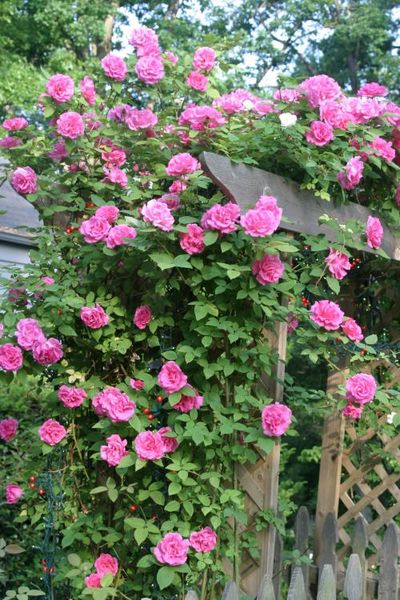
Looking for a climbing rose that has all the beauty and hardiness of an heirloom rose and blooms all summer? Then Zephirine Drouhin is for you!
What is a Zephirine Drouhin Rose?
The Zepherine Drouhin rose (Rosa ‘Zéphirine Drouhin’) was bred by a French rose breeder by the name of Bizot. He named the rose after the wife of a local rose enthusiast. Introduced in 1868, it is a Bourbon rose. Bourbon roses are crosses between Damask roses which bloom once a year in the spring and China roses which bloom all summer. It was a hit right from the start and remains one of the most popular climbing roses in Europe.
Zepherine Drouhin is an incredibly versatile rose. It can be grown as a climber attaining a height of 15- to 20-feet high, or it can be pruned and grown as a shrub rose. It can be grown on walls, trellises, arbors, fences or even around pillars. Pruned to 6 feet, it can be grown as a specimen plant or massed into a hedge.

The flowers are dark pink and 4 inches across with up to 20 petals. They appear in May like other heirloom roses, but then continue blooming until frost. Remove flowers that are past their prime to encourage new blooms. The fragrance is very strong and has been described as resembling raspberries.
The foliage is purple when young, darkening to green as it ages. The stems which are nearly thornless are also purple and can create winter interest in your garden after it sheds its leaves. The fact that it is nearly thornless makes it an excellent rose to grow if there are children in your family who might injure themselves on the thorns. In fact, it is often called the “Thornless Rose” although it is not truly thornless.
How to Grow a Zepherine Drouhin Rose
Zepherine Drouhin is hardy from zone 5 through 9. In zone 5, it should have winter protection. Give it a thick layer of mulch around the crown to protect your bush from the cold and to prevent heaving. Heaving is when a plant’s roots rise out of the ground during alternating periods of cold and warmth in the winter. If your bush does heave, gently step on the root ball to push it back into the ground. The roots should not be exposed to freezing temperatures or they will die.
The bush grows best in full sun but can tolerate light shade. It is known as a so-called shade rose but my experience growing it is that it doesn’t tolerate much shade. It grows and flowers very poorly if it is in the shade for more than half of the day.
It will grow in normal to poor soil, and likes to be well-watered. Water in the mornings at the roots. Avoid watering from overhead which can encourage disease such as black spot. A watering wand which is a nozzle with a long handle that will allow you to water at the roots is handy.
Your bushes should be fertilized twice a year. The first time is in the spring before they bloom. Use a fish emulsion and compost. Fertilize again after they bloom. Do not fertilize later in the season or in the fall. Fertilizing your bush will encourage it to grow. You want it to be going dormant in the fall so that it can survive the winter.
In the fall and the spring, dead leaves, branches and other brush should be removed from under your bush to prevent the spread of insects and disease.
How to Prune a Zephirine Drouhin Rose
Pruning should be done in late winter or early spring. Prune away any dead canes. Then prune the upright canes by ⅓, any side canes by ⅓ to ½. This will encourage new canes to grow in the spring.
Occasionally your will notice that your bush is not growing or flowering well. This means that the canes are old and need to be replaced. This type of pruning is called rejuvenation pruning. Rejuvenation pruning removes the old canes gradually over a period of years. The first year, remove ¼ of the oldest canes. The following year, remove another ¼ of the old canes and so on until all of the old canes are gone and new vigorous canes are growing.
How to Grow a Zephirine Drouhin Rose From Cuttings
New plants can be grown from cuttings taken either in the spring or fall. Cuttings taken in the spring are called softwood cuttings because the branches are growing and pliable. Cuttings taken in the fall are called hard wood cuttings because the branches are dormant and stiff.
Make a 4 to 6 inch cutting from your bush and remove the bottom leaves. Dip the cut end into rooting hormone to promote root growth then gently press the cutting into the soil in a container or even directly into the ground outdoors. Rooting hormone is not necessary. It just speeds up the process. When you see new leaves growing on your cutting, you will know that it has roots. Plants that have no roots cannot grow new leaves.
Leave a Reply