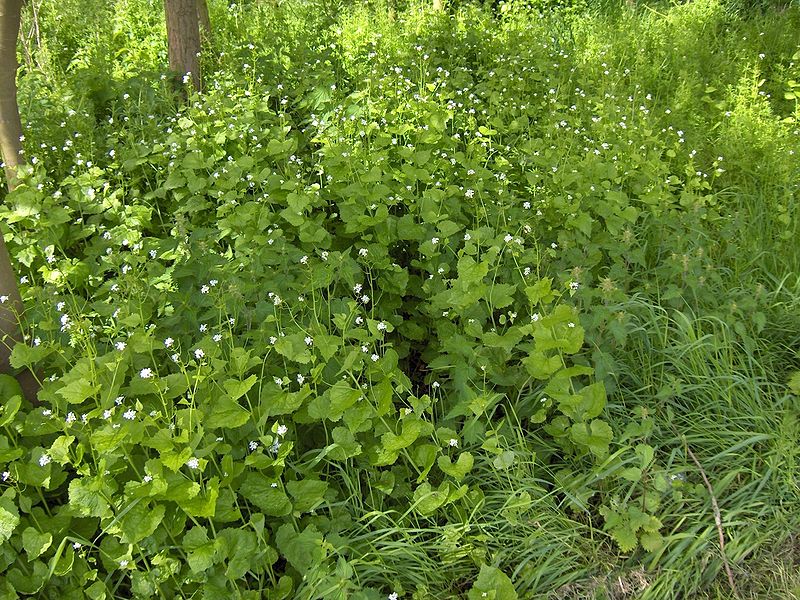
Ugh, it’s garlic mustard season. The roadsides, the woodland edges, seemingly everywhere I look, garlic mustard is blooming. What is it? Where did it come from? Most importantly, how do you get rid of it?
What is Garlic Mustard?

Garlic mustard (Alliaria petiolata) is also known as Poor Man’s Mustard, Hedge Garlic, Garlic Root and Jack-by-the-Hedge. It is an invasive plant found throughout the Northeastern and Midwestern US as well as Southeastern Canada. It is called garlic mustard because the leaves have a garlic smell when they are crushed.

It is a biennial plant meaning it completes its life cycle in two years. The first year, it grows a rosette of leaves. The rosette appears in mid-summer when the seeds germinate. In areas with warm winters, the rosettes remain green throughout the winter, photosynthesizing the sunlight while other plants are either dormant or have no foliage. This gives it a head start in the spring of the second year of growth.

The second year, the rosettes grow into a plant that can be up to 3 feet tall. In late spring, May through June, the plants bloom. The flowers are white with 4 petals arranged in the shape of a cross. The flowers develop seed pods. Each pod contains about 16 seeds. Each garlic mustard plant produces, on average, 600 seeds. When the pods are ripe, they forcibly eject the seeds several feet away from the originating plant. The seeds can stay viable in the soil for up to five years.
Where Did Garlic Mustard Come From?
Garlic mustard is native to Europe, Western Asia and Northern Africa where it is found in hedgerows and along the roadsides and forest edges. It has long been used as food and medicinally as a diuretic. In it native areas, it is kept in check by 76 different kinds of insects including butterflies and moths which lay their eggs on it. The resulting caterpillars feast on the leaves.
How Did Garlic Mustard Get to the US?
Some say that European colonists brought garlic mustard to the New World to use as they did in their old homes, to flavor food and as a medicinal. Others say that garlic mustard was brought to the US accidentally either in the soil of other plants that were brought here or as seeds stuck to the soles of boots. However it got here, the first recorded appearance was in 1868 on Long Island. Since that time it has spread throughout 30 US states and 3 Canadian provinces.
Why is Garlic Mustard Considered an Invasive Plant?
Garlic mustard is considered an invasive plant for three reasons. The most important one is that it has no natural enemies in North America that can keep it under control. The second reason is that due to its large seed production, it spreads quickly and crowds out other native plants. This is especially critical in forests where it replaces all native plants found on the forest floor.
The third reason it is considered an invasive plant is its long tap root. Normally plants with long tap roots only have one plant growing from the root. The tap root of garlic mustard has the ability to grow additional plants from buds that form along the root. Additionally, the root is allopathic meaning it excretes chemicals that prevent other plants from growing near it. This includes tree seedlings, another reason why a garlic mustard infestation is so disastrous for forests. The chemicals exuded by the tap root are also harmful to fungi in the soil that is needed by the roots of other plants.
The Best Way to Get Rid of Garlic Mustard
The most popular way to rid the landscape of garlic mustard is the use of herbicides such as Roundup. The problem with any herbicide is that it doesn’t distinguish between the good guys and the bad guys. It will kill all plants, not just weeds. As an organic gardener, I stay away from herbicides.
Garlic mustard is edible, tasting like garlic, so another way to get rid of it is by eating it. Unless you are feeding a lot of people though, this is not an efficient way to get rid of it.
The best way to get rid of garlic mustard is manually, i.e. pulling it up and discarding it. You should strive to pull up the plants before they set seed because the action of yanking the plant from the ground will spread the seed. I recommend waiting until after it rains to start removing it. The wet soil is looser making it easier to pull up the plants. You will more likely get all or most of the long tap root when you pull the plant out of the wet ground. Like dandelions, if you don’t get all of the tap root, the plant will grow back.
After you have pulled up the plants, resist the temptation to throw them in your composter. Either burn them if burning is allowed in your area or bag them up and throw them out with your garbage. They will be deeply buried in the landfill.
Manually removing garlic mustard is not only labor intensive but it is also a long-term project. The seeds remain viable in the soil for up to five years, so the plants will continue to reappear in subsequent years. That is why it is so important to remove them before they go to seed.
At first, it may seem like a losing battle, but if you watch carefully, you will see that native plants and even tree seedlings steadily re-populate the areas where you have removed the garlic mustard. They are proof that you are helping the forests and other areas return to health.
Leave a Reply