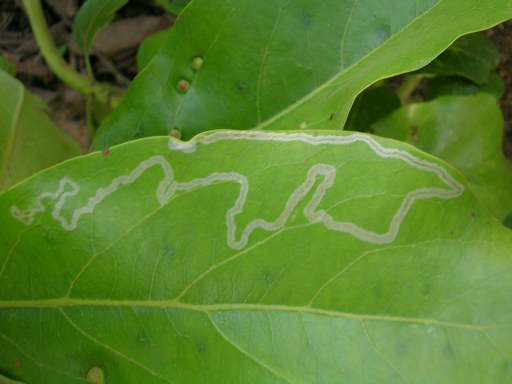
One of my favorite spring flowers is columbine. I love their clover like foliage and their uniquely shaped flowers. But having columbine means having leaf miners.
What are Leaf Miners?

Leaf miners are the larvae of various insects including flies, sawflies and moths. The larvae overwinter in the soil of your garden and emerge in the spring as young adults. The females lay up to 250 eggs on the undersides of leaves. They use their ovipositor to pierce the surface of the leaves and deposit their eggs inside of the leaves.
The eggs usually hatch within 10 days and the resulting larvae begin to tunnel inside the leaves creating the characteristic wavy lines that you see on your leaves. The larvae live and eat inside the leaf for 2 to 3 weeks before they mature. As the larvae grow, the width of the tunnels increase.
At maturity, they drop to the ground beneath the plant, burrow 1 to 2 inches into the soil and pupate. 15 days later, they emerge as adults and the cycle begins again. It is possible to have multiple generations of leaf miners during the growing season.
What Plants do Leaf Miners Like?
Leaf miners like broad leaf plants including ornamentals such as my beloved columbine. Citrus trees and blackberries are also on their menu. They cause the most trouble in the vegetable garden where they infest beans, cabbage, lettuce, tomatoes and peppers. They are a big problem for farmers as well as gardeners.
Why are Leaf Miners So Hard to Kill?
Leaf miners are difficult to kill because they live inside of the leaves of your plants. Spraying your plants doesn’t harm them because the spray only coats the outsides of the leaves. Systemic insecticides which are absorbed by the plants and can kill the leaf miners either contain ingredients that are banned in some areas or are not allowed to be used on edible plants.
Fortunately, there are some simple organic solutions that can help keep your garden free of these pests.
Kill Leaf Miners by Squeezing the Leaves
Keep a careful watch on your plants. As soon as you see the beginnings of the distinctive wavy lines, squeeze the lines on the leaves. This will squish the larvae, killing it. This is a great solution because you get the satisfaction of killing the bug without having to actually touch it. I’m a bit squeamish myself.
Remove Infected Leaves
If you only have a few leaves with leaf miner damage, you can break off those leaves and discard them. Don’t put them in your composter. You will infect the soil in your garden when you spread the finished compost. Put the infected leaves in your garbage.
Also carefully check any new transplants before planting them in your garden. If you see any evidence of leaf miner activity, either remove those leaves or return the plant to the nursery from which you bought it for a refund. It’s always a good idea to check plants before you purchase them for any evidence of pests.
Use a Trap Crop
Trap crops are a great way to keep leaf miners out of your valuable plants. Trap crops are plants that are also attractive to a pest. The idea is to plant the trap crop nearby so that the pest infests the trap crop instead of your crop. Good trap crops for leaf miners are columbine, lambsquarter and velvetleaf (a large annual plant that is a member of the mallow family).
Use Barriers

A great way to keep leaf miners out of your garden is to stop them from getting into your garden. There are two effective methods that you can use. Many vegetable gardeners and farmers use black plastic to cover the soil in their crop rows. This prevents the hibernating larvae emerging from the soil in the spring from accessing your plants. The plastic prevents any mature larvae that have developed in leaves from dropping to the ground and burrowing into it to finish pupating thereby disrupting the life cycle of leaf miners.
Another useful barrier is floating row covers. Since the adults are all flying insects, row covers prevent the females from landing on your plants to deposit their eggs. Make sure that you secure the sides and ends of your tunnels to the ground to keep the insects out.
Use Beneficial Insects
Beneficial insects are a great organic solution. For leaf miners, you want to purchase and release a parasitic wasp known as the leafminer parasite. The adults get into the tunnels that leaf miners have created in the leaves and kill them. Then they lay a single egg in the tunnel which hatches into a pupae. The pupae feeds on the dead leaf miner larvae, while it develops into an adult wasp.
Use Sticky Traps

Beneficial insects work great in greenhouses. Another good solution for plants grown indoors or in greenhouses are sticky traps. Sticky traps are cards that are covered with adhesive that are either hung or placed on stick holders in the greenhouse. They are brightly colored because each type of pest is attracted to certain colors. For leaf miners, use yellow or blue. The adults are attracted to the yellow or blue. When they land on the card, they become stuck on the adhesive so that they are unable to mate and then land on your plants to lay their eggs.
Leave a Reply