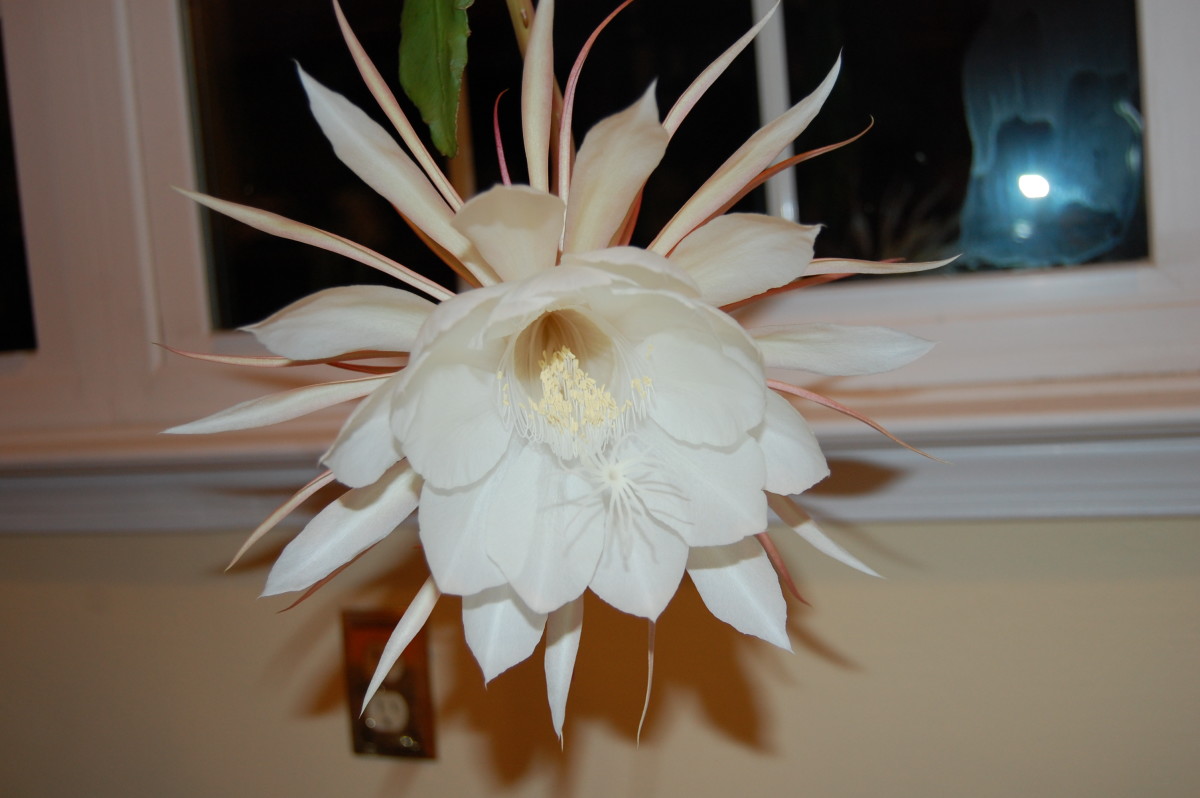
While I was taking the Master Gardener course, a fellow Master Gardener was transporting a gangly night-blooming cereus plant. A piece of it broke off and he offered it to me. He said it would be big and ugly, but that once a year, when it bloomed, it would fill my home with a wonderful fragrance.
Having completed the propagation class, I was eager to try my new skills and root this exotic houseplant. I was successful and the cutting rooted, but it didn’t grow much and didn’t bloom at all. I blamed it on the poor light in my house.
A few years later I moved into a townhouse with a kitchen that faced southeast. Bathed in sunlight, the scraggly plant came to life. It grew and grew and grew. Finally one night, it bloomed gloriously, filling my home with an incredible perfume as promised.
What is a Night Blooming Cereus?

The name “night blooming cereus” is used for many different plants that are flowering cacti that only bloom at night. Most bloom just once a year for a single night. A few will bloom up to three times a year. All of them have white or cream flowers that release an intense fragrance. The flowers open after dark. By dawn, they have begun to wilt.
The most commonly grown night blooming cereus is Epiphyllum oxypetalum, also known as the gooseneck cactus. It grows up to 12 feet and flowers from late spring through late summer. The larger plants can flower more than once during a season.
Despite being a cactus, it has no thorns. It does, however, have long stems and elongated leaves. They are very heavy plants. I have mine tied to its plant stand to prevent it from falling over from its own weight.
How to Grow a Night Blooming Cereus
These are tropical plants that are hardy in growing zones 10 through 12. Those of us in northern climates, grow them as houseplants.
If you are growing it as a houseplant, make sure it gets plenty of sun. A southern exposure is best. If grown outdoors or if you move your houseplants outside during the summer, night blooming cereus prefers light shade. Make sure that you delay moving it outdoors until the night time temperatures are above 40⁰F. And don’t forget to bring it inside in the fall when the night time temperatures fall into the 40s.
It may be called a gooseneck cactus and classified as a cactus, but it doesn’t like to be dry. Be sure to water it when the soil surface is dry.
Night blooming cereus bloom best when they are slightly pot bound, meaning its roots are a little crowded in the container. This usually happens after a plant has been growing in the same pot for a few years. So if your plant hasn’t bloomed yet, it may still be growing and filling its container.

Why Does My Night Blooming Cereus Only Have One Flower?
Since the plants flower along notches in the stems, the more stems it has, the more flowers that will be produced. To encourage more stems, you should repot your plant into a slightly larger container when it becomes completely potbound. The so-called experts say repotting should only occur every 7 years, but I wouldn’t wait that long if the roots are pushing up through the top of the soil or growing out of the bottom of the container.
My plant bloomed two years in a row and then stopped. I noticed that it also stopped growing. I repotted it into a larger container and it started growing again. My patience was rewarded with three beautiful flowers this summer.
Why Does a Night Blooming Cereus Only Bloom at Night?
Night blooming cereus are pollinated by sphynx moths and nectar feeding bats. Both of these pollinators are only active at night. To attract them, the flowers emit a strong fragrance and are bright white in color which glows in the moonlight. The moths and bats can smell the fragrance from far away. They follow the scent until they can see the flowers glowing in the moonlight.
How to Grow a Night Blooming Cereus From a Cutting
You can purchase a plant or, if you are fortunate like I was, receive a cutting from a friend’s plant. You can also take a cutting from a friend’s plant with permission.

Cuttings should be taken in the spring or early summer when the plant is actively growing. Choose a stem with healthy leaves. Avoid stems that have flower buds or are blooming. Make a cutting that is 2- to 4-inches long. Leave your cutting in a cool dark place for about 2 weeks. The cut needs to callous over. The callous prevents disease from entering the plant while it is developing its roots.
Once the cutting has a callus, dip the callused cut end of your cutting into rooting hormone, place the cutting in a container of moist potting soil. I always water before I plant my cuttings because I have found that if I water afterwards, both the soil and the cutting wash away.
Rooting hormone can be purchased at any nursery. It encourages the rapid growth of roots but you don’t need rooting hormone to root a cutting. You can also just plant the cutting into potting soil and water it regularly and it will develop roots, just not as quickly.
You will know when roots have developed when the cutting starts growing new leaves. Only plants with roots can grow new leaves. If a cutting has no roots, it will put its energy into growing roots instead of leaves.