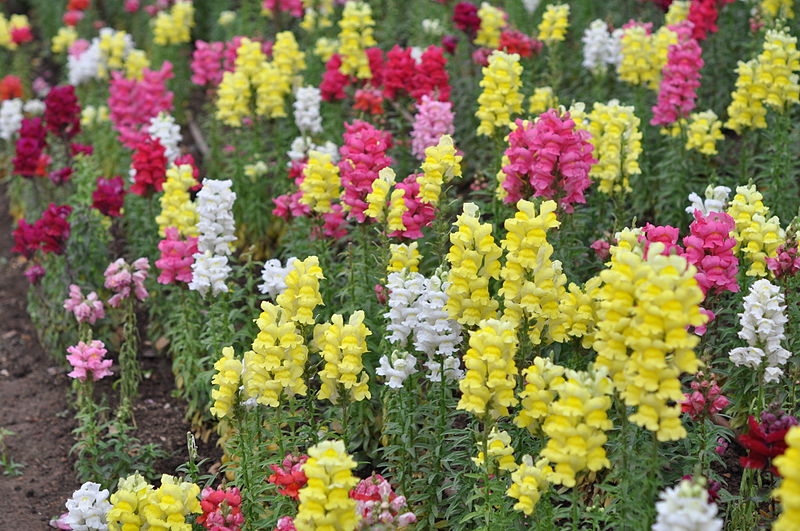
Snapdragons are a perfect flower for a child’s garden. The flowers, which look like dragons, open when you squeeze their sides and then “snap” closed when you release them giving them their name “snapdragon”. What child doesn’t like a flower that they can play with?
Poison Warning!
Every part of the snapdragon from its roots to its flowers is poisonous if ingested. Closely supervise young children and strongly caution older children when “playing” with the flowers. The plants and flowers can be safely touched but don’t eat them.
What are Snapdragons?
Snapdragons (Antirrhinum majus)are flowering plants that are native to the Mediterranean. Here in the US, they are hardy in zones 7 through 10. In more northern climates, we grow them as annuals. Occasionally due to a warmer than normal winter, snapdragons will overwinter in colder climes but the plants will not flower as well the second year.

Snapdragons come in many sizes. They are classified according to their height. Dwarf snapdragons grow 6” to 8” tall. Medium ones grow 15” to 30” while the tall ones reach heights of 30” to 48”.

The flowers grow on a tall stem and are often used as cut flowers. The flowers come in every color except blue. They may also sport bicolor blooms. They prefer full sun and well-drained soil but can be grown in partial shade to keep them cooler in warmer areas. Snapdragons bloom according to air temperature, not sunlight. Bloomtime is in the spring. They will stop blooming as the weather warms up for the summer.
Snapdragons are usually pollinated by bumblebees because, unlike the smaller honeybees, they are strong enough to open the flowers. Once they are inside, the flower closes behind them and covers the bumblebee with pollen. Snapdragons attract butterflies and hummingbirds, both of which have long tongues that can reach inside of the flowers to gather the nectar.
How to Grow Snapdragons
Snapdragons are usually purchased in the spring as plants. They should be planted in your sunny garden 12 inches apart. Dwarf varieties should be planted 6 inches apart. Mulch your plants to keep the soil cool. They are sensitive to heat. They will stop blooming as the weather warms up for the summer. Deadhead your plants and keep them well-watered during the hot summer and they may reward you with repeat blooms in the cooler fall weather. Fertilizing every two weeks with a fertilizer specifically formulated for flowering plants is also helpful. The taller varieties should be staked to keep their tall flower spikes from falling over due to the weight of their flowers.
How to Grow Snapdragons From Seed Outdoors
Snapdragons are easily grown from seed. You can allow the flowers to go to seed and drop their seeds in your garden. New plants will come up in the spring. Don’t expect them to look like their parents. The snapdragons that are sold today are hybrids, meaning the parents are the result of cross-pollination. When hybrid seed which is also a result of cross-pollination germinates, the resulting plants look nothing like the parent hybrids. If you allow your plants to go to seed and no seedlings appear in the spring, it may be because the seed was sterile. Some hybrids produce sterile seeds.
You can also direct sow the seeds in your garden either in the fall or late winter. You can even toss the seeds out on top of the snow. When the snow melts, the seeds will be deposited on top of the soil. They need light to germinate so it doesn’t matter that they aren’t in the soil. They just need to be on top of it. If you are sowing the seed in your garden, do the same thing. Just sow the seeds on top of the soil and don’t cover them.
How to Grow Snapdragons From Seeds Indoors
Start your seeds indoors 8 to 10 weeks before your last frost. Sow the seeds on top of the soil. I always moisten the soil before sowing my seeds because I have found that if I wait to water until after I sow my seeds, both the soil and the seeds tend to wash away. Do not cover the seeds. They need light to germinate.
No heat mat will be necessary. Snapdragons are a cool season plant. The seeds need the soil to be 55⁰F to germinate. Keep them cool and evenly moist and germination should occur in 2 to 3 weeks. When the seedlings have 6 leaves, pinch them back to encourage them to branch out and be bushy, instead of tall and spindly.
“Pinching” means remove the growing tip. This is usually done by literally pinching the tops of the plants between two fingers, breaking off the growing tip. The growing tip is where the leaves are emerging. Each plant will have only one. Pinch it off, and the plant will grow 2 or more new growing tips to replace it. This is will cause them to grow new branches, instead of the former single stem.
Your seedlings can be transplanted into your garden 2 weeks before your last frost. Snapdragons can tolerate light frosts. Plant them 12 inches apart, 6 inches apart for the dwarf varieties.
How to Harvest Snapdragon Flowers
Snapdragons are a great addition to a cutting garden. Their tall flower stalks add height to flower arrangements. Harvest the flowers early in the morning before the dew dries. You can harvest any stems that have ½ to 1/3 of the flowers open. The rest of the flowers will open in the coming days. Using a sharp knife or scissors, cut the stems on a diagonal and place them in a bucket of cool water. Cutting on the diagonal creates more surface area for the stems to take up water. Keep the flowers cool until you are ready to create your arrangement.
Until you are ready to use them, store the stems in an upright position. If you lay them horizontially for any length of time, the tips will start to curve upwards. This is because snapdragons are geotropic. This means that they grow against gravity. If you lay them down, they will curve upwards against gravity. Unfortunately, the curve is permanent, even if you eventually place them upright again. The tips will not straighten out so it is important that you keep them upright at all times.
Leave a Reply