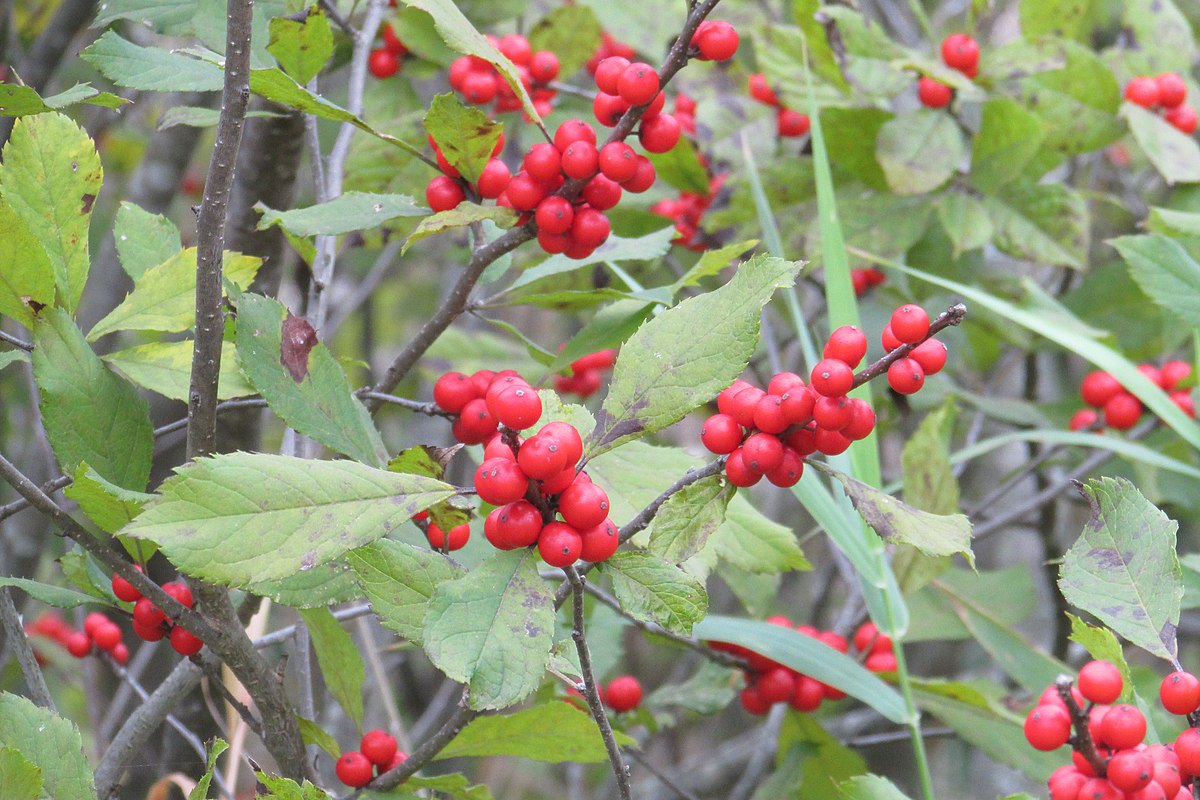
Looking for a way to jazz up your landscape during the winter? Look no further than the winterberry bush with its dazzling red berries.
What is Winterberry?

Winterberry (Ilex verticillata) is a shrub that is related to holly. It is native to the Northeastern US where it grows in marshy areas. If you have a wet area in your yard, this would be a great shrub to plant in that space. But it will also grow just fine in regular soil. Like its holly cousins, it is dioecious with male and female plants. Unlike its holly cousins, it is deciduous, losing its leaves in the fall. Once the leaves have fallen, the bright red berries are revealed. If they are not eaten by wildlife, they will stay on the branches for most of the winter providing color to your yard during a season with little color.
Winterberry is known by many different names such as Black Alder, Brook Alder, False Alder, Canada Holly and Fever Bush. It earned that last name thanks to the Native Americans who used the berries for medicinal purposes. They also used the bark to treat cuts and bruises. Do not eat the berries. They are poisonous.
How to Grow Winterberry

Winterberry is very easy to grow. It is hardy in zones 3 through 9. The shrubs range in height from 5 to 15 feet depending on the cultivar. They will grow in partial shade but produce more berries when grown in full sun. They will grow in wet areas as well as normal soil. The shrubs are deciduous, shedding their leaves in the fall. The leaves are dark green turning to yellow in the fall.
To produce the colorful berries, you will need a male and a female plant. They should be labelled at the nursery. If not, you can tell them apart when they bloom in the summer. The male shrub will have small flowers in clusters while the female shrub’s flowers will be more conspicuous and fewer in number. You don’t need to purchase your plants in pairs. One male is enough to pollinate six to ten females. Just make sure that the male is within 40 feet of the females.
How to Grow Winterberry From Seed

Winterberry bushes are as easy to propagate as they are to grow. They can be grown from seed. The seed needs moist, cold stratification. The easiest way to do that is to plant the seeds 1/8 inch deep in a container with pre-moistened soil. Then cover the container with plastic. Place the covered seeded container in your refrigerator for four weeks. The cold in the refrigerator mimics the cold weather that the seeds would experience outdoors. They need this period of cold to break dormancy. The plastic cover keeps in the moisture, preventing the soil from drying out. This mimics the seeds natural environment which is marshy and wet. You should check the soil periodically to make sure that it is not drying out. Mist it if it is becoming dry. Germination should occur in 4 – 6 weeks. Plants grown from seed will begin to produce flowers after three years.
How to Grow Winterberry From Cuttings
You can also propagate winterberry from softwood cuttings. Softwood cuttings are cuttings made in the spring or early summer when the plants are actively growing. The cuttings should be made from the soft, growing tips of the branches before they have hardened into stiff, woody branches which happens later in the season. The advantage of using the soft growing tips is that they develop roots very easily.
Make a cutting that is 6 – 8 inches long. Remove the leaves from the bottom half of the cutting. Dip the cut end into rooting hormone then gently press it into moist soil in a container. Place the container on a sunny windowsill. Cuttings take from 30 to 90 days to start growing roots. You will know that your cutting has roots when new leaves appear. Plants with no roots cannot grow new leaves.
Plants grown from cuttings should produce flowers the following year.
Growing Winterberry in a Wildlife Friendly Yard
Winterberry shrubs are perfect for a wildlife friendly yard. The berries are an important food source during the winter when food is scarce. Although they are poisonous to humans, dogs, cats and horses, birds and other small mammals love them. Naturalists have counted 49 different species of birds that eat the berries. That includes not just the usual songbirds but also waterfowl and gamebirds. The term “small mammals” includes mice as well as larger animals like raccoons. But it’s not just the berries that will attract wildlife. Moose, white tail deer, cotton tail rabbits and snowshoe hares will eat the stems and bark if no other food source is available.
Growing native plants is always preferable to the exotics commonly found in most yards. Natives are adapted to our growing conditions and provide a valuable source of food and shelter for the wildlife in our yards.
Winterberry is a native plant that will add a splash of color to your winter landscape as well as provide a welcome buffet for wildlife.
Leave a Reply