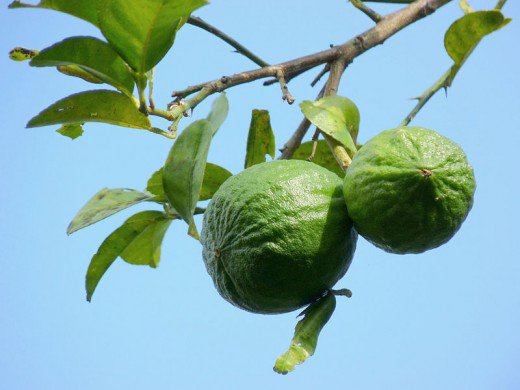
Key Lime pie is most often associated with the Florida Keys but the main ingredient, key limes, are not native to Florida.
What are Key Limes?

Key limes (Citrus × aurantiifolia) are native to Southeast Asia. They are hybrids; a cross between two lesser known primitive citrus, papeda and citron. It is thought that from their homeland in Southeast Asia , the fruit travelled along the trade routes to the Middle East and then to North Africa and on to Spain from whence it was carried to the New World by the Spanish as they colonized the West Indies. From there, it was just a short hop to the Florida Keys. In modern times, the fruit is grown in Central and South America as well as tropical parts of the US including Florida, California and Texas.
The trees are hardy only in zones 9 – 11. Grown outdoors in a tropical climate, the trees will reach heights of up to 20 feet. They are multi-stemmed meaning they don’t have just one trunk. Rather they grow more like a shrub with multiple stems which are quite thorny. The flowers are approximately one inch in diameter and yellowish white with a faint purple tinge on the edges. The trees flower year round, but bloom most heavily from May to September.

The fruit is usually harvested before it is ripe because it will continue to ripen even after it is picked. Unripe fruit is green in color. When the fruit is fully ripe, it is yellow. It takes 6 to 9 months for the fruit to grow and ripen from green to yellow. Interestingly, key lime pies that are green have been artificially colored because the flesh of the fruit is greenish yellow. Pies made with the fruit come out yellow instead of green. The rind on key limes is much thinner than ordinary limes and the fruit has more seeds. The flavor is stronger than ordinary limes.
Fortunately, there are now dwarf cultivars that are suitable for growing in containers so that those of us who do not live tropical climates can grow our own fresh key limes indoors entirely or outdoors during the summer and indoors during the winter.
How to Grow a Key Lime Tree Outdoors
If you are fortunate enough to live in a tropical area, you can grow your key limes outdoors in the ground. Choose a sunny location and dig a trench. The root system on the trees is very shallow. Planting your trees in a trench allows the roots to gain more of a foothold and protects the trees from toppling over when it is windy. Keep your trees pruned to allow for good air circulation and ease of harvest. Grown outdoors, the trees are self-pollinating which means that they don’t depend on insects or animals to pollinate the flowers and produce fruit.
Key limes need to be kept moist. Do not allow the soil to dry out completely between waterings. They are heavy feeders meaning they need a lot of nutrients in the soil. To prevent them from using up all of the nutrients in the soil, you will need to add nutrients back via fertilizer. Use fertilizer that is specifically formulated for citrus during the growing season. Do not fertilize during the winter. The plants rest during the winter meaning they are not actively growing. You can also prune any time except during the winter.
How to Grow a Key Lime Tree Indoors

If you live outside of a tropical area, you will need to choose a dwarf variety and plant it in a container. Dwarf varieties only grow to 6 to 8 feet which is a manageable size indoors. Most people prune them so that they stay about 6 feet making it easier to move the plant in and out of the house depending on the season. You can place the container outside during the summer in a sunny spot that is protected from the wind. The shallow root system, even in a container, makes them prone to falling over in strong winds. Bring your tree indoors before the first frost. If your plant blooms while it is indoors, you will need to hand-pollinate the flowers to get fruit. The reason you need to hand-pollinate indoors is because outdoors, the wind aids in the pollination. There is no wind in your house so you will need to help Mother Nature along.
Key limes grown in pots need to be constantly monitored so that they don’t dry out. All of that watering washes a lot of nutrients from the soil. You will need to replace the nutrients. Use fertilizer that is specifically formulated for citrus during the growing season. Do not fertilize during the winter. The plants rest during the winter meaning they are not actively growing. You can also prune any time except during the winter.
How to Grow a Key Lime Tree From a Cutting
You can propagate from cuttings or more drastically by cutting the roots of an existing tree which will encourage it to produce sprouts which can then be severed from the tree and planted elsewhere. The sprouts will quickly develop roots in their new location.
Cuttings should be done in the late spring or early summer when the trees are actively growing. Take a cutting that is 6 inches long from a branch that doesn’t have any flowers or fruit so that your cutting will put its energy into making roots. Dip the cut end in rooting hormone and then gently push it into a container filled with moistened soil.
Create a mini greenhouse by covering the container and the cutting with a plastic bag. Place the plastic covered container on a heat mat so that the soil will be warm, between 70F and 80F.
Roots should begin to develop within 8 weeks. You will know that your cutting has rooted if it is growing new leaves. Plants without roots cannot grow new leaves.
Trees propagated from cuttings or sprouts should start producing fruit the following year.
How to Grow a Key Lime Tree From a Seed
Hybrid plants do not normally grow true from seed. The Key Lime tree is an exception. It can be grown from seed. Use seed from a fruit so that it is fresh and moist. Clean off the pulp and plant it ½ inch deep in a container. Keep the soil in your container evenly moist. Germination should occur within two to six weeks. You can move your seedlings outdoors when the daytime temperatures are above 70⁰F and the nighttime temperatures are above 55⁰F.
Trees grown from seed will start to bear fruit between 4 and 8 years old.
Leave a Reply