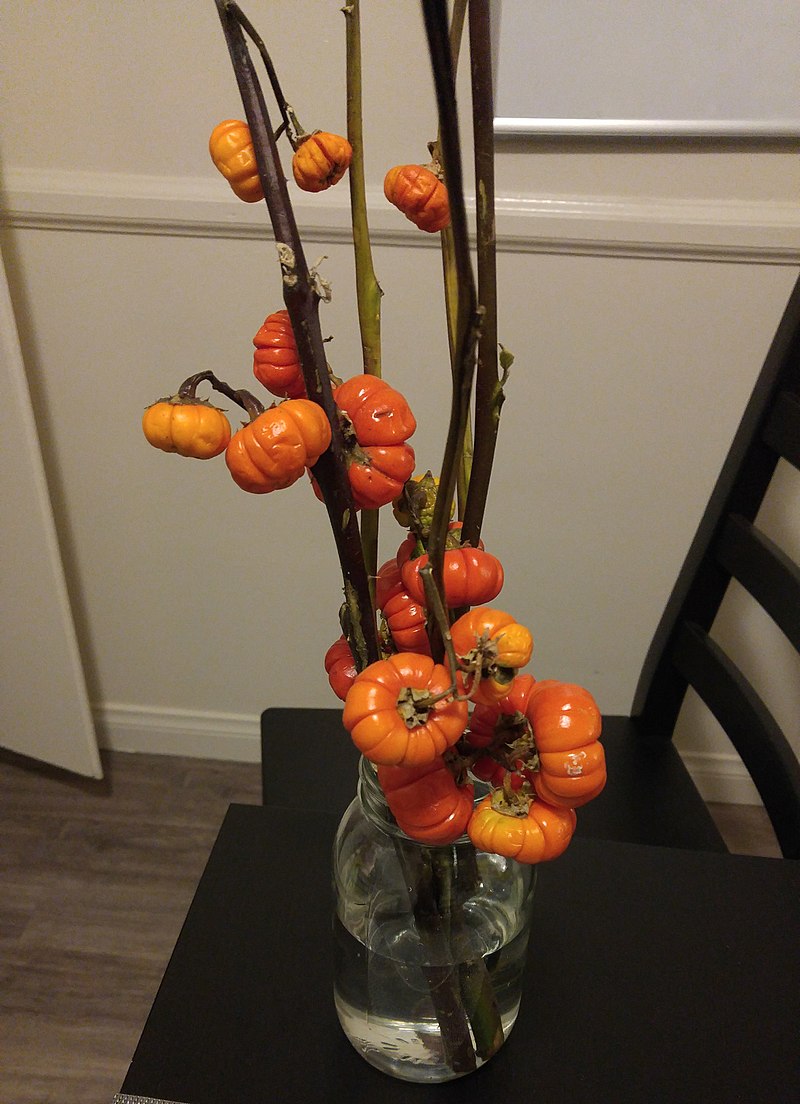
I’ve been adding flowers to my garden that I can dry for floral arrangements. Pumpkin on a Stick seemed like a great addition to both my garden and my arrangements. Imagine my surprise when I found out that it’s not a pumpkin!
What is Pumpkin on a Stick?
Pumpkin on a Stick (Solanum integrifolium), also known as Pumpkin Tree or Pumpkin Bush, is actually an eggplant. It is native to tropical Africa. It then spread to Asia over the trade routes.

The plants grow to 3 to 4 feet tall and 2 to 3 feet wide. They have the characteristic thorns that are found on eggplants. They also have the characteristic star shaped flowers that develop into 2- to 5-inch fruit which resemble tomatoes. The fruits are green then ripen to red, which gives them their tomato appearance. If left on the branches, the fruits will eventually dry and turn orange, at which point they look like tiny pumpkins. The leaves are large and shade the ripening fruit to prevent it from being scalded by sunlight.
Is Pumpkin on a Stick Edible?

Pumpkin on a stick is used in both African and Asian cuisines. In Africa, it is called Ethiopian Nightshade, Garden Eggs and Mock Tomato. In Asia it is known as Hmong Eggplant, Scarlet Chinese Eggplant and Red China Eggplant.
It is eaten both raw and cooked. The fruit is harvested while it is green much as we harvest and eat bell peppers when they are green and unripe. It can be very bitter due to the saponins it contains. Fruits that contain little or no saponin are sweet and used in Thai curries. The leaves are also eaten.
How to Grow Pumpkin on a Stick
Pumpkin on a stick can be grown in full sun or partial shade. Full sun is preferable, resulting in strong plants. Grown in partial shade, the plants are smaller and weaker, with fewer fruits. Whether grown in sun or shade, plan to stake your plants. Even though the branches are woody, the growing fruit is heavy so the plants will require support to prevent them from falling over. The plants do best in rich loamy soil that is well-drained. Plant them 3 feet apart to give them plenty of room to grow as well as to maximize air circulation between plants which will prevent powdery mildew. The fruit will be ready to dry 70 days after germination. It will be ready to eat in less time which will vary depending on the amount of sunlight, heat and water the plants receive.
How to Grow Pumpkin on a Stick From Seed
Pumpkin on a stick is easy to grow from seed as long as you keep in mind that this is a tropical plant and needs hot weather and warm soil to germinate and grow.
You can direct sow the seeds in your garden 2 to 4 weeks after your last frost when the soil temperature reaches 70⁰F and the soil has warmed. Plant the seeds ¼ inch deep and 2 to 3 feet apart. Germination should occur in 10 to 20 days. No thinning will be necessary because of the wide spacing.
Most gardeners prefer to start their seeds indoors. Start them indoors 6 to 8 weeks before your last frost date. Plant the seeds ¼ inch deep. It is recommended that you use a heat mat to warm the soil. The ideal soil temperature for germination is 70⁰F to 80⁰F. Germination should occur in 10 to 20 days. You can transplant your seedlings outdoors after your last frost when the soil is at least 60⁰F. Space the seedlings 3 feet apart.
How to Harvest Pumpkin on a Stick

If you are going to cook with pumpkin on a stick, harvest the fruit while it is still green. This will actually encourage the plants to flower and produce more fruit. Refrain from pulling the fruit off of the plants. Instead, using a sharp knife, scissors or pruners, cut the fruit from the plants. This will avoid damaging the plants. Healthy plants produce healthy fruit!
If you are harvesting pumpkin on a stick to use in dried arrangements, harvest the fruit when they are dark red or orange. You can harvest an entire branch with the fruit still attached or you can harvest individual fruits. Use a sharp knife, scissors or pruners to cut the branch itself or fruit from the plants. They can be air dried. The fruits will retain their bright color for 2 to 3 months.
Leave a Reply