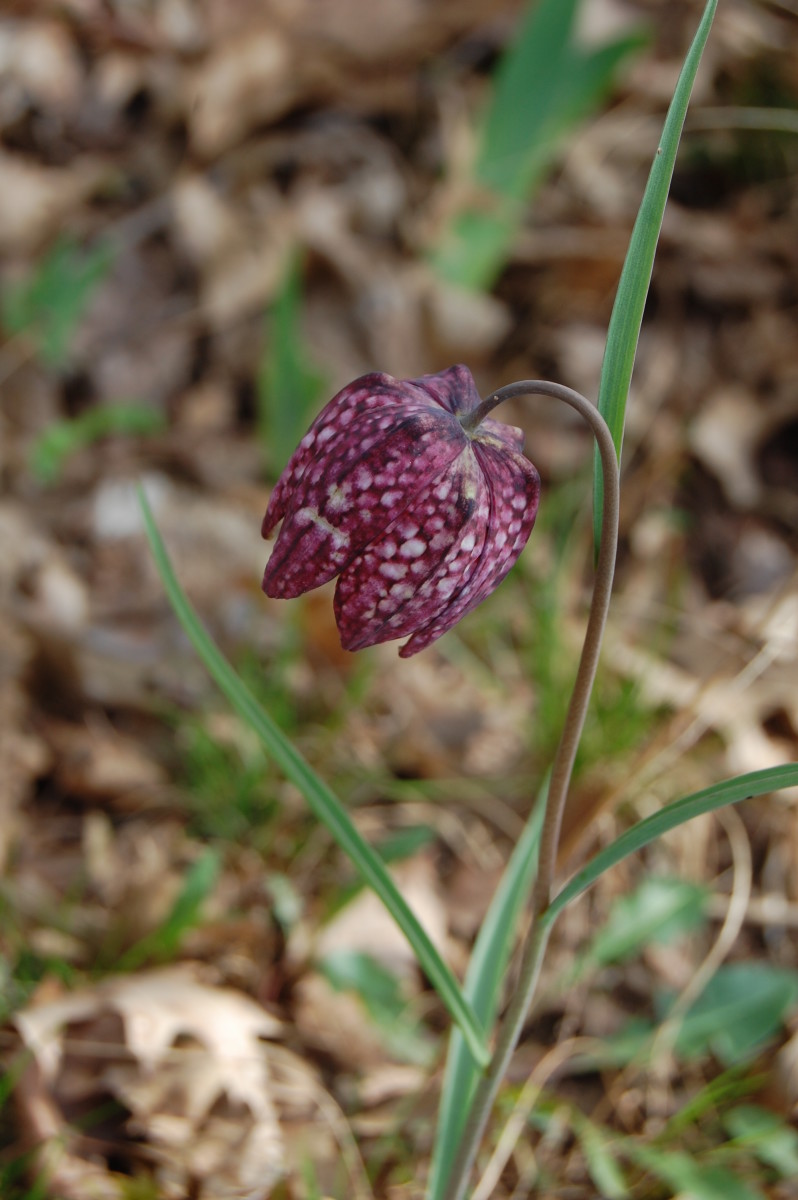
If you are looking for something different for spring/early summer flowers, you should consider the Fritillaria family. They come in a variety of sizes, colors and bloom times.

What are Fritillaries?
Fritillaries (Fritillaria spp) are bulbs with pendant flowers that bloom in the spring or early summer depending on the variety. They range in size from 8 inches to 3 feet. The name, fritillarie, is from the Latin word for a dice-box (fritillus) which refers to the checkered pattern of the flowers of some of the species. My personal favorite is the Snakes Head Fritillary (F. meleagris) with its purple checkered flowers. Most popular are the Crown Imperials (F. imperialis) which grow to a statuesque three feet and come in either orange or yellow. Other fritillary species have columns of pendant flowers in white, green and even a purple so dark that it looks black. They all share one virtue: deer don’t like them. In fact, the Crown Imperials emit an odor that many people liken to a fox. I’ve never smelled a fox. To me, it smells of skunk.
Fritillaries are Poisonous
Fritillaries are not edible. They contain alkaloids that are poisonous to both animals and people. There are a few native species that if prepared carefully can be eaten and were, in fact, eaten by the native peoples of the Pacific Northwest. However, those are not the bulbs that we grow in our gardens. The bulbs that we grow in our gardens originated in Europe and Asia. The bulbs that we grow with the attractive flowers should only be enjoyed in our gardens and not on our dinner plates.
How to Grow Fritillaries

Fritillaries are native to the Northern Hemisphere, specifically the temperate regions such as the western North America, southwestern Asia and the Mediterranean. They are hardy in growing zones 4 through 8. They prefer partial afternoon shade which will extend their blooming period to two to three weeks.
Fritillaria bulbs are rarely seen in big box stores and garden centers. That’s because they don’t live long out of the ground. You should order them from a catalog or online and plant them immediately when you receive them. If you delay planting them, the bulbs will dry out and die.

The bulbs are susceptible to rot so drainage is very important. Plant them on their sides to prevent water from collecting on them. Smaller bulbs should be planted five inches deep and six inches apart. Larger bulbs, such as the Crown Imperials, should be planted seven inches deep and twelve inches apart.
Prior to planting, the soil should be amended to be very rich. After planting, keep your plants watered. If the soil dries out, the bulbs will dry out and die.
There is no need to deadhead your plants. They will only bloom once. After the flowers die, you can remove them or leave them on the plant to produce seeds.
After your plants have finished blooming, continue watering them to keep the foliage alive and making food for the bulb. Do not remove the foliage until it starts to yellow and die later in the summer.
How to Divide Fritillaries
Every three years, you should divide your fritillarie bulbs to keep them healthy. Overcrowding encourages disease and insect infestation. Division should be done after the bulbs go dormant in the fall. Carefully dig the bulbs up using a garden fork. Replant them with the proper spacing, 6 to 12 inches apart depending on the size of the plants.
How to Grow Fritillaries From Seed
Unlike spring blooming bulbs like tulips and daffodils, fritillaries can be grown from seed. Allow the flowers to die and make seeds. Then plant the seeds in the fall at the same depth that you plant the bulbs. When the seed germinates in the spring, the foliage will provide the food for the bulb to grow underground. It takes about five years to grow the bulb. The plants won’t flower until the bulb is fully grown, so be patient. You might want to establish a nursery bed where the seeds can grow and mature into bulbs. After the five years, you can transplant the mature bulbs into your garden in the fall for blooms the following spring or summer depending on which one you are growing.
Leave a Reply